Maui Residents Anxious About More Military Telescopes Atop Haleakalā
The final environmental and cultural review is expected by the end of the year.
Several months after Maui community members came out in droves to voice opposition to the military’s plan to build up to seven telescopes in a state conservation district atop Haleakalā, some residents are anxiously waiting to see how federal officials respond to their feedback.
“We’re all waiting,” said Hina Kneubuhl, an organizer with Protect Haleakalā, a collective of Hawaiian cultural practitioners, environmentalists, community leaders and others working to protect culturally significant landscapes. “The mountain is a sacred space for us, and Hawaiians are really tired of having to fight military expansion in our home.”
Kneubuhl was among the more than 100 Maui residents who spoke directly with federal officials from the U.S. Air Force and U.S. Space Force during one of two packed community meetings earlier this year, nearly all of them arguing that the 516-page draft environmental review published for the nearly $6 million project in January did not lay out a sufficient plan to mitigate the potential damage to one of the most culturally and ecologically significant spaces on the island.
More than 650 others submitted written testimony before the end of the public comment period in April, according to a Space Force spokesperson.
The community’s feedback is in the process of being incorporated into a final environmental impact statement, which federal officials expect to finalize along with a record of decision before the end of the year, Space Force spokesperson Ashley George said in a statement.
“We thank the Maui community for sharing their voices through hearings and comments,” she wrote in an email Thursday in response to Civil Beat’s request for more information. “This critical feedback helps us balance vital environmental and cultural stewardship with the space capabilities advancements essential to national defense and the protection of global technologies we’ve come to rely on.”

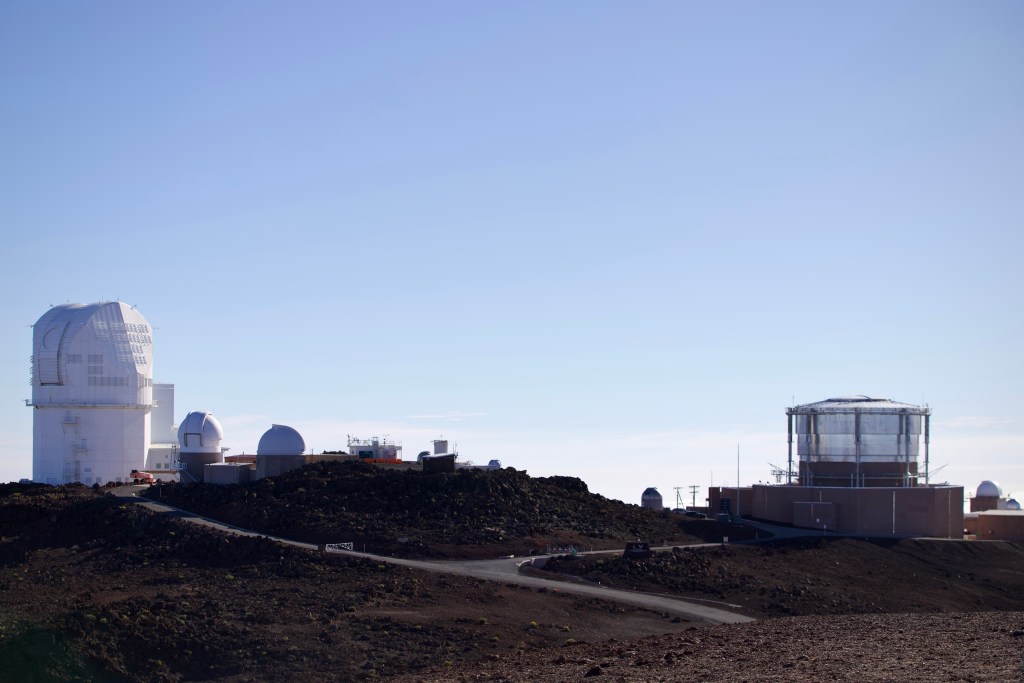
There are already six academic and four space surveillance telescopes on the dormant volcano’s summit, the Valley Isle’s highest peak at just over 10,000 feet. Military officials have said additional telescopes are needed to enhance the United States’ ability to track and identify potential threats among satellites and space debris orbiting the Earth.
The overwhelming majority of residents who testified during the public meetings in Kīhei and Pukalani earlier this year — as well as those who spoke during scoping meetings in 2024 — were opposed to the new telescopes because of concerns about the project’s potential to degrade cultural resources, negatively affect the environment and make Maui a target for foreign militaries. Many also pointed out that federal officials have yet to finish cleaning up a 720-gallon diesel fuel spill caused by a lightning strike at the Maui Space Surveillance Complex on the mountain in January 2023.
Haleakalā is home to numerous endangered or threatened species like the Hawaiian hoary bat, the band-rumped storm petrel, Hawaiian shearwater, the Hawaiian goose or nēnē and a species of silversword that cannot be found anywhere else in the world.
The project’s environmental impact is expected to be minimal, according to the draft EIS. Military officials acknowledged that there would likely be profound adverse effects on cultural resources, however, because the mountaintop is considered by many Native Hawaiians and others to be a sacred and deeply spiritual place, the EIS says.
Kneubuhl said federal officials have not sufficiently acknowledged the significance of the summit, or piko, for many Native Hawaiian people.
“I would never roll up to somewhere like St. Paul’s Cathedral and be like, ‘I have to build something right here,’ or the Sistine Chapel, or any other place that is super sacred to other people,” she said. “I would never enter that space and assume that my needs are so important that I’m going to need to desecrate a temple or structure or place that is so sacred to others, but they come here and they want to do that to us.”

The Space Force supports the rights of individuals to peacefully express their views, George said. “We deeply respect the profound cultural and spiritual significance of Haleakalā, and we remain dedicated to open dialogue, collaboration, and environmental stewardship in our shared efforts,” she said.
Officials have said construction of the Air Force Maui Optical and Supercomputing Site Small Telescope Advanced Research Facility, or AMOS STAR, was planned to begin later this year or in 2027. It is expected to take about two years to finish building the domed telescopes — as well as infrastructure improvements including a new paved access road, parking facilities and surface water runoff management measures — on less than 1 acre of land near the existing space surveillance complex near the summit.
Another Telescope?
With little new information related to the projects coming out, tension has been growing as the anticipated construction date draws nearer. Earlier this week, “AMOS Out Protect Haleakalā!” was painted in bright red and yellow paint on the side of an abandoned building facing Maui Veterans Highway in Puʻunēnē.
On Tuesday evening, Kneubuhl and dozens of other residents gathered outside the entrance to Wailea Beach Resort, where scientists, academics and others were arriving for an annual space domain awareness conference. They waved signs bearing messages like “Kick AMOS off Maui,” “ʻAʻole AMOS” and “AMOS OUT!”
“There’s no trust in the military,” Kneubuhl said, explaining why many of the telescopes’ opponents were not optimistic about their comments being incorporated into final plans. “Hawaiians and others have been fighting these kinds of fights for so long.”
She noted how federal officials have largely moved forward with military development plans on Haleakalā, Kahoʻolawe, Pōhakuloa Training Area and Mauna Kea despite community resistance. The proposed $3 billion Thirty Meter Telescope project atop Mauna Kea on Hawai‘i island stalled after huge protests in 2019.
Standing on the side of Wailea Alanui Drive, Kahele Dukelow thought back to 2017, when she was among the dozens of protesters who lay in the road to block construction convoys headed to build the $344 million Daniel K. Inouye Solar Telescope, or DKIST.
“Now, seven, eight, nine, 10 years later, they’re asking to build another one,” she said, throwing her arms up in frustration. “So you know what’s gonna happen with this one, even if we show up in droves, right?”
Still, Dukelow and Kneubuhl said they would not stop showing up.
The mountaintop has long been a place where some Native Hawaiian people go to connect with their ancestors and visit one of two ahu, or shrines, Kneubuhl said, but the experience has changed dramatically in recent years.
“This place of religious and spiritual observance was entirely swallowed up by the DKIST,” she said, adding that the telescope emits a loud whirring noise that can be heard by those visiting the shrines. “It completely disturbs the serenity of the entire experience, and it makes it really hard to connect with your kūpuna when in your viewplane and in your ear is this massive telescope.”
Space Force Lt. Col. Douglas Thornton, 15th Space Surveillance Squadron commander, said this week’s conference on Maui is one of the leading forums for collaboration on space domain awareness, and it is important to the military branch “because it strengthens partnerships, deepens shared understanding of the space environment, and provides opportunities to engage the Maui community.”