

How Kaua‘i’s Mayoral Candidates Plan To Address Cesspools
Bernard Carvalho Jr. and Mel Rapozo say the island needs to manage its solid waste better but have different ideas on how to get there.
Kaua‘i’s mayoral candidates Bernard Carvalho Jr. and Mel Rapozo agree that addressing the Garden Isle’s wastewater woes — from maintaining and repairing the island’s aging wastewater system to reducing the number of cesspools — is a priority.
They differ, however, on whether the county should expand its sewer system as part of the solution. Rapozo says this needs to be considered to help get homeowners off cesspools while Carvalho says he’d want to first explore smaller, clustered wastewater systems shared between multiple properties.
Kaua‘i has until 2050 to convert roughly 14,000 cesspools, but neither candidate in the Nov. 3 general election thinks the state-imposed deadline is realistic.
Cesspool Conversions
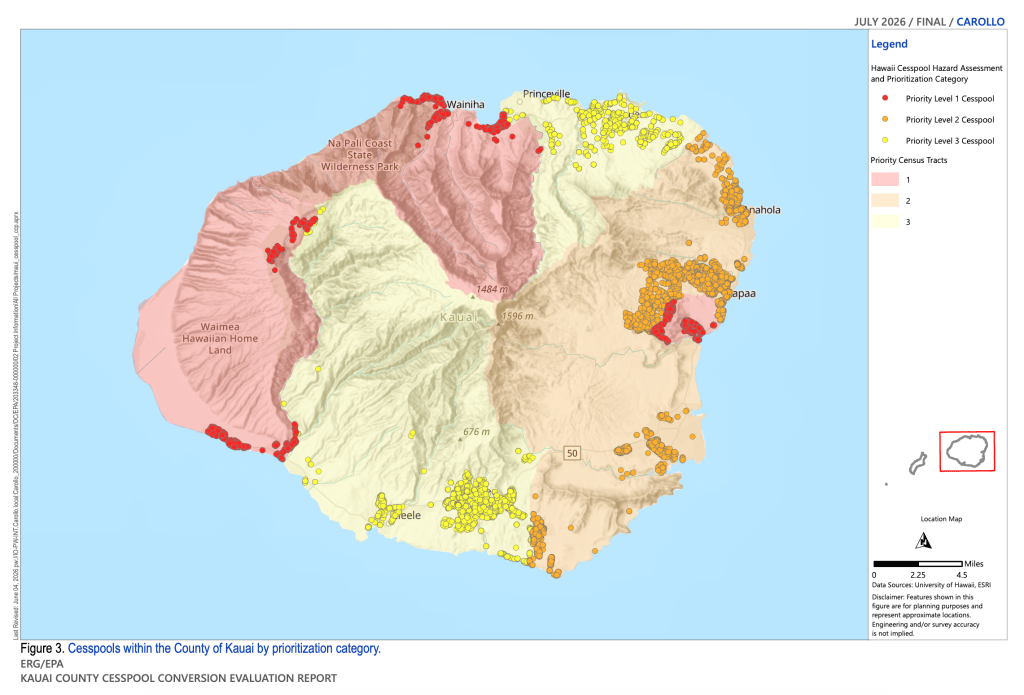
Converting Kaua‘i’s cesspools to septic or other individual wastewater systems can cost residents $40,000 to $70,000, according to the county’s July 2026 Cesspool Conversion Evaluation Report that was obtained by Civil Beat. It would cost nearly $569 million to convert all 14,200 of the island’s cesspools to septic or other individual wastewater systems, based on a conversion cost of $40,000.
Given those high costs, Carvalho, who was Kaua‘i’s longest serving mayor, said that he wants to see cesspool conversions done in a more efficient way. For him, that means looking at options like septic systems or other types of smaller decentralized wastewater systems that can be clustered or shared between a handful of houses or even a whole street, rather than just serving individual homes, to help make the costs more attainable for local families.
“I’m trying to see what, you know, will be practical for every family,” he said.
Some commercial spaces, such as the Ching Young Village Shopping Center in Hanalei, have their own wastewater treatment plants that serve multiple structures. Carvalho said he hasn’t seen any existing examples of shared septic or other decentralized wastewater systems in residential areas on Kaua‘i.
Hanalei is looking at pursuing a liquid-only, pressure sewer system for its 115 cesspools. The town’s low-lying elevation, shallow groundwater and fast-draining, sandy soils have made it difficult to deal with wastewater.
Hanalei Bay, along with other parts of Kaua‘i, experience brown water advisories after heavy rains in part because of the public health risks of swimming in water contaminated by cesspool runoff. Kaua‘i’s roughly 14,000 cesspools dump about 9.5 million gallons of raw sewage into the environment daily.
Carvalho added that he’d want to work with state lawmakers to see if the state can push back its 2050 deadline. He’s also open to having different deadlines based on where cesspools are located, such as whether they’re at risk of contaminating a water source or not.
The state already prioritizes cesspool conversions by the level of risk they pose to human and environmental health, but there’s no mandate that says more hazardous cesspools must be converted ahead of the 2050 deadline.
Rapozo agrees that the 2050 deadline is not doable.
“Because of the cost and the number of cesspools that we have, there’s going to be a lot of households that are simply not going to be able to do it, and I’m not sure what the state will do,” he said.
Alden Alayvilla, public information officer in the mayor’s office, said in an email Monday that the current administration sees the 2050 deadline as the state’s call. Mayor Derek Kawakami has said state funding should be flexible enough for counties to use it where it works best, including for design and engineering work needed to start sewer projects.
Kaua‘i was the first county in Hawai‘i to launch a cesspool conversion grant program. During the program’s first year, the county received 340 applications and awarded $20,000 each to 100 homeowners. The program is accepting applications for 50 more $20,000 awards.
The grant program is funded by state Department of Health loans. Alayvilla said the county accepted what the state made available. The first year was $2 million and the second was $1 million.

Rapozo said the grant is not meeting the need, both in terms of the number of people who need to convert and that it only covers part of the conversion costs. The county grant is reimbursement-based, so homeowners need to front the bill before getting the reimbursement.
Carvalho said he’d want to see if the county can get other grants or federal support to further lower costs for homeowners if the deadline can’t be pushed back.
“I want to look at every single option because I’m hearing everywhere I go how difficult this will be for our families,” he said.
Community members say they want to see Kaua‘i’s next mayor prioritize helping residents get off cesspools.
“We want a mayor who will take leadership and understand this is an important issue,” said Laurie Makane‘ole of Kōloa.
The South Shore area has roughly 670 cesspools. Makane‘ole is part of a handful of people with the Kōloa Community Association, which has spent the last two years trying to learn more about its conversion options. Cesspools, she said, are the biggest barrier to area residents expanding their homes or building an additional dwelling unit.
Improving County Infrastructure
Rapozo said Kaua‘i needs to look at expanding its sewer system to help residents get off cesspools.
Carvalho said that could be an option if the state doesn’t push its 2050 deadline back. But he’d still want to aggressively look at clustered wastewater systems.
County-managed sewer already exists in Līhu‘e, Hanamā‘ulu, ‘Ele‘ele, Waimea and along Kūhiō Highway in Wailua and Kapa‘a. The county evaluated nine potential sewer expansion projects to Kekaha, Hanapēpē and additional parts of Līhu‘e, Wailua and Kapa‘a in its cesspool conversion report.
Troy Tanigawa, county engineer and head of the public works department, said the county was especially interested in expanding the sewer to Kawaihau Road in Kapa‘a. That project would help convert 1,720 cesspools and 250 other individual wastewater systems and is estimated to cost nearly $300 million, according to the county’s cesspool conversion report. The area’s cesspools are considered medium priority because they post a hazard to human and environmental health and are somewhat close to water sources.
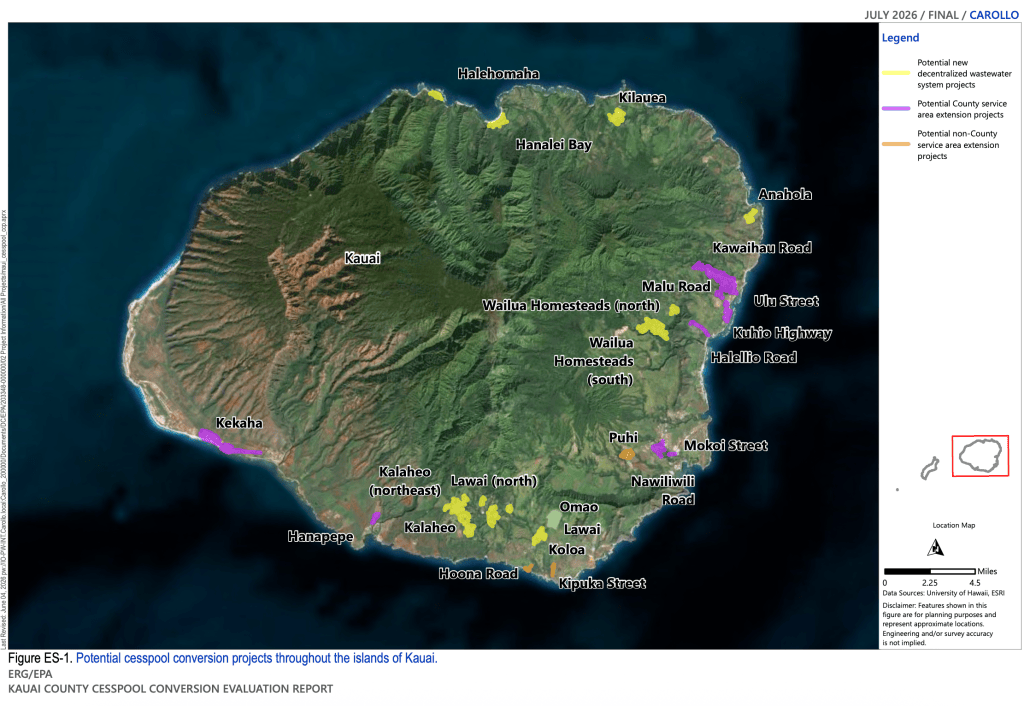
Altogether, the nine potential county sewer expansion projects would cost an estimated $790.5 million and remove roughly 4,050 cesspools.
The cesspool conversion report is not yet available on the county’s website. Rapozo said he didn’t know the report was finished but said even if costs are significant, the county should not ignore the need to expand its sewer system.
Tanigawa said the county recognizes that expanding its sewer system will inevitably be needed. He added that his department doesn’t have a timeline for when it’ll decide whether to pursue the Kawaihau Road sewer expansion project, but it’ll require conversations with the next administration and council.
Much of the county’s focus has been on addressing the deferred maintenance for its aging wastewater infrastructure, some of which is 60 years old, Tanigawa said. Construction is underway for maintenance and improvement projects at the Wailua, Waimea and Līhu‘e wastewater treatment plants and one of the Wailua sewage pump stations. Twelve other projects are being designed.
Earlier this year, the county council questioned the purpose of spending tens of millions of dollars on improvements at the Wailua Wastewater Treatment Plant when the county was looking at relocating it outside of the tsunami zone. Carvalho and Rapozo requested that the Department of Hawaiian Homelands be present at the meeting to provide a status update on the potential relocation.
Tanigawa said a recently adopted building code requires that new equipment and facilities at the treatment plant be elevated 30 feet above ground, which is cost prohibitive. The county is working with DHHL to develop a new treatment plant on the state agency’s land mauka of the highway, where it plans to build subsistence agricultural lots.
Repairs and upgrades are still needed to the existing facility to continue treating effluent until a new plant is operational.
Rapozo said he firmly believes the plant needs to be relocated.
Carvalho said working collectively with the state and federal governments is the only way the county will be able to move forward on its aging infrastructure.
Earlier this year, he introduced a council-approved resolution to authorize the county to get a larger state loan to improve the Wailua Wastewater Treatment Plant. The larger loan was needed after construction bids came back higher than initially estimated, and the improvements are needed to help the facility comply with new state effluent treatment standards.
“By ourselves there’s no way,” he said.
Rapozo said the county can’t continue making Band-Aid fixes to its aging wastewater infrastructure
“There’s no more road to kick the can down,” he said. “So, you know, this next administration is going to be tasked with some very, very, very difficult decisions to make.”

