Should City Boards Allow Non-Citizens And Loosen Quorum Rules?
Two Honolulu charter amendments could bring changes to dozens of city boards and commissions.
Two proposals on Honolulu ballots are aimed at making it easier for some city boards and commissions to operate by expanding who can serve on the board and changing the number of members who need to be present to vote on issues.
Oʻahu’s 33 neighborhood boards, which have long struggled to fill positions and meet quorum, were the subject of the original proposal submitted to the Honolulu Charter Commission. But commissioners ultimately excluded them from the proposed charter amendments that will go before voters on Nov. 3 so the vote would not have an impact on their operations.
The Honolulu Authority for Rapid Transportation is one of more than 20 city boards that would be affected and supporters of the measure that redefines what constitutes a quorum say it will help HART move ahead with business decisions that are sometimes delayed because several of the board’s 14 members are often missing from meetings.
Question 16
Honolulu Charter Question 16 proposes to allow permanent resident aliens — in essence green-card holders — to serve on boards and commissions. Currently, only registered voters can serve. An early draft would have expanded eligibility to all permanent residents, including residents who aren’t registered to vote.
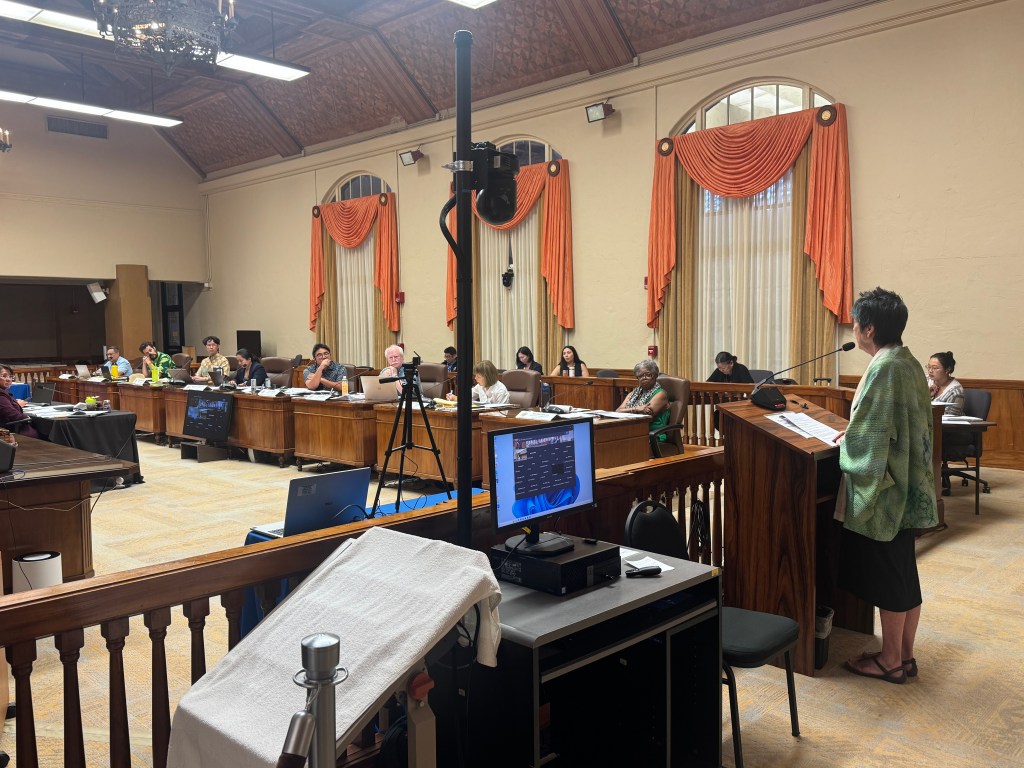
But the proposal was amended with little public discussion just before commissioners voted to send it to the ballot. The reference to “permanent resident” was replaced with “permanent resident alien.” The commissioners didn’t explain what was behind the change. And there was no testimony either supporting it or opposing it.
The change would mean that to be on a city board you would need to be a registered voter or a green-card holder. But residents who aren’t registered to vote still couldn’t be appointed to one of the commissions identified under Section 13-103 of the City Charter, which according to the city’s website include things such as the Honolulu Ethics Commission, the Planning Commission, the Salary Commission, even the Board of Water Supply. The neighborhood boards, whose members are elected not appointed, are organized under a different section of the charter.
Commissioner Trey Gordner, who introduced the amendment adding permanent resident aliens, said it was something suggested by the city’s Corporation Counsel. He said there had been some discussion that Honolulu is a very diverse community and the change would open up civic service to the international community including people at the University of Hawaiʻi.
The commission’s ballot explainer says this: “City boards and commissions are groups of experts who volunteer to advise, assist, or oversee certain parts of City government without pay. Currently, you must be a registered voter of the City and County of Honolulu to serve on a board or commission. Many willing and capable long-term residents — including employees of international businesses, nonprofit organizations, and universities — are currently excluded from serving in these roles.”
Question 17
Honolulu Charter Question 17 got more of an airing, but not much more. It changes the definition of a quorum for purposes of taking official action to be based on the number of eligible voting members currently on a board, not the total number of seats on a board that are often vacant.
The other problem is that some boards, such as HART, include government officials and other experts who are required by law to be on the board. The HART board includes the state director of transportation and the city planning director as well as one citizen member who is designated as non-voting.
“The amendment would clarify that vacancies and non-voting members are excluded when determining whether a quorum is present and that, once a quorum has been established, official actions may be approved by a majority of the members present and voting, unless state law or the Charter itself requires a higher voting threshold,” the Charter Commission’s ballot explainer explains.
The Backstory
Both ballot questions stem from Proposal 003 which was submitted to the commission by Chris Moylan, a former elected official from California who moved to Hawaiʻi seven years ago and got involved in local government. He’s currently the second vice chair of the Mānoa Neighborhood Board and is a former member of the HART board.
His proposal was aimed at two things: one was resolving an ongoing problem faced by neighborhood boards who find it hard to get things done because they often can’t make quorum and the other was fixing a situation he’d seen with HART where ex-officio members like the state and city officials can’t designate someone to attend for them so if they are absent they count as a no vote.

Moylan told Civil Beat he decided to take these issues to the Charter Commission because the Legislature had failed to address them in a bill that passed last session updating some things regarding neighborhood boards. But the quorum problem and the issue with ex-officio members not showing up were cut out of the bill in conference committee, he said.
“Neighborhood boards are the group most in need of the charter amendment, and it should absolutely apply to them,” Moylan said in testimony to the commission.
“Most of our board has been appointed during a term because there are so many vacancies,” he said. “At any given time neighborhood boards desperately fill multiple vacancies with anyone willing to sign up, and those people are not elected until a term comes up.”
Moylan is angry about the changes to his proposal and why. In an interview, he called it “a concerted effort to not let citizens get anything done.”
“It’s really suspicious that both houses of the Legislature passed (the bill this session) and then gutted it in conference behind closed doors, so the governor signed a zombie bill into law,” he told Civil Beat. “And then someone went to the Charter Commission and stuck that other sentence in there. Somebody doesn’t want neighborhood boards to do anything. Somebody else also deleted the language about the HART board allowing ex officio members to appoint voting alternates. These people all work behind the scenes while constantly nagging us that we have to follow the Sunshine Law.”
“Somebody doesn’t want neighborhood boards to do anything.”
Chris Moylan, second vice chair of the Mānoa Neighborhood Board
He said the California county where he served had a similar problem with quorums and officials worked to get it straightened out. When he saw Honolulu suffering from the same issue with vacancies and members who didn’t show up, he decided to try to change things, first at the Legislature and then at the Charter Commission.
“But I had no idea how amateurish Hawaiʻi government was,” he said.
Tom Heinrich, another longtime neighborhood board official, also urged the commission to include the neighborhood boards in the ballot measure. He agreed with Moylan that the Legislature dropped the ball and said he thought it would be reintroduced this coming session.
The only opposition to the proposal came from Natalie Iwasa, who is a non-voting member of the HART board.
“If vacancies are excluded from the definition of quorum, a big part of the motivation for filling vacancies is removed,” she told the commission in written testimony. “An example of this is the Honolulu City Auditor position. That position has been filled by a temporary auditor for about the last three years. While I understand some boards have had issues with meeting quorum, we should look into other ways to solve that issue.”
Despite his frustration, Moylan said he would probably vote yes on Question 17 simply because it at least would resolve HART’s quorum issue.