Addressing Hawaiʻi’s High Cost Of Living
Rising prices helped drive a national “blue tsunami” at the polls Tuesday, but few places have it as bad as Hawai‘i — a state long controlled by Democrats. Here are some key takeaways about the Aloha State’s ongoing affordability crisis.
A few weeks before the midterm elections, I took my 6-year-old daughter to Texas for fall break.
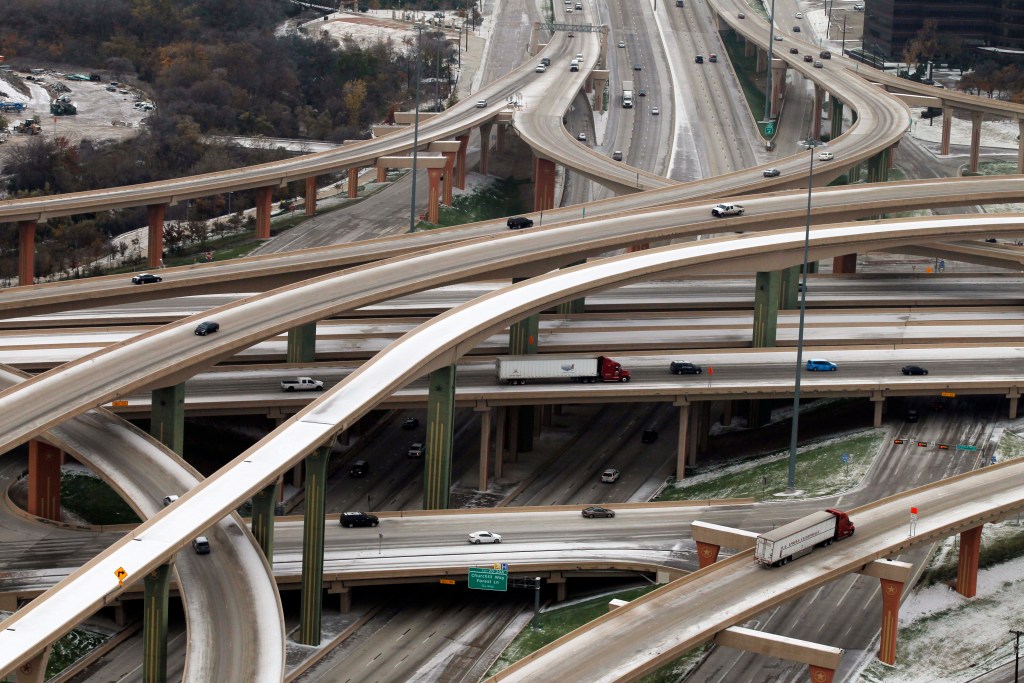
She was struck by the size of everything from the Fletcher’s Original Corny Dogs at the state fair to the enormous elevated highway interchanges in Dallas. I was struck by all the Talarico signs adorning the yards of formerly conservative enclaves — and the number of people complaining about the high cost of gas.
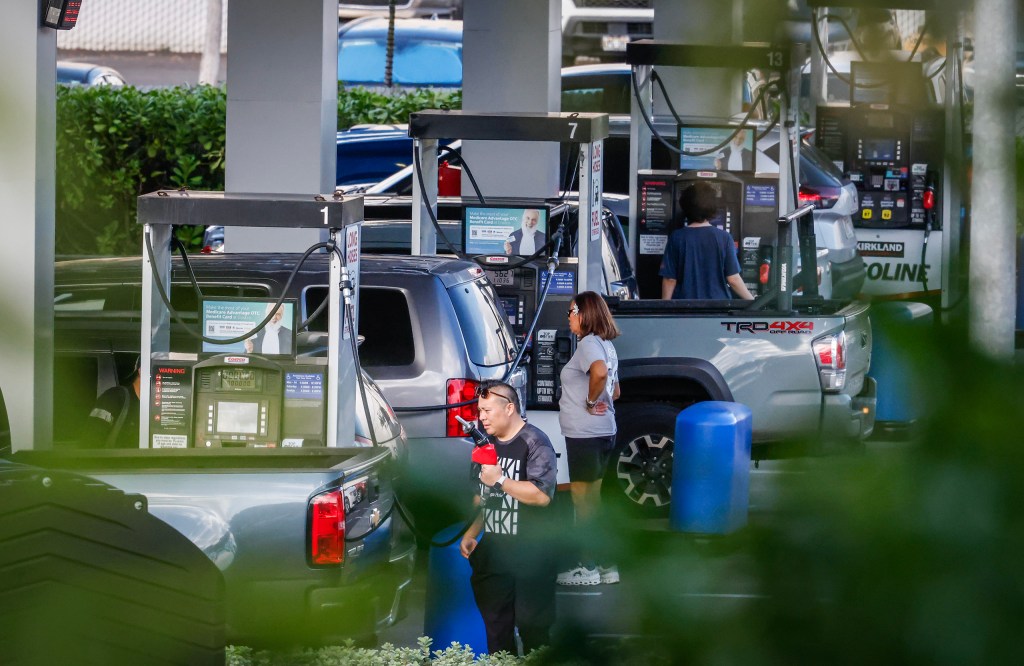
Everyone it seemed had a complaint about how much it cost to fill up their car, a gripe that helped propel the so-called blue tsunami that flipped Texas politics upside down last Tuesday. Yet it was hard not to laugh when I took my rental car to a Dallas gas station and saw the price everyone was lamenting: $3.60 a gallon. My latest fillup in Kaimukī clocked in at $5.86 a gallon.
Hawai‘i didn’t experience the same blue wave as the continent — in part because the state is already about as blue as can be, having been heavily controlled by the Democratic Party for decades. Yet cost of living was still a huge issue in the elections here. Nearly every candidate who answered our election Q&As this year talked about the state’s affordability crisis.
Civil Beat has been covering the state’s high cost of living challenges for more than 15 years. Yet increasingly in interviews, it seems like people here are at a breaking point.

To get some additional context in the wake of the election, I reached out to Steven Bond-Smith at the University of Hawaiʻi Economic Research Organization, who validated what Civil Beat reporters have been hearing — with one important caveat.
“There absolutely is a breaking point, particularly for people in Hawaiʻi, more so than on the mainland,” Bond-Smith said. “But it’s not because of changes in the cost of living.”
While it seems like soaring prices of food, housing and healthcare are what’s hitting us hard in the islands, the real problem is that paychecks aren’t keeping up with those costs.
“Our economy in general has just been growing much more slowly than the rest of the country,” Bond-Smith points out.
Several decades ago, Hawai‘i had higher incomes and higher GDP per capita than much of the continental U.S., and so it didn’t matter as much that everything was a bit more expensive here. These days, our incomes are about average — or just below.
“Once you account for cost of living,” Bond said, Hawaiʻi ends up “right down at the bottom.”
Comparing Hawaiʻi to Texas offers a pretty stark illustration of this. The median price of a single-family home there was around $300,000 last year. In Hawai‘i it was more than triple that — close to $1 million.
Texas has some pretty places, but few would argue that homes in a state that also has stretches described by one country singer as “Flatter than a tabletop / Makes you wonder why they stopped here” should be as valuable as a lot in Hawaiʻi.
But the rub comes when you look at income. Per-capita income in Hawaiʻi last year was $46,005, according to census data. In Texas, it was $40,752.
Because incomes here haven’t kept up, Bond-Smith says, cost of living pressures get felt in Hawaiʻi much the same as places in the U.S. normally associated with deep economic desperation. Essentially, we have more in common with Appalachia and Louisiana than one might think.
Now that the Democrats have won back both houses of Congress, there’s going to be a lot of pressure on the party nationally to do something about affordability. Yet many of the changes that would make a real difference rest at the state and county level.
Opening day of the Hawaiʻi Legislature is Jan. 20 and we’ll be tracking cost of living proposals carefully.
(For some of Bond-Smith’s ideas on what would help, scroll down to his short Q&A below.)
— Jessica Terrell, Civil Beat managing editor
Go deeper:
Why Isn’t Hawaiʻi’s ‘Affordable Housing’ More Affordable?
A complicated formula results in a price-setting benchmark that’s higher than if it measured only income. The result: More people qualify, but rents are out of reach for many.
Employers Face Double-Digit Increases In Health Insurance Rates
The rising cost of healthcare is battering Hawaiʻi employers with soaring costs for health plans covering hundreds of thousands of workers and their families, illustrating the wide-ranging effects of a healthcare system that experts say has become increasingly unsustainable.
High Housing Costs Force Hawaiʻi Residents Into ‘Impossible Choices’
The first sentence of the 2026 Hawaiʻi Housing Factbook landed with a distressing thud familiar to readers of last year’s Factbook: “Hawai‘i residents face the highest housing costs in the nation.”
Help us cover the crisis:
Cost of living on the islands continues to be a key area of coverage for Civil Beat (case in point, we hired reporter Jeremy Hay in 2024 to focus on income inequality). In coming months, we expect to pay particular attention to ongoing challenges in the state’s healthcare system, which is impacting both affordability and economic growth in the state.
We’re also paying special attention to housing affordability, and the chasm between the need and the supply of housing people can afford to buy out here in the middle of the Pacific.
If you have ideas, reach out to us by putting “Priced Out” in the subject line and emailing tips@civilbeat.org.
What can be done?
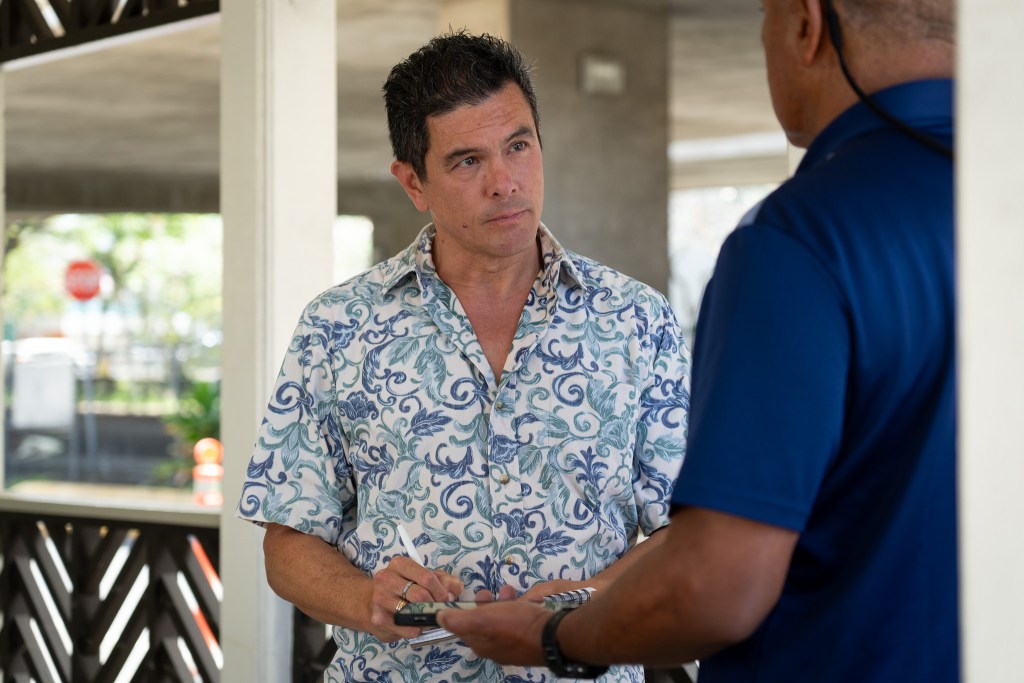
We asked economist Steven Bond-Smith for a few key takeaways after the election. Answers have been edited for length and clarity.
Q. What would you say is the biggest driver of the state’s high cost of living?
A. In Hawai‘i, I think it’s primarily around scarcity of land. Obviously, we live on an island. There’s big mountains (which means) a lot of land here isn’t developable, and therefore less land available for development makes that land more expensive. So that’s sort of a primary fundamental driver. But on top of that, we have a permitting system that’s very slow … that in itself adds quite a lot of cost to building in Hawai‘i.
It’s very restrictive about where you can build and what you can build. And if you look at sort of our flow of … new buildings over time, new permits, it’s relatively constant, which is a little bit strange because you would expect that … when the economy is booming, you would get a whole lot more housing. When the economy is not booming, you would get a whole lot less. We don’t have a responsive construction sector like that … That essentially suggests to me that permitting is a bottleneck for that development, and so in permitting as a bottleneck, when you get a surge in demand, you get price increases, right? So there’s sort of a scarcity because of land, and then there’s an additional scarcity because we use land poorly.

Q. What’s something that can be done to improve affordability here?
A. I think there are there are a number of things that could be done. The short term … quickest payoff things would be around improvements around permitting: speeding up permitting, increasing zoning, increasing density — or not even necessarily increasing the density, but increasing the potential for higher density.
So I want to point you to a blog I wrote about recently, which was looking at housing reforms in Auckland, New Zealand, where they required that the city have enough zoned capacity that the land market becomes much more competitive. So the idea is to actually zone much much more housing than what the city actually needs. Now that doesn’t mean the housing gets built, it just means that (the zoning) is available, and then people can choose if they want to build or not. But it means that permitting and zoning are not a bottleneck for housing.
But what that did was reduce rents by 28% on what it would have been had they not done that reform.
What happened was in Auckland, they created a building boom where a lot of older homes that were ready to be torn down were replaced by new townhomes … You have a few more units per site, but that actually puts them in that affordable bracket, even without any kind of affordable housing requirement.
Q: Is there anything that I didn’t ask about … that you want people to be thinking about here in Hawai‘i?
A. So anything that we do … on affordability and prices, I think mostly what that does is kind of kick the can down the road. Because the real trouble in Hawai‘i, the thing that makes it bite right now, is that our incomes haven’t kept up.
To properly address the problem, we need to address the trajectory of our economy, which has been growing very slowly for the last 35 years and is falling further and further behind the rest of the country.
From the archives:
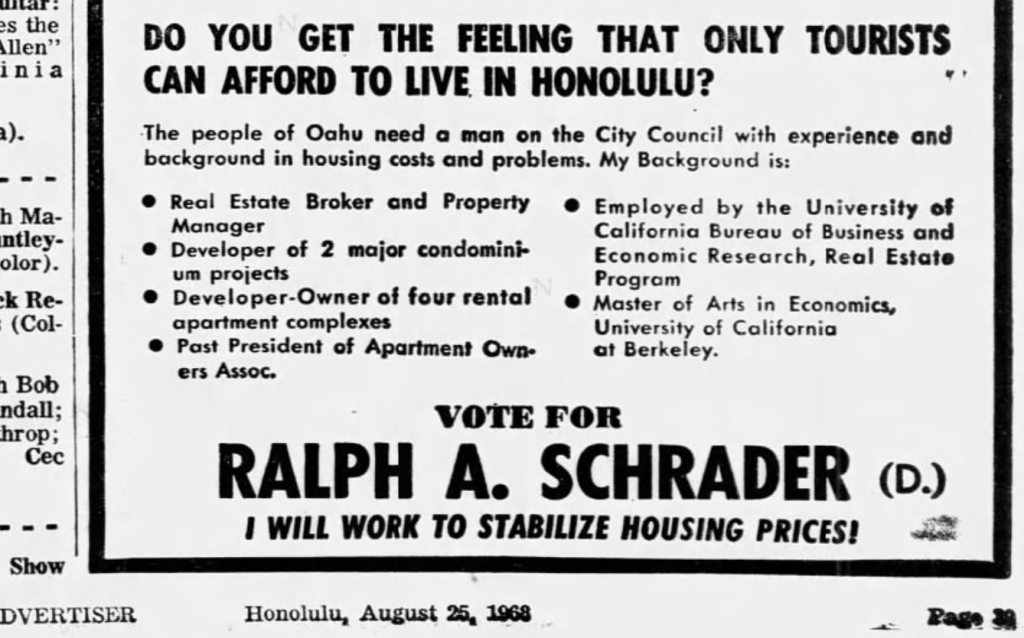
Bond-Smith points out that the high cost of living in Hawai‘i has been an issue for decades. A search through the state’s newspaper archives shows that people have been complaining about the price of paradise since at least the 1850s.
In fact, people were ordering food from the mainland to avoid the markup at local island grocery stores more than 100 years before the advent of Amazon Prime.