

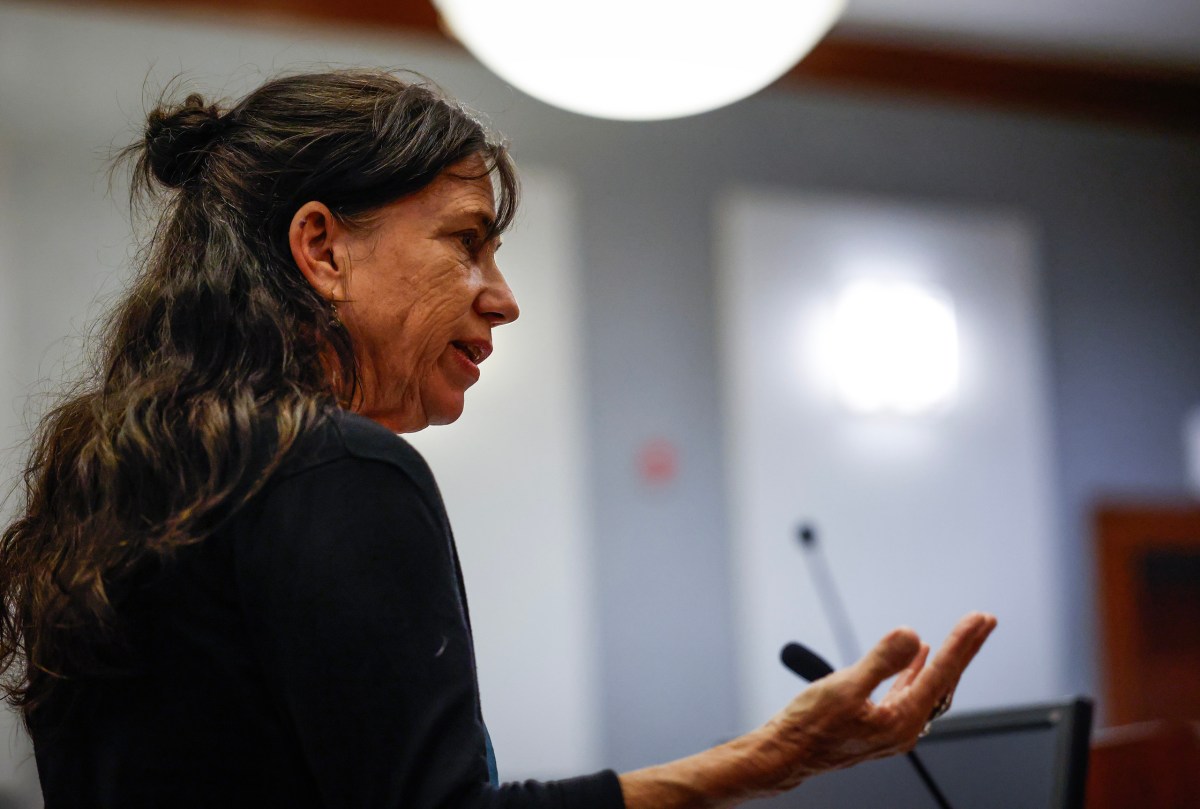
Eden Peart stood to accept her sentence in a Līhuʻe District Court on Tuesday morning, facing the possibility of up to four months in jail for misdemeanor property damage charges. The gallery was packed, standing room only.
Such low-level charges would not normally garner so much community interest, but Peart’s crimes had touched a nerve on Kauaʻi.
The 64-year-old librarian was found guilty in August of placing stickers on a Kapaʻa falafel truck menu sign owned by a local Israeli man. The rectangular stickers show a black fist raised in the air with the words: “This company’s funds support the Palestinian genocide. Free Palestine.”
The case on Kauaʻi is a microcosm of the tensions playing out around the world amid the conflict between Israel and Palestine that erupted three years ago.
On Oct. 7 , 2023, the Palestinian terrorist group Hamas attacked villages and a music festival in southern Israel, killing more than 1,200 people and abducting at least 250 more. The Israeli government’s response and ensuing war has led to the deaths of more than 74,000 Palestinians, losses scholars and international authorities consider a genocide.
The conflict has sparked pro-Palestinian protests across the globe, including on Kauaʻi where demonstrators have gathered on a near weekly basis at the Kapaʻa Public Library to protest Israel’s military campaign and American involvement. Meanwhile, Jewish leaders have reported a rise in antisemitism, both locally and internationally.

Battle lines have been drawn in communities across the globe, extending into people’s everyday lives far from the Middle East, and tensions have flared in ways big and small. In this case, the battle is over stickers placed on a sign some 9,000 miles from the conflict.
To Jewish community members on the island, Peart’s targeting of the food truck, Shakalafel, owned by Uriel Churgin, was an act of antisemitic vandalism, something that historically has been a precursor to violence against Jews.
To Peart and her supporters, placing the stickers was a relatively minor act, intended to spark conversation about the Palestinian cause and the treatment of pro-Palestinian demonstrators on Kauaʻi.
Lauren Miller, a Jewish community organizer on the island, said she respects anyone’s right to protest or express their opinion on the conflict, as long as they respect the humanity of the people on both sides. What Peart did, though, was not freedom of expression, she said, but rather a hateful attempt to hurt a Jewish business.
“A line was crossed here,” she said.
Peart, for her part, said she is not antisemitic and didn’t intend to cause harm by placing the stickers.
A review of fourth-degree criminal property damage cases dating back to 2021 showed the count is often charged alongside a more serious felony, such as terroristic threatening or robbery.
Judge Michael Scarbo sentenced Peart to 100 hours of community service. He told the court that the right to freedom of speech allows you to express your beliefs on your property, not plaster them on the property of someone else.
“This was not a sticker that was a butterfly or that said “Live, Laugh, Aloha,” he said. “This was a sticker intended to draw attention to someone because of their racial, ethnic, religious beliefs and a series of assumptions based on those beliefs. It was done with intent.”
He called freedom of speech “a fundamental tenet of life in the United States,” that allows us to put signs expressing our ideology in our own yards.
“It does not allow us the right to put a political sign on our neighbor’s yard,” he said.
Property Damage By Sticker
Shortly after 9 p.m. on Dec. 18, 2025, surveillance cameras at Churgin’s food truck captured Peart placing two 5×3-inch stickers on his menu board out front, court documents show.
It was not the first time Peart had vandalized his business, Churgin said. Another time, a worker had seen her place a similar sticker on the board during the day and called Churgin, who rushed over to the business. He said he found Peart a few blocks away charging her electric car and pulled over to take a photo of her license plate.
Between October and December, Churgin said he peeled the stickers from his business’s signage dozens of times only to have them reappear the next day. The constant peeling not only damaged his signage, he said, but also caused fear among his staff.

Peart said she only placed stickers on the signs a couple of times. Court records don’t specify a number.
Miller, the Jewish community leader, remembers talking to Churgin at the time.
“He called me, and he was like, ‘I’ve got to talk to you, this is happening on a daily basis,’” she said. “There’s lots of other food trucks in the area, nobody else’s food truck was getting stickers on it.”
Churgin told her he’d put up surveillance cameras outside his truck. Miller encouraged him to report the vandal to the police and the FBI, which he did.

Churgin said it was important to him to report Peart and hold her accountable for her actions. It wasn’t just about the stickering, which he saw as a targeted antisemitic attack. Throughout history, vandalism of Jewish businesses has preceded episodes of violence. He said he recalled reading an article about the 2025 shooting at a Hanukkah celebration at Bondi Beach in Sydney, Australia. Jewish businesses and synagogues in Sydney had reported increased rates of vandalism leading up to the shooting.
“That’s what gave me the motivation to feel like I’m responsible to catch this individual and press charges,” he said.
Police arrested Peart on Jan. 8 on two counts of fourth-degree property destruction, according to court records. The petty misdemeanor charge is used for cases in which a person “intentionally or knowingly damages the property of another without the other’s consent.”
Peart said that at the time, she didn’t even know placing a sticker on someone’s property was a crime, though she now admits that ignorance of the law isn’t a defense.
At her sentencing Tuesday, Scarbo, the judge, said that given her position as a librarian, he would have expected her to have a better understanding of the law.
“To say you were ignorant of the law to that extent, as a librarian, also flies in the face of reason,” he said.
‘Plain Old Racism’
Peart said she put up the stickers in hopes of sparking a broader conversation about the plight of Palestinians. She said she became especially moved watching the news and and seeing the suffering of children in Gaza. But she also described it as a kind of revenge for the way pro-Palestinian protesters, including herself, had been treated by pro-Israel demonstrators locally.
When she decided to place the stickers on Churgin’s business in late 2025, she said she was still reeling from the trauma of something that happened to her at a demonstration nearly a year and a half prior outside the Līhuʻe airport in February 2024.

That day, as she and a friend stood at the northeast corner of Ahukini Road and Kapule Highway, a man draped in an Israeli flag approached them, shoved Peart in the chest and told her he hoped her daughter and granddaughter got raped and killed, Peart said. Her friend, artist and activist Isa Maria, who’d organized the demonstration, said the threatening phrase has stuck in her mind to this day.
“Those are the words I remember, word for word,” Maria said.
Neither woman pressed charges or filed a police report about the incident. Maria said she called 911 after the confrontation, but by the time an officer arrived, the man had gone back to the other side of the road. She remembers the officer went over to talk to the man and told him to stay away from her and Peart. The two women didn’t take any further action.
“I wish I’d thought to defend myself and press charges,” Peart said. “But I didn’t think of it.”
Peart said she doesn’t know who the man was who confronted her and Maria that day. But a photo from the event shows him standing near a group of four other men who are leaning on a blue pickup truck. One of those men was Churgin.
“That she had an encounter with someone else that may share the same ethnicity as me as an excuse to vandalize my business is kind of crazy.”
Uriel Churgin, business owner
Churgin said he remembers attending the demonstration that day to show his support for Israel. But he said he doesn’t remember seeing Peart or noticing any confrontation between the Israeli and pro-Palestinian protesters. He also said he doesn’t know the man Peart says assaulted her.
For Peart to draw a connection between the man from the protest and Churgin’s business is “plain old racism,” Churgin said.
“That she had an encounter with someone else that may share the same ethnicity as me as an excuse to vandalize my business is kind of crazy,” he said
Peart said she now acknowledges that taking her frustration out on Churgin’s business was “not the best approach.”
“I think it was like a therapeutic gesture I came up with to feel like I defended my daughter and granddaughter,” said Peart, whose 40-year-old daughter and 15-year-old granddaughter live in Sardinia. “I realize it’s illogical.”
Concerns About Antisemitism
Shortly after Peart’s arrest in January, the Jewish community on Kauaʻi suffered another blow. Multiple swastikas were found spray painted on the Sleeping Giant Trail on Nounou Mountain.
A Hawai’i News Now article about the vandalism quoted Churgin, who talked about the stickers at his falafel truck. The surveillance footage from his business played on the news, and even though Peart’s face was blurred, she said people in the small community recognized her.

After the article came out, she recalled a supervisor at the library suggested she “lay low” and remove a “Read Palestine” pin she often wore at work.
The Hawai’i Public Library System did not respond to a request for comment.
Churgin said he has no evidence that Peart was involved in the swastika painting, but he thinks she contributed to emboldening other vandals.
“She’s definitely to blame with trying to normalize this very clear Jew hatred,” he said.
Peart was horrified at the suggestion that she might be involved in painting swastikas on the trail, something she called “abhorrent.”
Andrew Laurence, a spokesman for the state Department of Land and Natural Resources, said the investigation in the trail vandalism is ongoing.
On Feb. 8, Peart was arraigned on two counts of fourth-degree criminal property damage and two counts of second-degree criminal tampering for placing the stickers on Churgin’s signs. She pleaded no contest to the first count and not guilty to the second. Members of Kauai’s Jewish community, including Churgin, came to the courtroom to observe.
Shortly after her arraignment, Peart filed for a temporary restraining order against Churgin. She wrote in her petition about the Hawaiʻi News Now story and said he appeared at her court hearing with a woman who stared at Peart in a “very threatening manner.”
Judge Robert Goldberg denied her petition the same day stating that Peart failed to show Churgin had been harassing her.
‘Not Rainbows And Unicorns’
In June, Peart’s public defender, Samantha Mead, filed a motion to dismiss the charges.
She said prosecutors hadn’t shown that Peart intended to damage Churgin’s sign and harm his business.
“Churgin continued to operate his business under normal circumstances and was not substantially inconvenienced simply by having to remove some stickers,” she wrote.

She also wrote that the potential consequences, up to 30 days in jail and a $1,000 fine for each count, far outweigh the severity of the crime.
But deputy prosecuting attorney M. Cherice Siebert wrote in a counter motion that the “hateful and racist stickers” Peart placed on Churgin’s business were intended to drive away customers.
The business owner was “not substantially inconvenienced simply by having to remove some stickers.”
Public defender Samantha Mead
“Defendant’s stickers were not rainbows and unicorns but a hateful message intended to cause not only a substantial inconvenience but harm to Mr. Churgin’s business,” Siebert wrote.
Judge Matthew Bracken denied the motion to dismiss, and Judge Michael Scarbo found Peart guilty in August of both counts at a bench trial.

Churgin said he hoped Peart would do jail time to set an example for others who may want to harm people because of their identity. He was disappointed Tuesday by what he saw as a too-lenient sentence and feared bad actors would be emboldened to commit future vandalism against his business and others.
“I don’t think the sentencing was meaningful enough to show an example,” he said.
He and others in the Jewish community were also disappointed that Peart’s crimes were not treated as hate crimes.
There is no separate charge in state law for hate crimes. Rather, a judge can dole out a harsher penalty at sentencing if the defendant is found to have acted against their victim on the basis of protected characteristics, including religion.
In Peart’s case, the sentencing enhancement could not be applied to such low-level charges, according to Kauaʻi prosecutor Rebecca Like.
But Miller said it was crucial for the Jewish community that the police and prosecutors took the case seriously.
“If this were to go unnoticed or not have consequences, then our fear as the Jewish community is it would then signal to others that it’s okay to do that,” she said. “That’s one reason why we’ve watched this case so closely.”
Jews are an extreme minority in Hawaiʻi, making up less than 1% of the islands’ population, according to the Pew Research Center.
There have been 12 anti-Jewish hate crimes reported since 2021, according to a dashboard run by the Hawaiʻi Attorney General’s office, which tracks hate crimes. The majority of hate crimes recorded in Hawaiʻi are anti-white, with 128 reported since 2021, according to the dashboard.
Some high-profile cases of antisemitism have rocked the community in recent years, including a series of bomb threats emailed to synagogues around the state in 2023 and Montana man who recently pled guilty to sending antisemitic death threats to Gov. Josh Green.
For the Jewish community on Kauaʻi, Peart’s stickers were another example, and even though the case is now closed, the harm continues, Miller said. Because Peart still works at the Princeville Public Library, some Jewish families no longer feel comfortable going in with their children.
“There are many ways to advocate for Palestinian rights and sovereignty that don’t infringe on the rights and sovereignty of Jews or Israelis.”
Lauren Miller, Jewish community organizer on Kauaʻi
Peart said she was saddened to hear that and said everyone is welcome in the library.
Pro-Palestinian activists said they planned to continue their regular demonstrations and hoped to do so peacefully and without confrontations from counterprotesters.
Rachel Lawrence, a local activist, said she hopes Peart’s case will serve to keep people talking about the genocide and human rights violations happening in Gaza.
“I think that that could be some of the good that comes out of this,” she said, “because the more people have conversations about this, the better.”
Miller said moving forward, she would remain focused on uplifting positive voices for the community. She recently helped host a series of talks by Holocaust survivor Gabriella Karin. She also hopes to one day soon host Ahmed Fouad Alkhatib, a Palestinian-American activist who founded the organization Realign For Palestine and has spoken out against Hamas.
“There are many ways to advocate for Palestinian rights and sovereignty that don’t infringe on the rights and sovereignty of Jews or Israelis,” she said. “There’s so much nuance there, and our culture and tradition invites debate and argument for the sake of learning. Jewish tradition cherishes this.”
