Tyler Dos Santos-Tam Elected Honolulu Council Chair
The councilman representing Chinatown was chosen to lead the Honolulu City Council despite concerns about how he secured the council’s support.
Council member Tyler Dos Santos-Tam was elected council chair by his colleagues Thursday afternoon following a contentious discussion that bounced between his record in office and his participation in a gathering that may have broken the state’s public meetings law.
His vice chair will be council member Esther Kiaʻāina, and his floor leader will be council member Scott Nishimoto.
The measure passed with six votes in support. Council members Andria Tupola and Val Okimoto voted against the leadership change, while current Council Chair Tommy Waters abstained. Dos Santos-Tam’s ascent makes him the first openly gay Honolulu City Council chair.
“Now the work begins,” he said in his office after the meeting as he took off lei, including one with rainbow flowers.
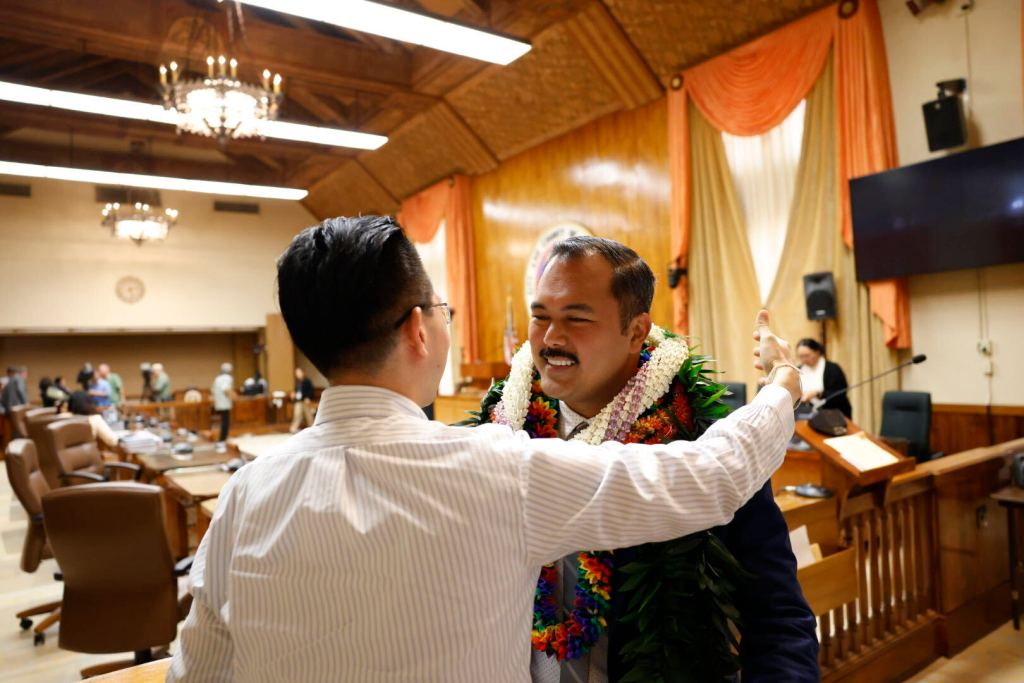
Public testifiers were split on Dos Santos-Tam’s bid for leadership. Supporters argued that he’s a hardworking, smart and friendly elected official who would be an effective chair. Opponents, however, said the proposed leadership slate was tainted because a majority of council members allegedly met in secret last month at Zippy’s Waipahu to arrange it.
The state Office of Information Practices is currently investigating whether that meeting – attended by Dos Santos-Tam, Kiaʻāina and council members Radiant Cordero, Augie Tulba and Matt Weyer – violated the Sunshine Law, which generally requires public business be conducted in public meetings.
The council chair is a powerful position that appoints the members and chairs for each council committee and determines which bills make it onto meeting agendas.
Per the resolution’s language, Dos Santos-Tam will replace Waters on Dec. 1. But there will be another vote for the chairmanship no later than Jan. 2, when members will be sworn in, as required by the City Charter. Dos Santos-Tam said he hopes his colleagues reelect him to the position when that time comes.
Mānoa resident Dylan Armstrong testified in opposition, characterizing the private Zippy’s meeting as an underhanded move by making decisions outside the public eye.
“This is not just a simple disagreement about style,” Armstrong said. “I really hope this works out well for you, but you’re not starting off on a good foot.”
An ‘Impromptu’ Private Meeting?
When the Supreme Court ruled Waters ineligible for reelection, council members started jockeying behind the scenes to succeed him as chair. While other members have been rumored to be interested, Dos Santos Tam apparently garnered enough support to submit a resolution for consideration at Thursday’s meeting.
Kiaʻāina, the current floor leader, aligned herself with Dos Santos-Tam. Tupola, the vice chair, on the other hand, has been a vocal critic of the Zippy’s meeting and opposed Dos Santos-Tam’s bid.
Tupola had questions for the five council members at Zippy’s, including who else was considered for chair and whether committee assignments were decided. Nobody answered her at Thursday’s meeting.
The Corporation Counsel’s office, the city’s legal department, defended the Zippy’s meeting, and in a letter last month said the gathering was “not pre-arranged,” lacked a formal agenda and was therefore legal, according to the Honolulu Star-Advertiser. In an interview this week, Dos Santos-Tam said the Zippy’s meeting complied with the Sunshine Law.
“We did not take a vote, and we did not come to any firm agreements on any particular arrangement,” Dos Santos-Tam said in an interview Monday. “It was impromptu and unplanned to the extent that we did not go in with: ‘Here’s the agenda for the meeting,’”
But Tupola said at Thursday’s meeting that Dos Santos-Tam told her there was a vote — and that he had been declared the winner.

Council member Val Okimoto also opposed the resolution, saying the Zippy’s meeting, which she called a “restaurant booth backroom deal,” violated the public trust. The idea that five council members just so happened to show up at a Zippy’s in Waipahu at the same time, she said, “defies common sense.”
“The word ‘impromptu’ means spontaneous, without planning or preparation,” she said. “No one can believe that our colleagues convened in that way.”
Also, Okimoto said, the resolution will only be in effect for a month before Councilman-elect Trevor Ozawa joins the body in the beginning of January, at which point the charter mandates another vote on leadership. Ozawa said Tuesday night that he’s willing to work with whoever is in leadership.
“This measure is an attempt to predetermine and lock down power before the new council convenes,” Okimoto said, “and it is doing so under an active, unresolved legal cloud.”
In response to questions from Kiaʻāina, city attorney Duane Pang noted that even if a Sunshine Law violation had occurred, the remedy would be to hold a public meeting and discuss the proposal — which occurred on Thursday.
Priorities Going Forward
Despite the complaints about the process, most attendees at Thursday’s meeting supported Dos Santos-Tam.
Sen. Stanley Chang showed up in support. Dos Santos-Tam worked on Chang’s council campaign in 2010, Chang said.
“He is a bus rider and a regular Chinatown shopper,” Chang said in written testimony. “He understands the experiences of the humblest among us, and he fights for them with compassion and mutual respect.”
After the vote, many of the testifiers applauded.
Dos Santos-Tam said he plans to bring a bold approach to the council, and he has the legislative record to back up that promise. During his time in office, he has passed more bills into law than any of his eight colleagues, ranging from resident-only parking zones to a first-of-its-kind requirement for alcohol-serving establishments to keep naloxone on hand.
“We’re going to expand the low-income bus fare program,” he said in an interview before the vote.

Dos Santos-Tam has a construction lobbying background, and his support of the Honolulu rail project and housing policy proposals reflect that. He often aims to make it easier for developers to build, arguing that more housing supply helps keep housing affordable.
He wants to add more units to urban Honolulu areas such as downtown and King Street.
“We made it so difficult to build apartments in the apartment zones in the urban core that we created a whole separate program,” he told Civil Beat, referring to the city’s Bill 7 program aimed at expanding housing in affordable walkup buildings. “Let’s look at the underlying structure as well.”
He contrasted his point of view with one of the council’s recent housing efforts.
“We patted ourselves on the back for simply increasing the homeowner’s exemption,” he said, which translated to people who already own homes saving less than $6 each month.
Dos Santos-Tam said he wants to think bigger.
The proposed empty homes tax — co-introduced by Waters, the current chair — “was an exercise in looking at something different,” Dos Santos-Tam said. He wants to explore more options from other cities, as well as interrogate Honolulu’s historic homes exemption, which keeps those properties’ taxes at $300 per year.
As the heads of their respective branches of government, the mayor and the council chair often work together — or butt heads — on city issues. Mayor Rick Blangiardi said in a written statement that he looks forward to collaborating with Dos Santos-Tam.
“I do not expect to always agree on every issue,” Blangiardi’s statement said, “but that is part of good government. What matters most is that we maintain open lines of communication, respect one another’s roles, and stay focused on doing what is best for the people of Oʻahu.”
Dos Santos-Tam said people often judge the council’s performance by asking how much members stand up to the mayor’s proposals versus rubber-stamp them for approval.
“That’s the wrong question to be asking,” he said. “We are a co-equal branch of government, and we have the ability to set the agenda.”