

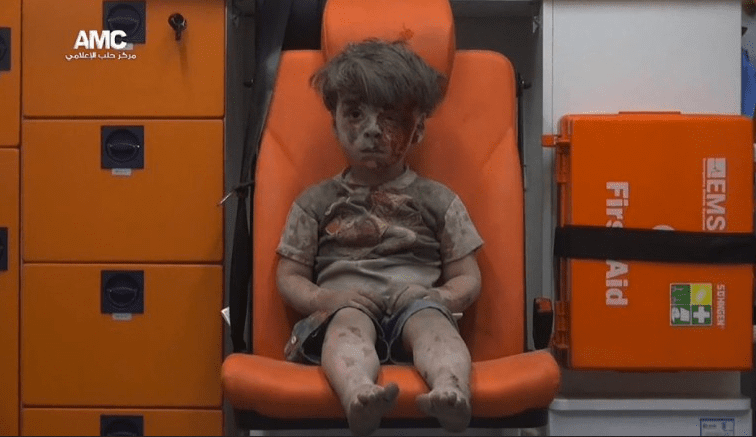
By now you’ve probably seen the clip of Libertarian presidential candidate Gary Johnson’s painful deer-in-the-headlights moment when he was asked what he would do about Aleppo if he was elected. Seemingly oblivious of Syria’s once most populous city, a place that is sadly encapsulated by the recent viral photo of a 5-year-old shell-shocked bomb survivor, Johnson looked utterly unburdened by any knowledge of a city that has become synonymous with the pain and suffering of war.
“And what is Aleppo?” Johnson asked a stunned “Morning Joe” TV panel.
You’re kidding, his incredulous questioner asked.
No, Johnson wasn’t kidding. And while he was clueless, he certainly wasn’t alone.
How many Americans would have answered in the same way?
Even The New York Times stepped into the unseemly mess with both feet when it had to amend its own story on Johnson’s gaffe with not one but two corrections clarifying Aleppo’s political status.
We Americans are often criticized for our lack of knowledge of global affairs, world history and geography. A decade ago the National Geographic-Roper Survey of Geographic Literacy revealed a shocking ignorance of basic geography among young Americans (63 percent of 18-24 year olds couldn’t find Iraq on a map; half couldn’t locate New York).
In May 2016, National Geographic partnered with the Council on Foreign Relations to conduct a somewhat different survey that posed 75 questions to gauge how well-versed college-educated Americans between the ages of 18 and 26 were in geography, current international politics, economics and the environment. The results were anemic at best with less than one-third of those surveyed earning a minimal passing grade of 66 percent.
This would be troubling for any industrialized society with access to endless sources of information, but even more so for the self-proclaimed “leader of the free world,” where we frequently tell ourselves (and everyone else) that we are an “exceptional nation.”
As a nation we have no problem remembering sports scores and movie stars but we would all do well to dedicate more time to studying the rest of the planet and the policies of our government.
It’s not only millennials and pot-smoking ex-governors that are woefully uninformed about the world. How many Americans might also ask “What is Aleppo?” Or “What is Whitestone?” (where the U.S. Army massacred 300 to 400 from the Sioux Nation) or “What is Enewetak?” (where the United States tested 43 of 67 nuclear weapons in the Marshall Islands).
As Americans, our leaders claim to lead the world even as we know so little about how much we affect it. Wouldn’t most Americans also ask “What is the Plain of Jars?” “What is Kahoolawe?” Or what is Manbij, Kunduz or Henoko?
All of these are places where U.S. militarism has taken a heavy toll, even as they remain unnoticed by most Americans. Gary Johnson’s “What is Aleppo?” slip-up reflects the disparity between our nation’s inclination to impose itself militarily on others and our apparent inability to understand and empathize with countries in a more substantive manner, other than just as tools to manipulate in order to advance our own national interests.
As a nation we have no problem remembering sports scores and movie stars but we would all do well to dedicate more time to studying the rest of the planet and the policies of our government. Short of that, we will continue to serve as enablers of foreign policies that are under-scrutinized, poorly understood, haphazardly planned and all too often recklessly executed.
Remember, it was just over a year ago when Donald Trump stumbled badly on a foreign policy question in which he confused Iran’s Quds Force and Iraq’s Kurds and admitted not knowing the difference between Hamas and Hezbollah. Later in the campaign, during a debate, it was clear that Trump had no idea what the term “nuclear triad” referred to until Marco Rubio jumped in to explain.
It’s profoundly disturbing to realize that, like the public they seek to govern, some of the candidates running for president demonstrate a startling lack of foreign policy smarts or even basic world geography and are grossly unprepared to assume our nation’s top job, which is of extraordinary consequence to our country and the world.
We may not be able to change our politicians, but educating ourselves about the rest of the world is as simple opening a book and unfolding a map. If you haven’t done so in a while, this is a good time to start.