‘This Has To End’: Revelations Renew Calls For Government Accountability
House and Senate leadership have little to say about the subject of a federal bribery investigation giving one of their 2022 colleagues $35,000.
A growing chorus of good government advocates want the Legislature to increase accountability within its own ranks following a Civil Beat story about an unknown Hawaiʻi lawmaker receiving a $35,000 donation amid an ongoing federal corruption investigation.
At minimum, they want lawmakers to reduce the influence of special interests by publicly financing campaigns and banning donations from government contractors and their families. Both of those measures are under consideration this session, which is scheduled to end May 2.
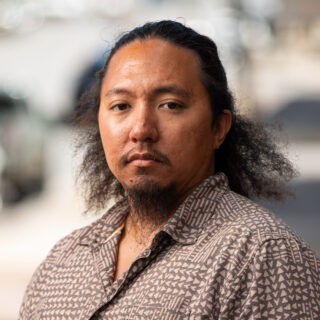
“They need to take a firmer stance and just say: Absolutely not. This has to end,” said Aria Juliet Castillo, who directs a pro-democracy program at the Hawaiʻi Alliance for Progressive Action.
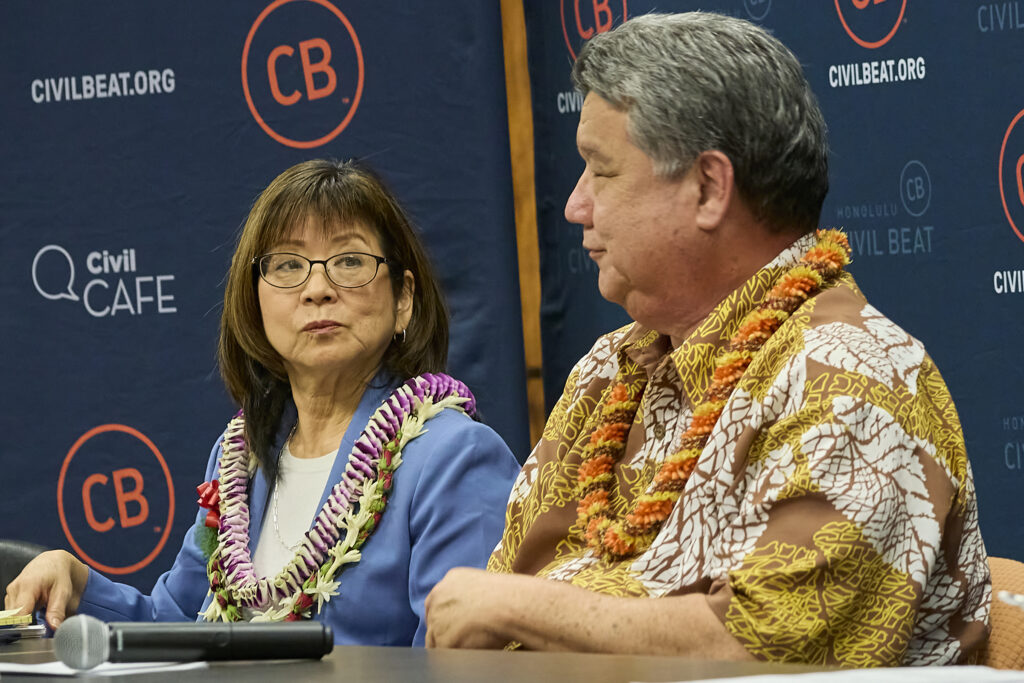
Current and former lawmakers and others say the Legislature suffers from a perception of corruption that was underscored in the Civil Beat story, which revealed previously unknown details from a federal investigation. Federal prosecutors say that in January 2022, an unnamed man allegedly paid former Rep. Ty Cullen $3,000 hoping for help with an “official request”, and that the man later paid $35,000 to another “influential” lawmaker for an “existing campaign.”
One or both of those transactions was likely illegal, experts say, but three years later, neither has resulted in criminal charges.
The handoffs were part of a federal investigation that resulted in Cullen and former Senate Majority Leader J. Kalani English pleading guilty to bribery and serving prison time.
House Speaker Nadine Nakamura declined to be interviewed by Civil Beat. In a written statement, she broadly defended current lawmakers and said that the criminal justice system so far “did what it’s supposed to do.” Senate President Ron Kouchi didn’t respond to requests for comment.
What’s The Plan?
It’s been three years since Cullen recorded his interaction with the unnamed man and the “influential” lawmaker for the FBI. Yet, no charges have been announced.
Camron Hurt, state director for the government accountability nonprofit Common Cause Hawaiʻi, said state law enforcement officials should investigate the $35,000 handoff. With President Donald Trump’s Department of Justice allegedly cutting staff that focuses on public corruption, he said Hawaiʻi can’t afford to wait for the federal government.
“Hawaiʻi being reactive to corruption is how we’ve become one of the seemingly most corrupt supermajority states in the union,” Hurt said of the Legislature, where Democrats have held most of the seats for decades. “And that should be an embarrassment to all, and it should be a call to action to fix this.”
State ethics commission Executive Director Robert Harris has already taken an interest in the case of the lawmaker who accepted the $35,000, which would violate the law if the lawmaker did not report it as income or as a gift.
The state Campaign Spending Commission, which oversees political donations, may also get involved because there is no indication the $35,000 was reported as campaign donations.
Tony Baldomero, the commission’s associate director, said he would need to know the legislator’s name to look at their campaign finance reports.
“We would do an investigation,” he said. “If it was not reported, there’s consequences for that.”
Hurt called on legislative leaders to tell the public how they will regain the public’s trust.
“Democrats in the state of Hawaiʻi have a serious corruption perception problem,” he said. “How are we supposed to trust this Legislature if we don’t know if someone who participated in bribery is still there?”
Key Corrective Measures Stalled
Three years ago, following a series of corruption scandals, including the one involving Cullen and English, the House convened a panel chaired by retired Judge Dan Foley. The commission’s final report made a series of recommendations to address what it called the “deep moral crisis” at the Legislature.
Lawmakers passed several recommendations, including restricting campaigns from accepting more than $100 in cash from any single donor, boosting transparency around political fundraisers, increasing ethics training and banning campaign finance violators from public office for 10 years.
However, legislators left many other reforms on the cutting room floor in 2023 and failed to pass them the following year. Lawmakers still have time to take action on some of these proposals during this year’s session.
The Hawaiʻi Alliance for Progressive Action and other reform advocates are pushing for passage of House Bill 370, which would expand public financing in elections, and House Bill 371, which prohibits government contractors and their immediate family members from donating to candidates.
Foley said that at a minimum, lawmakers should pass both this session.
But he thinks lawmakers should eventually ban all campaign contributions during the legislative session so legislators aren’t taking money from people or organizations that are lobbying for their votes. A bill that would have done that was passed by the House this session but died after it failed to get a hearing in the Senate.

He also wants the Legislature to ban candidates from using campaign money to donate to other campaigns, which has allowed powerful lawmakers with large war chests to build coalitions and maintain control over members.
Passing measures that have failed to gain traction could help increase transparency and accountability in government, Foley said.
“Maybe I’m a glass-half-full guy, but I think the public demands it,” he said.
Former state Sen. Russell Ruderman agreed with Foley, but said he would add other reforms, including term limits and comprehensive public funding of political campaigns. Those measures, versions of which Ruderman supported as a senator, could “bring about reform of a fundamentally corrupt system.”
“The people with the most power retain the most power and the public doesn’t have a chance at seeing any real reform,” he said.

Rep. Kim Coco Iwamoto, a progressive Democrat who unseated former House Speaker Scott Saiki last year, said the state’s political leadership is not listening to the people.
“I think the message is the Legislature doesn’t care if the public trusts them or not,” she said. “The onus is on the Legislature to show, and demonstrate, that we are worthy of trust, and we are listening, and we are changing the laws.”
Numerous government reform measures have been ignored, she said. Committee chairs continue to hold unilateral power to kill bills, and powerful politicians are still allowed to spread their campaign money around to their allies, who reciprocate by supporting their friends’ bids for leadership positions. Measures to curb these two practices have not advanced.
Perhaps the most effective way to force a politician to listen, she said, is to vote them out of office.
“That’s the only recourse,” she said.
‘Unsubstantiated Allegations’
Nakamura, the House speaker, has said little about the revelation of the $35,000 transaction that occurred at the start of the 2022 session.
She instead pointed in her statement back to the “dark cloud” that Cullen and English cast over the Legislature after they were caught accepting bribes.
“Fortunately, our legal system did what it’s supposed to do: investigate, press charges, convict, and send two guilty individuals to prison,” Nakamura said, calling on federal prosecutors to continue pursuing evidence.
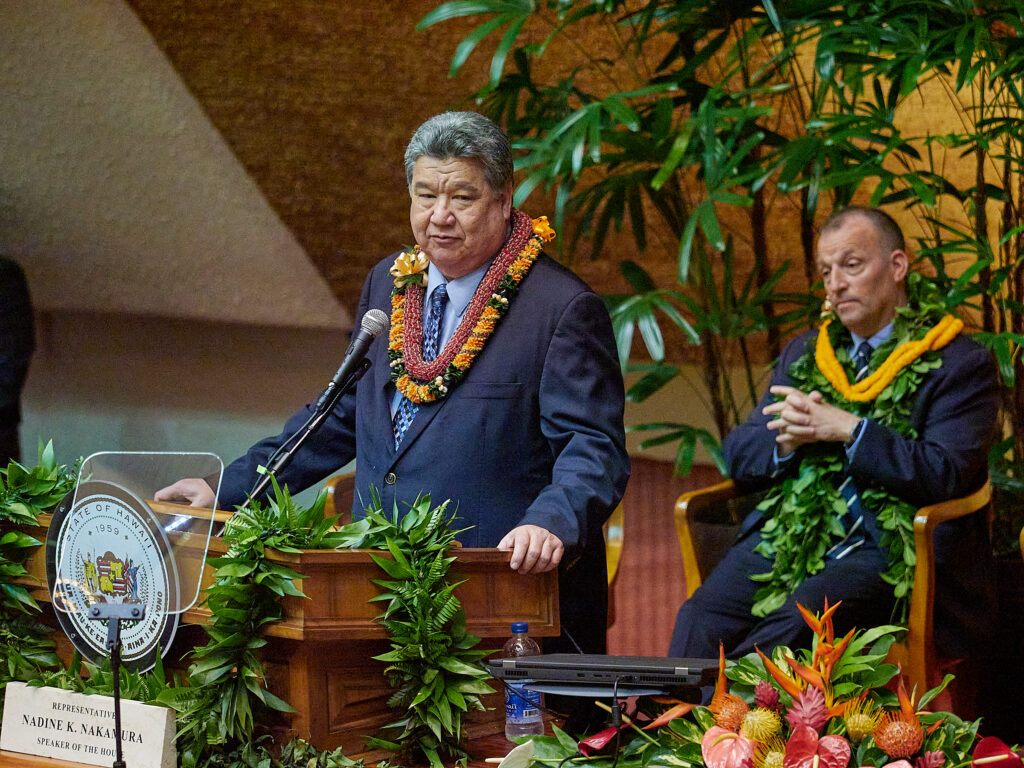
“However, it saddens me that the law-abiding men and women of the Hawaiʻi State Legislature, who are truly serving their communities, and are working on impactful legislation to benefit residents throughout our State are subjected to unfounded and unsubstantiated allegations of ‘rampant corruption’,” she said in her statement.
That Kouchi, the top leader in the Senate, did not respond to multiple phone and email messages from Civil Beat this week is the kind of silence that is deafening, according to government reform advocates.
“They always want to just go back to business as usual because that is easiest for them,” Castillo said.
Sen. Brenton Awa, one of only three Republicans in the Senate, said lawmakers should hold themselves to a higher moral standard. To those who fail to do so, he said, shame on them.
“Whether it’s in their lifetime or not, they’ll be found out, and they’ll be judged,” he said. “I know today it might feel good taking something for yourself, but when your life is over and your kids and grandkids have to live with your name — I hope they think about that.”