Change of Command for US Army Garrison Hawaii
Col. Tom Barrett made a point of sharing COVID-19 numbers with the public in Hawaii — until the Pentagon told him to stop.
Col. Tom Barrett has handed over command of U.S. Army Garrison Hawaii after two years in command.
“COVID has made ceremonies like this a little different,” Barrett said Tuesday as he addressed a crowd of soldiers and family members in masks during a ceremony broadcast live on Facebook.
Over the past two years Barrett has dealt with volcanic eruptions, a military housing crisis, modernizing aging facilities and most recently a global pandemic.
Similar to a city manager, the garrison commander is in charge of overseeing operations and services across 22 Army installations on Oahu and Hawaii — including Schofield Barracks, Wheeler Army Airfield, Tripler Army Medical Center, Fort Shafter, Fort DeRussy and others.
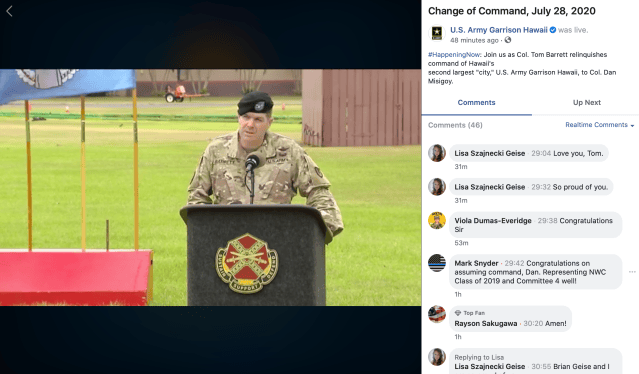
After the World Health Organization declared COVID-19 a pandemic in March, Barrett told community members during a digital town hall on Facebook Live that he planned to “continue to be as transparent as possible” and “provide the most current number of cases during these community updates.”
Barrett and his staff continued giving updates until orders came down from the Pentagon to stop reporting numbers publicly on the local level. Though the military still shares numbers with Hawaii state officials, civilian officials also don’t disclose how many of the state’s total cases are military.
The Pentagon’s policy of secrecy has put local commanders in an awkward spot as they try to reassure a sometimes skeptical public. The Army has since resumed large-scale training.
Col. Daniel Misigoy, who most recently served as staff officer with the NATO Rapid Deployment Corps in Turkey, will take on the job from Barrett. For Misigoy it’s a return to Hawaii — before his posting at NATO he was assigned to the 25th Infantry Division from 2015 to 2017.
While Barrett is moving on from his post, he won’t be leaving Hawaii. His next assignment is at U.S. Indo-Pacific Command at Camp Smith as its new deputy for strategy and policy.