

Chad Blair: Is Panhandling Free Speech?
In challenge to a Hawaii County law, the ACLU argues solicitation is a First Amendment right.
He was a white man in his late 40s, I’m guessing. His hair was greasy and unkempt, his T-shirt and shorts torn and soiled. I avoided looking at his feet.
I could not avoid him otherwise, however, because he was standing in the grass median next to the left-turn lane where Vineyard Boulevard meets the Pali Highway as it melds into downtown Honolulu.
In his hands he held up a crude message on a piece of cardboard. It read, “Please help. God bless.”
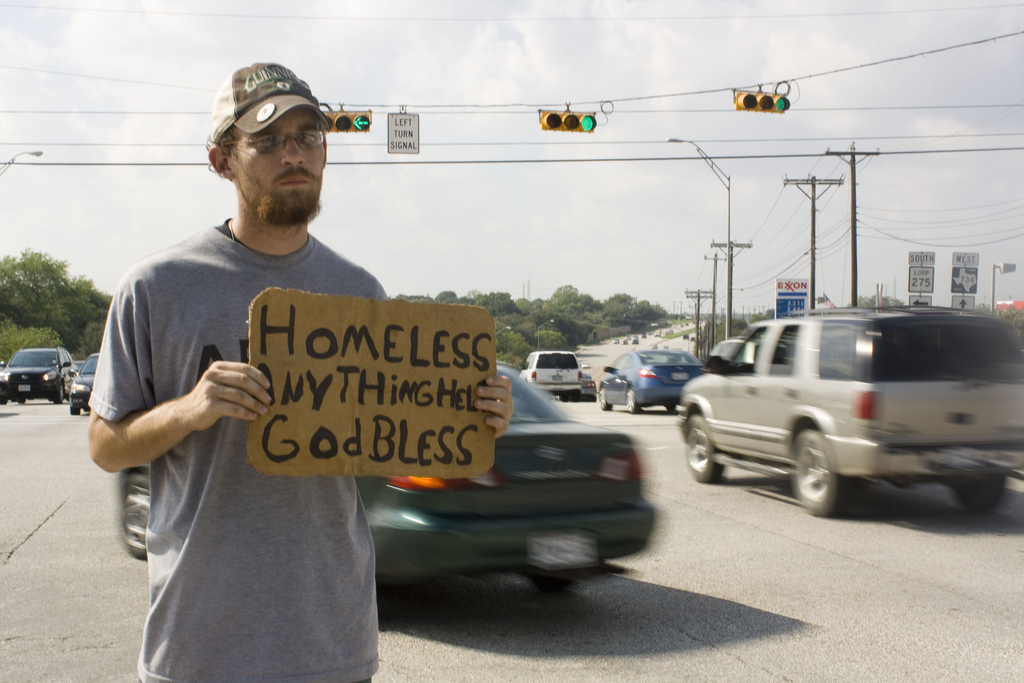
Is this man engaging in a form of protected speech?
Hanlly Sam/flickr.com
It’s been awhile since I regularly saw this man, as I don’t frequent that intersection much anymore.
But there are always men like him around town (and they always seem to be men), with the same worn-down demeanor and sad face, seeking my spare change. The only thing that varies is what’s written on the sign. “Will work for food,” maybe. “Vietnam Veteran.” I never give them money.
Don’t Sit, Don’t Lie, Don’t Relieve Yourself
It’s been a tough month for people who already hit hard times. The Honolulu City Council passed bills last week prohibiting sitting and lying on the sidewalks of Waikiki and using public places on Oahu to relieve oneself. A measure still pending would extend the sit-lie prohibition to other commercial districts.
“People can’t be sent to jail merely for holding a sign by the side of the road.” — ACLU of Hawaii
On Friday, the state Land Board approved a city petition to lease state land for a temporary homeless encampment on Sand Island.
Earlier this year, the Hawaii Legislature extended a ban on urinating and defecating in downtown Honolulu and made it illegal to partially obstruct sidewalks.
A third measure, prohibiting lying down at bus stops, was held.
Another aspect of homelessness, however, has received less attention: flat-out begging for money like the man at the corner of Vineyard and Pali. But that is beginning to change, as Civil Beat reported last week.

Gov. Neil Abercrombie at the corner of South King Street and Ward Avenue just before the primary. ACLU attorneys likened beggars with signs to political candidates waving signs at election time.
PF Bentley/Civil Beat
“Many of the visitors would comment to us that they feel that the streets are not safe,” Helene “Sam” Shenkus, marketing director for the Royal Hawaiian Center, told City Council members at a public hearing. “Many of the parents are troubled that they are having to explain to their children as they watch half-naked people, people who have cardboard signs that are begging for money.”
In a related development, the ACLU of Hawaii filed a lawsuit last week against Hawaii County challenging its panhandling ordinance.
It is on behalf of Justin Guy, a homeless man who in June held a sign saying “Homeless Please Help” while standing to the side of Kaiwi Street in Kailua-Kona.
Big Island cops told Guy that panhandling was illegal, but Guy responded that he had a right to hold a sign by the side of the road. Guy received a citation.
“No person shall solicit in an aggressive manner in any public place.” — Hawaii County Code
In its brief, the ACLU says Hawaii County’s panhandling law violates the First Amendment that guarantees freedom of speech — something that ACLU attorney Dan Gluck says has been upheld by the U.S. Supreme Court.
In Guy’s case, the Fourth Amendment prohibiting unreasonable searches and seizures and the 14th Amendment on equal protection have also been violated, the brief contends. The ACLU is asking the U.S. District Court on the Big Island to invalidate the Hawaii County law, order the county’s police department to stop threatening Guy and to award him damages.
Are Beggars Intimidating?
On Friday, Hawaii County filed its response to the lawsuit. (Both briefs are posted below.)
Attorneys for Corporation Counsel argue that the county’s law is constitutional “and merely places reasonable restrictions on the manner and location of solicitation in order to prevent aggressive and dangerous solicitation practices.” They believe the Supreme Court has recognized that solicitation bans “are content-neutral,” adding, “Government has considerable latitude to regulate conduct, even where the conduct has an expressive component.”
“Not all roadways or sidewalks are deemed public forums.” — Hawaii County
The Big Island law was enacted in 1999 after several solicitation complaints from members of the public who said they felt intimidated, including a County Council member who was an attorney.
“When the Council member left a movie with her two young children, an individual asked for money and then followed her to her car,” the county’s brief explains. “She feared for the safety of herself and her children. The public also felt intimidated and forced to give money to these individuals. There were concerns for the public’s safety raised by individuals, merchants and the police.”
In the June incident involving Justin Guy, the county states that he was impeding traffic and creating a hazard, and that he refused to follow a police officer’s order.
“Not all roadways or sidewalks are deemed public forums,” says Corporation Counsel.
Asked about the county’s response, Gluck said, “They said they are fully entitled to regulate solicitation in the way they have done. We disagree, and we will be filing our response Monday.”
Are Sign-Waving Politicians Beggars?
The sections of the Hawaii County Code cited by the ACLU concern solicitation (section 14-75) and begging in public parks (section 15-20). Section 14-75 lists 12 prohibited acts, including, “No person shall solicit in an aggressive manner in any public place” and “No person shall solicit an operator or other occupant of a motor vehicle while such vehicle is located on any street, for the purpose of performing or offering to perform a service in connection with such vehicle or otherwise soliciting the sale of goods or services.”
Section 15-20 (a) states simply, “Begging is prohibited.”
In its complaint, the ACLU said Guy’s actions do not appear to be applicable under the code’s solicitation violation, and that both laws are unconstitutional. In an interesting analogy, ACLU attorneys likened beggars with signs to political candidates waving signs at election time.
“The courts have consistently held that the homeless have the same free speech rights as everyone else.” — ACLU of Hawaii
“Laws limiting free expression often wind up being used to stop speech with which the government disagrees,” said Matthew Winter, an attorney with Davis Levin Livingston, in the ACLU’s press release announcing its complaint. “Here, the law allows political candidates to hold signs by the side of the road, but prohibits the poor from holding signs asking for help.”
Winter added, “The First Amendment does not allow the government to pick and choose which messages it likes and which ones it will allow in public spaces. That is why we need this law off the books.”
Gluck states in the press release, “The courts have consistently held that the homeless have the same free speech rights as everyone else. People can’t be sent to jail merely for holding a sign by the side of the road.”

Soliciting donations for mission work — do the same principles apply?
Chad Blair/Civil Beat
Gluck told Civil Beat he didn’t think Honolulu had a similar ordinance regarding begging and said he did not know whether other island counties have similar restrictions on begging.
My search of the Maui County Charter, the Kauai County Charter, the Revised Charter of Honolulu and a 2002-2012 supplement did not turn up results for “begging” or “panhandling,” nor definitions of “solicitation” as found in the Hawaii County Code. (I did not search for “alms for the poor.”)
The June 2014 incident involving Guy and Hawaii County cops, which was dismissed in August, is not the first. The ACLU says there have been “multiple occasions,” including one this spring near the intersection of Luhia and Kaiwi streets in Kailua-Kona.
Playing the Guitar for Tips
In 2012, Guy was sitting on a concrete wall near the Hulihee Palace in Alii Drive, between the sidewalk and the beach. He was playing guitar and had his guitar case open on the sidewalk with a sign that read, “Tips.”
A police officer told Guy he could not display any sign, even one that said “Donations.” Guy gave up playing the guitar for cash.
But here is how the county views Guy’s musical ambitions: “Plaintiff wants to be professional musician. In his quest for stardom, Plaintiff practices his music ‘all the time’. He chose not to have a job because it takes times away from his practicing. As a result, except for the times he stays with his girlfriend, he is homeless.”
“The First Amendment does not guarantee the right to communicate one’s views at all times and places or in any manner that may be desired.” — Hawaii County
The county also notes that the ACLU waited 15 years to complain about its ordinance.
What does Guy want? “Plaintiff Guy would like to stand on a public sidewalk, or along public roadways, and hold a sign telling the public that he is homeless and that he would like their help,” the ACLU’s brief explains. “He would like people to know how difficult it is to be homeless.”
What does the county think about that? “The First Amendment does not guarantee the right to communicate one’s views at all times and places or in any manner that may be desired.”
Another Roadside Distraction
After I finished a draft of this column, I drove along Beretania Street and stopped at a red light at McCully Street. A pleasant young woman with a nice smile extended a basket to me.
I rolled down the window, thinking it was the Hawaii Food Bank or kids raising money for some cause. I put a dollar in the basket and asked if I could take her picture. She said yes, I snapped the shot, and then she handed me a flyer. The light turned green and I drove off.
At the next red light, I looked at the flyer. It was a promotion for International Campus Ministries. “This voucher entitles you to receive a FREE Bible!!!” the flyer explained — as long as I redeemed it at a Sunday service in Manoa. My reaction? God bless the First Amendment.

