

Two weeks of roiling controversy at the Honolulu Police Department calmed a bit Wednesday with word that Maj. Ryan Borges had refused his controversial promotion to assistant police chief, and that HPD Chief Louis Kealoha would now look for a different senior leader.
But the controversy over Kealoha’s bid to promote the police supervisor with a history of domestic abuse and restraining orders isn’t over — nor is the need for Mayor Kirk Caldwell to address the broader problems this event exposes both with the department and the Honolulu Police Commission.
In a short-lived bid to salvage his promotion, Borges mobilized community leaders to write letters of support for him. That move may have violated HPD’s standards of conduct, which forbid officers from seeking “the influence or intervention of any organization or persons outside the department for purposes of personal preferment, advantage or transfer.”
The internal affairs investigation of that effort shouldn’t end with Borges’ announcement, given that it included letters from former lieutenant governor and possible Honolulu mayoral candidate James “Duke” Aiona, Honolulu City Council Chair Ernie Martin, Honolulu Fire Department Chief Manuel P. Neves and Native Hawaiian activist Walter Ritte, among others.
Police leaders not only didn’t distance the department from Borges’ efforts to leverage external influence over an internal matter, they surprisingly featured that work prominently on social media and on the department’s website.
“HPD has received dozens of letters in support of Major Ryan Borges’ promotion to the rank of assistant chief,” brags a Feb. 1 post prominently featuring the HPD seal on the department’s official Facebook wall, which is followed by more than 31,000 users. The post links to 19 pages of letters on Google Docs and includes multiple hashtags to promote interest and searchability.
Caldwell’s Welcome Intervention
That Kealoha tried quietly to make what he undoubtedly knew would be a controversial appointment to begin with was bad enough. (Department insiders, recognizing the problem, leaked word to the media of Borges’ promotion.) Lawmakers and domestic violence advocates, among others, raised serious concerns about it.
But it appears Keahola likely also would have let the appointment stand, if not for the unexpected but welcome intervention of Caldwell.
The mayor met on Tuesday with Kealoha, whom Caldwell has been pressing in recent weeks to more aggressively handle fallout from an FBI investigation into alleged improprieties by the chief himself.
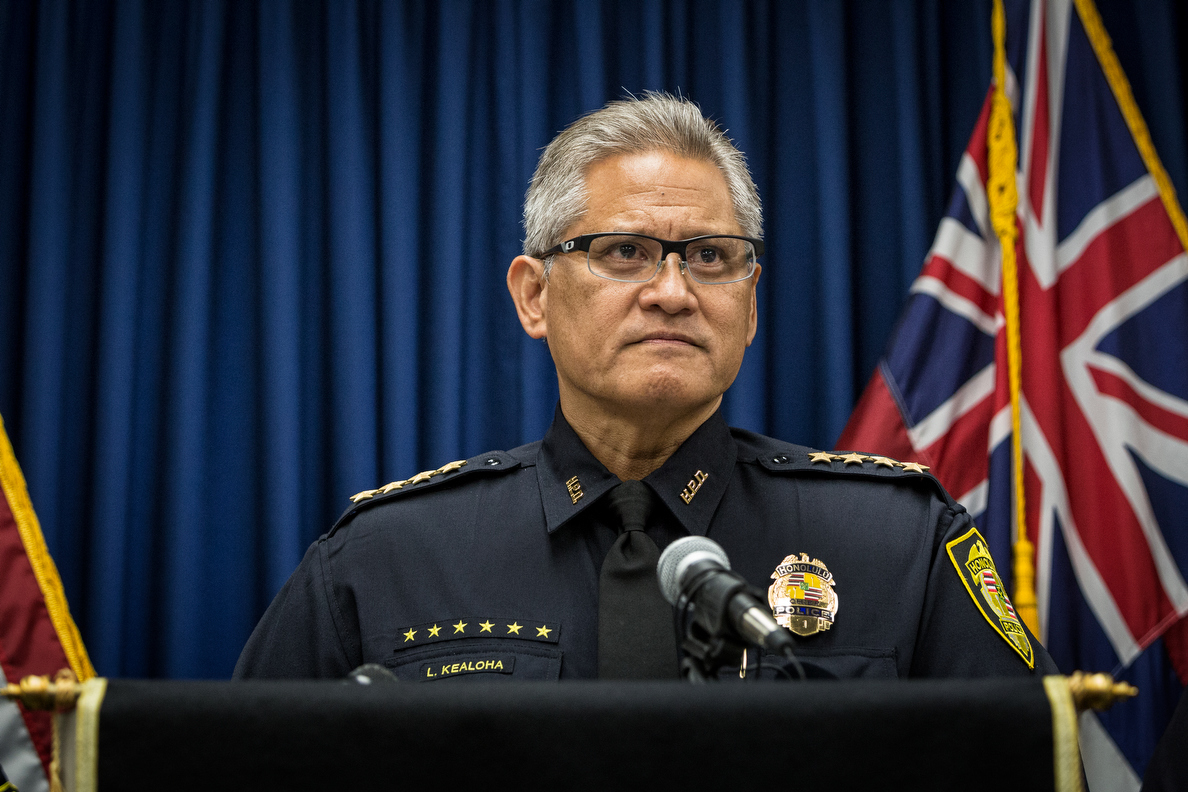
“Mayor Caldwell firmly believes that there is no place for domestic violence in our community and in the police force,” said a Caldwell spokesman after the meeting. “He met with the police chief today to discuss the decision to promote Major Borges, expressing his strong concerns and requesting additional information about past incidents.”
The mayor’s intervention comes after the Honolulu Police Commission has shown almost no public interest either in Kealoha’s legal troubles, continuing misconduct issues within the department or the Borges promotion.
While the police department ultimately falls under the mayor’s administration, it’s the police commission that ought to be active here. Its seven members, appointed by the mayor, are responsible for hiring and firing the police chief, for reviewing rules and regulations concerning the department and for investigating misconduct complaints.
Yet, the commission chair claimed last fall there was no evidence Kealoha was even under FBI investigation, despite numerous media reports confirming the inquiry and even naming the special prosecutor who is heading it. Just a few months prior, with several police misconduct cases in the news and word already spreading of federal inquiries into the department and the chief, the commission wrapped up Kealoha’s third annual review by saying his performance “exceeded expectations.”
Over the past two weeks, with controversy swirling around Borges’ promotion, the commission has been silent as a stone. In the absence of anyone seeming to police the police on this matter, HPD leadership already seems to be trying to undermine its own internal affairs investigation.
How can any investigation have credibility when the deputy chief pre-empts its work with a public statement saying no rules were broken and that the personal preferment prohibition doesn’t apply?
In a written statement released Tuesday, Deputy Police Chief Marie McCauley said HPD’s Professional Standards Office will investigate Borges’ request for letters of support. But she also declared that it doesn’t appear any rule was broken.
Because Borges’ letter to community leaders was sent out after the decision to promote him had been made, the departmental standard prohibiting personal preferment “would not apply,” McCauley said.
But Borges’ promotion had only been announced internally; he wasn’t due to start in the position until Feb. 28, and the letter he sent to community leaders clearly was intended to leverage “the influence or intervention of any organization or persons outside the department for purposes of personal preferment, advantage or transfer.” If not, why ask for the letters to begin with?
Second, how can any internal investigation have credibility when the deputy chief pre-empts it with a public statement saying no rules were broken and that the personal-preferment prohibition doesn’t apply? Shouldn’t the police commission be concerned?
Of course it should.
If he isn’t already, Caldwell ought to be pressuring the commission, just as he is pressuring Kealoha, to do its job, while he simultaneously looks for new commission members.
Until he finds them, the mayor should continue his stepped-up involvement in the department’s affairs. That should include joining the calls for Kealoha to step aside and moving the Borges investigation from HPD’s internal affairs office, where it is already compromised, to the police commission.
Without such action, the cloud of suspicion that hangs over Honolulu’s Police Department will only grow darker.