Reader Rep: Stand Up To Stop Police Chief-Style Deals
Unless the public fights for transparency along with journalists the important public business will continue to be done in secret.
Since you’re paying the bills, maybe you also should be demanding – as public interest attorneys have been – that public business be done in public view. The world is turning dark right now, scarily opaque from an open-society perspective, and democracy will dissolve absent an informed, engaged and active citizenry.
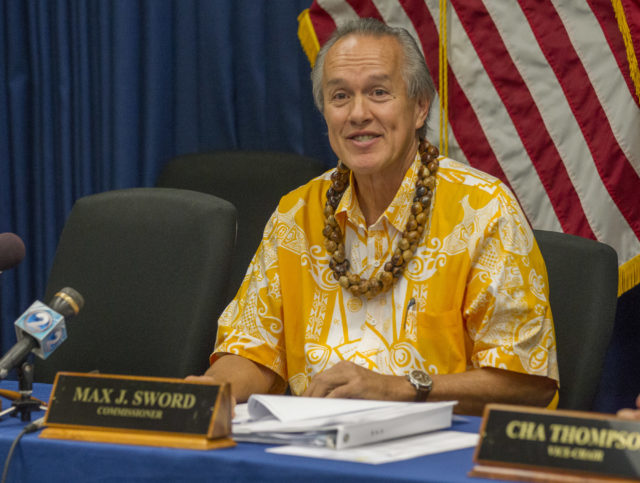
Yet the Honolulu Police Commission, led by chairman Max Sword, kept us, as the commission’s letter to the City Council recently put it, “in a cloud of uncertainty” while it secretly decided the fate of Police Chief Louis Kealoha. As reader/commenter “JackBurton” noted, “ironic, don’t ya think …?”
If you would rather live in an oligarchy, aristocracy, theocracy – or some alternate system in which other people constantly tell you what to do and you have to obey – there are many options around the world for you to consider. You can be subservient chattel in many places.
You are blessed in this country, though, to be remarkably free to participate as much as you like in the grandest democracy experiment in world history. If you don’t do your part, don’t complain, not even for one second.
My advice: Take this opportunity to be an engaged American citizen at least as seriously as you take your annual tax bill.
Because, at the minimum, you are going to be paying Kealoha a lot of money for the rest of his life, at least $150,000 a year, despite the fact that the department under his leadership is in shambles, and he will be “retiring” under federal investigation for public corruption and abuse of power. So you get the bill for this lemon and don’t even get to know what you bought.
Kealoha’s done such a terrific-terrible job that the Police Commission also threw in a $250,000 bonus payment, to help him go away. Oh, he has to pay it back, if he gets convicted of a felony within seven years. But this is the same state that couldn’t convict Big Island Mayor Billy Kenoi of misusing a public credit card, even though he apologized for doing just that on the local TV news. So, in all likelihood, the public is paying for Kealoha’s defense fund so he doesn’t get convicted of a felony.
This shady way of doing public business has become a pandemic, in Hawaii and beyond.
I bet if this was your money (wait, it is!), and you had control of the purse strings (you could have, if you had asserted enough public pressure), you might instead have given Kealoha a small cardboard box and had a security guard watch him carefully, as he cleaned out his desk, so he didn’t also make off with the stapler.
In Bizarro World, though, your elected representatives on the Honolulu City Council were pushed down and had sand kicked into their eyeballs by the appointed and all-volunteer Police Commission members when the council folks meekly asked to see the Kealoha settlement before it was finalized.
The council – again, you elected them, and they work for you – initially asked for a few minor details, like who in the world is going to pay for this ridiculous settlement (You!). The appointees on the Police Commission, led by evasive chairman Sword, not only wouldn’t reveal that kind of information, but Sword also told the council members earlier this month that they would find out about it when everyone else does.
Shouldn’t such decisions about the shenanigans of a top law official (the people we hire and train and give the cars and buildings and guns to, so they protect us), be aired publicly? Not according to Sword, illustrating yet another local abuse of the state’s Sunshine Law, which dictates that all but the most sensitive of decisions in Hawaii be made in full public view.
The law is straightforward and simple, including that: “the discussions, deliberations, decisions, and action of governmental agencies – shall be conducted as openly as possible.” Under a “personnel issue” exemption, Sword closed all meetings on the Kealoha matter.
While the law states the commission “may” close the meeting to the public, under various exceptions, and Sword said it is more appropriate to work outside of public view, every member of the public could have been writing and calling Sword to ask, “Why?”

Kealoha is a prominent public figure, in a position of power, and he has been charged with abusing that power. Let his case be heard, not hidden by the people who most benefit from it going away quickly. As reader/commenter Frank DeGiacomo plainly stated: “The Sunshine law allows for an open hearing, they just are choosing to close it …”
This shady way of doing public business has become a pandemic, in Hawaii and beyond. On the national level, we have a new president so hostile to ethics and press freedoms that the incoming White House chief of staff, Reince Priebus, remarked recently that the Office of Government Ethics ought to “be careful” about looking too closely into public concerns about ethical violations.
Huh? Seems like that is exactly what it is supposed to be doing. The incredulous director of the nonpartisan office, Walter Shaub, Jr., has remarked, for example: “I don’t think divestiture is too high a price to pay to be the President of the United States of America.”
In this same sort of corporate-raider spirit, the Hawaii Tourism Authority has been spending about $100 million in taxpayer funds a year in an increasingly secretive manner. Since president and CEO George Szigeti took over in 2015, according to reporting by the Honolulu Star-Advertiser’s Allison Schaefers, he has more than doubled the number of closed-door executive sessions, arguing that he is just following common business practices.
Szigeti, who was appointed, not only keeps out journalists, but he also brazenly rebuffs elected public officials who want to know what’s going on as well, including Sen. Glenn Wakai, chairman of the state Senate’s Tourism and International Affairs Committee who, like a lot of us, has a pending open-records request slogging through the under-funded Office of Information Practices system.
What Sword and Preibus and Szigeti and many others like them clearly don’t seem to understand is that yes, they are doing business, but it is public business. We are the de facto shareholders in these organizations, funded by our taxes. Without us, there is no them. Since we are the stakeholders (not the other way around), we deserve to know what’s going on with our investments. Transparency isn’t some sort of add-on frill.
Journalists can write columns of outrage every day about this topic, but unless enough members of the public fight for transparency, too, our view of public business will get smaller and smaller until the pinhole we can see through only shows some pre-approved slides from the public-relations/marketing/advertising department.