

Corruption Defendant Dennis Mitsunaga Jailed For Alleged Witness Tampering For Duration Of Trial
The 82-year-old businessman tried to get a trial witness to change his upcoming testimony, prosecutors say.
A Honolulu businessman on trial for corruption spent the weekend in jail and will continue to be detained following new allegations that he tampered with a witness soon to take the stand in his case.
Dennis Mitsunaga is currently facing federal charges that he conspired with his associates to bribe former Honolulu prosecutor Keith Kaneshiro. Prosecutors say Mitsunaga’s team directed nearly $50,000 in campaign contributions to Kaneshiro so the city prosecutor would pursue a meritless theft case against a former Mitsunaga employee, Laurel Mau.
Now, the businessman is accused of trying to change the testimony of an upcoming witness, his longtime friend and former Honolulu police officer Rudy Alivado. Mitsunaga was arrested on Friday for alleged obstruction of justice and witness tampering.
He spent the weekend at the Federal Detention Center in Honolulu and will remain there for the duration of the trial, Magistrate Judge Nathanael Cousins ordered on Monday.
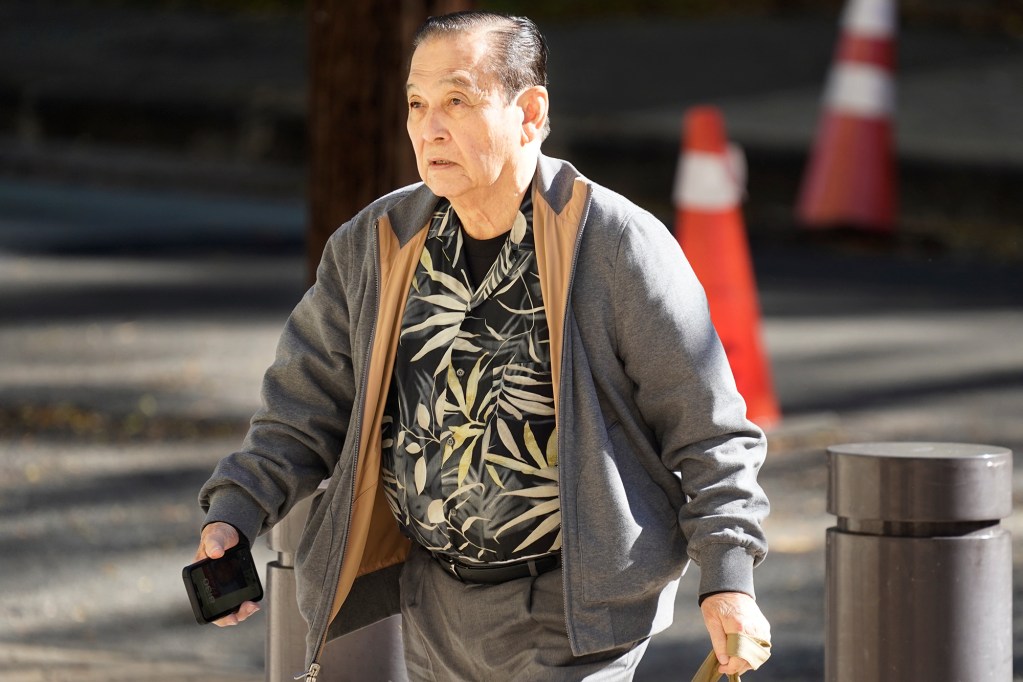
Mitsunaga is accused of taking action to “corrupt this trial, right in the middle of it,” Cousins said from the bench.
Mitsunaga’s attorney Nina Marino did not deny the allegations at the detention hearing or in a filing with the court. She argued that her client’s age and health conditions warrant house arrest, but the judge was not persuaded.
Now, prosecutors want the jury to know about the new allegations.
“Mitsunaga’s tampering with Alivado is relevant and admissible because it shows his consciousness of guilt of the underlying crimes,” prosecutors wrote in a court motion. “This is direct evidence of the conspiracy.”
A hearing on the matter is set for Tuesday morning. Already, Mitsunaga’s five co-defendants are asking the court to exclude the evidence from the trial so that the jury does not see them as guilty by association with Mitsunaga.
The allegations are laid out in court records. Mitsunaga — who founded the engineering firm Mitsunaga & Associates Inc. — met with a firm employee with the initials “J.K.” on April 1, according to federal prosecutors. J.K. is also a witness in the case, federal prosecutor Andrew Chiang said in court.
There, Mitsunaga gave J.K. two transcripts of Alivado’s remarks, one from a 2014 civil lawsuit between Mitsunaga and Mau and another from grand jury testimony in the current criminal case, prosecutors said.
The grand jury testimony was underlined, highlighting references Alivado made to the Mitsunaga firm’s then-attorney — Sheri Tanaka, now one of Mitsunaga’s co-defendants — and Vernon Branco, the investigator for the city prosecutor’s office whose declaration was used to charge Mau with felonies.
In civil lawsuit testimony, Alivado claimed that when he paid Mau for work she performed at his Kaneohe property, he believed he was paying her employer, the Mitsunaga firm. This claim later became part of the theft case Kaneshiro’s office brought against Mau, naming Alivado as a victim.
But later, at the 2021 grand jury, Alivado stated that Mau had not stolen from him or the firm, and he was surprised to be named as a victim in the case.
On April 1, Mitsunaga “ordered J.K. to hand Alivado a transcript annotated with underlines in order to get him to alter what Alivado will do when he takes the stand.”
Under the apparent guise of taking photos of Alivado’s farm, J.K. paid Alivado a visit on April 2. Through J.K. as an intermediary, Mitsunaga “threatened and intimidated Alivado” to plead the Fifth Amendment, exercising the right against self-incrimination, when he is called as a witness in the ongoing trial.
On April 6 and 7, Alivado told federal officials what had occurred, according to prosecutors. In those conversations, Alivado also revealed that he lied under oath during the 2014 civil case because Tanaka had coached him to.
“Specifically, Tanaka coached Alivado to falsely testify that when he paid Mau for work she had performed on his property, he believed he was paying MAI,” prosecutors said, using the abbreviation for Mitsunaga’ s firm.
“Alivado has recently confirmed to the United States that he intended his payment to go directly to Mau for her good work.”
Alivado has been a friend of Mitsunaga’s since high school, and the two men have maintained a longtime business partnership in real estate, according to prosecutors. Alivado told the feds he was willing to lie for his friend because of their longstanding relationship and because it was a civil case at the time, not a criminal matter.
For Mitsunaga to “create a ruse” to change his friend’s testimony violates a court order prohibiting him from contacting witnesses and provides probable cause of new crimes, the feds say.
Obstruction of justice and witness tampering carry penalties of up to 10 years and 20 years in prison, respectively. But because the new alleged felonies occurred on pretrial release, they carry an additional penalty of up to 10 years in prison, Cousins said.
As of now though, Mitsunaga has not been indicted for these new alleged crimes.
In a motion to the court filed on Sunday, which is partially redacted, prosecutors ask the court’s permission to make the jury aware of the situation.
Alivado and J.K. are prepared to testify to the alleged witness-tampering effort, which is corroborated by text messages, phone records and J.K.’s contemporaneous notes from the meeting with Mitsunaga, prosecutors said in their filing.
In one text message, Mitsunaga referred to J.K. as his “ninja,” Chiang said.
“There are ninjas around him who are willing to do his work, including break the law,” the prosecutor said.
In a partially redacted filing and in court, Mitsunaga’s attorney Nina Marino didn’t dispute the government’s claims, though she did deny threats were made and said the “ninja” reference was not something Mitsunaga came up with.
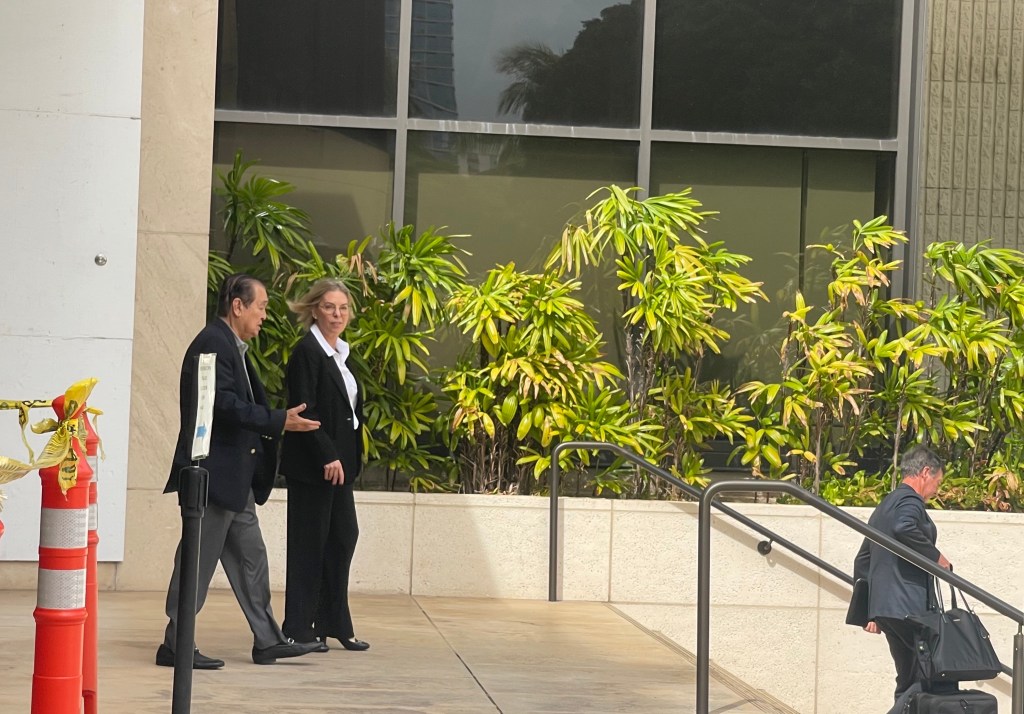
Marino opposed Mitsunaga’s continued detention. She said that her client is 82 years old, has led an “upstanding life” and has not violated the terms of his bond since his indictment in 2022.
“In nearly two years, Mr. Mitsunaga has not had a single violation until now,” she said.
Marino noted that Mitsunaga suffers from multiple health conditions that could be worsened if he is incarcerated. She proposed several increased restrictions on her client that fall short of pretrial detention.
Mitsunaga and his wife have a home worth $2.4 million that could be used as collateral for a bond, she said. And Mitsunaga could be subjected to house arrest with an ankle monitor and restrictions on his in-person and phone communications that limit him to conversations with his attorneys and family members. Mitsunaga is even willing to pay for a security guard to make reports of who comes and goes from his house, Marino said.
In a response, prosecutors said that Mitsunaga is trying to attribute the situation, at least in part, to some unspecified mental health issue. To the contrary, the feds say Mitsunaga “exercised cunning and guile” to evade the court’s no-contact order.
“Mitsunaga’s conduct was not a mental blunder — it was a calculated attempt to bury the truth about
Mitsunaga’s past criminal conduct and destroy the integrity of this trial,” prosecutors said. “Mitsunaga claims his witness tampering was an isolated incident. Even if true, it would not lessen the seriousness of Mitsunaga’s actions.”
They continued: “His actions towards Alivado — in the middle of this trial — convey desperation.”
In the end, Cousins said there is a legal presumption that a criminal defendant will be detained if they commit new crimes while on pretrial release.
“I find the defense has not rebutted the presumption,” he said.

