Catherine Toth Fox: Closed Since 1979, Waikīkī Natatorium May Be Restored
The memorial to World War I veterans is one of only a few ocean water natatoriums left in the world.
January 21, 2025 · 5 min read


About the Author

Mo Radke grew up in Seattle, joined the U.S. Navy in 1976 and wound up stationed in Hawaiʻi in 1992 — 16 years after the Waikīkī War Memorial Natatorium was declared unsafe and closed to the public.

He didn’t know much about it until 2007, when his wife, Jill, who was then director of development at the Historic Hawaiʻi Foundation, told him the memorial was going to be torn down.
“I came home from work one day and my wife was crying,” Radke said. “I asked her, ʻWhat’s the matter?’ And she kept saying, ‘It’s so unfair, it’s so unfair.’”
So Radke did some research.
He learned that the Olympic-size saltwater pool and bleachers were built in 1927 to honor the 10,000 sailors, soldiers and volunteers from Hawaiʻi who served in World War I. He learned about its architectural importance, designed by renowned architect Lewis Hobart — think San Francisco’s Grace Cathedral and Macy’s Union Square — with a grand Beaux-Arts archway leading to an open-water basin.
He learned that for decades it served as the epicenter of swimming and water sports in Hawaiʻi, hosting celebrity swimmers such as Esther Williams, Buster Crabbe, Johnny Weissmuller and 34 members of the International Swimming Hall of Fame, that generations of local families learned to swim here, that legendary Olympic gold medalist and surfing ambassador Duke Kahanamoku dove into the pool to take the first ceremonial swim.
He learned that it’s one of only a few ocean water natatoriums left in the world, and the only one of its kind in the U.S. In 1995 it earned a spot on the National Trust’s list of America’s 11 Most Endangered Historic Places.
It fell into disrepair and was eventually closed in 1979.
“The more research I did,” Radke said, “the more upset I got.”
He joined the Friends of the Natatorium, a nonprofit that started in 1986 to advocate for the preservation and restoration of the Waikīkī War Memorial Natatorium. He’s now its president.
For decades there have been conflicting plans for what to do with the pool. Some wanted it restored; others wanted it torn down.

After nearly 40 years of the Friends of the Natatorium advocating for its preservation, the city is finally moving forward with plans to restore and reopen the pool.
Later this year the city will reveal the final design, which will take into consideration potential sea level rise. The total cost of the project will be at least $30 million, most of it to be raised by the Friends of the Natatorium.
The goal is to reopen it to the public — and ideally, to have something to unveil in 2027 to mark the natatorium’s centennial.
“The administration, in no way, is in the business of tearing down war memorials.”
Andy Sugg, chief of staff to Honolulu’s mayor
“We want the natatorium to be functional again,” said Andy Sugg, Honolulu Mayor Rick Blangiardi’s chief of staff. “There are absolutely no plans to tear it down.”
One of the most compelling reasons for Radke to advocate for the natatorium’s preservation is that it’s a memorial for veterans who served during World War I. It also honors the 102 Hawaiʻi residents who died during the war.
Radke, himself a 30-year Navy veteran, remembered looking at the pool through the fence and feeling angry about how dilapidated the memorial had become.
“I was still an active-duty service member and I felt insulted,” he said. “It doesn’t matter if you served in World War I or Vietnam or Korea. If you come to look at that site and you understand what it represents, it’s a shot to the heart.”
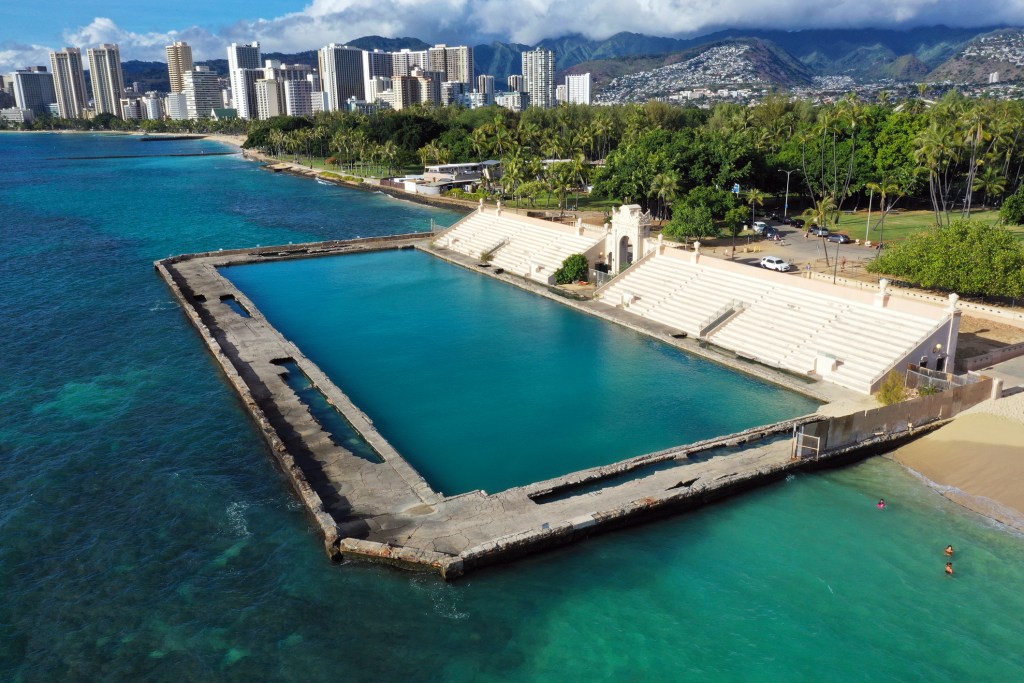
Sugg said the city fully acknowledges the importance of the memorial, that the natatorium is more than just a beautiful saltwater swimming pool.
“First of all, it’s a memorial and the administration, in no way, is in the business of tearing down war memorials,” he said.
I don’t have memories of floating in the pool or watching a swim meet from the bleachers because I was only 4 years old when it closed.
But I can get behind the idea of preserving something historic, something so meaningful to people, something that honors wartime service and lives lost. Razing it would be akin to dismantling the terraced granite pedestals in downtown Honolulu that honor Hawaiʻi folks who died in the Korean and Vietnam wars, or tearing down the white obelisk at Haleʻiwa Beach Park that pays homage to area veterans who died in World War II and the Korean and Vietnam wars. That shouldn’t happen.
The Waikīkī War Memorial Natatorium was meant to be a living memorial — a place where people could gather and enjoy. Solemn, sure, but vibrant and active, too.
“When I imagine what it would look like, I see families having picnics, folks talking story and swimming,” Radke said. “Imagine going to the natatorium and watching the sunset. It could be one of the greatest gathering places we have left on Oʻahu.”
 Sign up for our FREE morning newsletter and face each day more informed.
Read this next:

Local reporting when you need it most
Support timely, accurate, independent journalism.
Honolulu Civil Beat is a nonprofit organization, and your donation helps us produce local reporting that serves all of Hawaii.
ContributeAbout the Author