

Honolulu Officials Who Arranged Illegal Kealoha Payout Agree To Pay Up
One of the last chapters of Honolulu’s infamous Kealoha scandal has come to an end.
Three former county officials who improperly arranged for disgraced police chief Louis Kealoha to get a $250,000 retirement payout — and faced felony conspiracy charges for doing so — concluded their years-long legal battle on Tuesday.
Part of their punishment: Paying back the $250,000.
Former Honolulu Corporation Counsel Donna Leong and former Police Commission chair Max Sword both pleaded guilty in federal court to misdemeanor offenses, charges that were downgraded from felonies under plea deals with prosecutors.
Leong and Sword admitted to conspiring in 2016 to pay Kealoha, who was on the brink of a corruption indictment at the time, so that he would retire early. They arranged the deal in secret and intentionally sidestepped the Honolulu City Council. City lawmakers at the time were less than enthusiastic about giving taxpayer dollars to a chief who was about to be criminally prosecuted.
According to their plea deals, Leong and Sword will each serve one year of supervised release and pay $100,000 in restitution to the county.
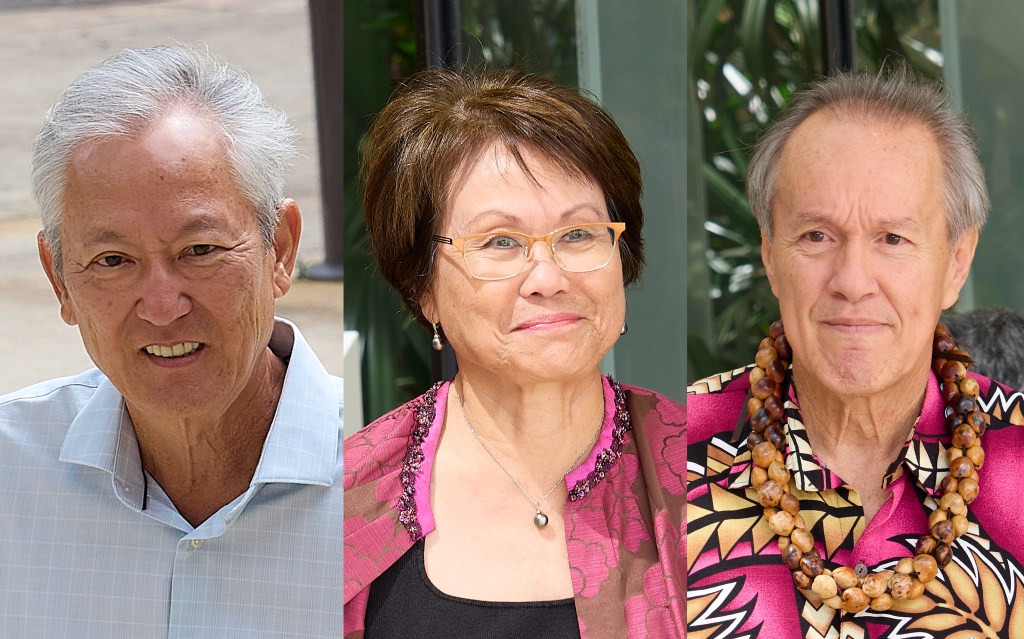
Former Managing Director Roy Amemiya accepted responsibility for helping to arrange the Kealoha payment, but a deal with the San Diego U.S. Attorney’s office will allow his case to be dismissed. His deferred prosecution agreement requires him to serve two years of supervised release, perform community service and pay $50,000 in restitution.
Kealoha was convicted in 2019 of using his position to frame an innocent man. His retirement deal stipulated that if he were convicted of a crime in the years following the agreement, he would pay the money back, but he has not done so and is currently in federal prison.
During the sentencing hearing on Tuesday, U.S. District Court Judge Leslie Kobayashi said Leong and Sword decided Kealoha had to go, “perhaps with the mindset that the ends justified the means.”
“In doing so, you held yourself above the law and acted with arrogance and complete disregard for the law and separation of power between the executive branch and the legislative branch,” the judge said.
Leong was the “leader” in the arrangement, Kobayashi said, and used her “special skill” as an attorney to convince others that the deal was legal, even though it wasn’t.
However, Kobayashi also considered that Leong did not personally profit from the deal, which she called a “truly misguided” attempt to save the city from harm.
In an emotional address to the court, Sword said the officials’ actions were a well-intentioned attempt to get the city out from under the “dark cloud” of Kealoha’s misconduct. Firing Kealoha for cause could have embroiled the city in a lengthy and expensive lawsuit, Sword said, while waiting for Kealoha’s criminal trial to play out could’ve taken years. At the time, Kealoha was on administrative leave but still collecting a paycheck.
However, all the righteous reasons in the world don’t excuse improper conduct, Sword said, noting it was a mistake not to bring the matter to the City Council.
“I was wrong for sacrificing transparency for expediency,” Sword told reporters after the hearing.
The judge said the sentences serve as a just punishment which she hopes will deter others from going down the wrong path.
Outside the courthouse, Amemiya said his deal with prosecutors will allow him to restore his reputation.
“While my attorneys and I strongly believe that going to trial would’ve resulted in a not-guilty verdict, having the opportunity to have all charges dismissed as if they never were brought weighed heavily in my decision to accept the government’s proposal,” he said.

Leong’s attorney Tommy Otake said that it’s unfortunate the trio was prosecuted for “just trying to do their jobs.”
“They were trying to remove Chief Kealoha quickly and permanently without lengthy litigation that would’ve cost the city a lot more than $250,000 and would’ve delayed Kealoha’s removal,” Otake said. “There was no greed, no self interest, no self benefit to any of them by doing this.”
The resolution of the case marks the end of the federal investigation led by San Diego-based Assistant U.S. Attorney Michael Wheat that captured the island’s attention for a decade. After putting Kealoha and his wife in prison, Wheat’s team put former Honolulu prosecutor Keith Kaneshiro and some of his campaign donors on trial for bribery last year; that case ended in an acquittal. Wheat retired in December.
In all the years the Kealoha saga has played out, one question has remained unanswered: What involvement, if any, did then-Mayor Kirk Caldwell have in Kealoha’s retirement payout?
Caldwell, who appointed all three defendants, has refused to answer the question, which was most recently posed to him last month.
Civil Beat asked Leong, Sword and Amemiya outside the court on Tuesday, but they remained silent as their attorneys declared their clients wouldn’t be answering any questions.

