

Seen These Oʻahu Donation Sites? Gifts Don’t Go Where You Think
A corporate giant’s eye-catching collection bins pay charities pennies for pounds of donated goods, drawing scrutiny in Hawaiʻi and across the U.S.
You might think you’re donating to charity when you drop off that old lamp, toaster or pair of jeans at one of the GreenDrop trailers popping up all over Oʻahu.
After all, the donation sites are plastered with the distinctive logos of the American Red Cross or other charities. “CHARITABLE DONATIONS,” bold letters say. “Donate here.”
But GreenDrop is not a charity.
It’s actually an arm of a for-profit, publicly traded, multinational thrift store operator with $1.5 billion in net sales and a chief executive officer who made $10.1 million in 2023, the most recent year available.
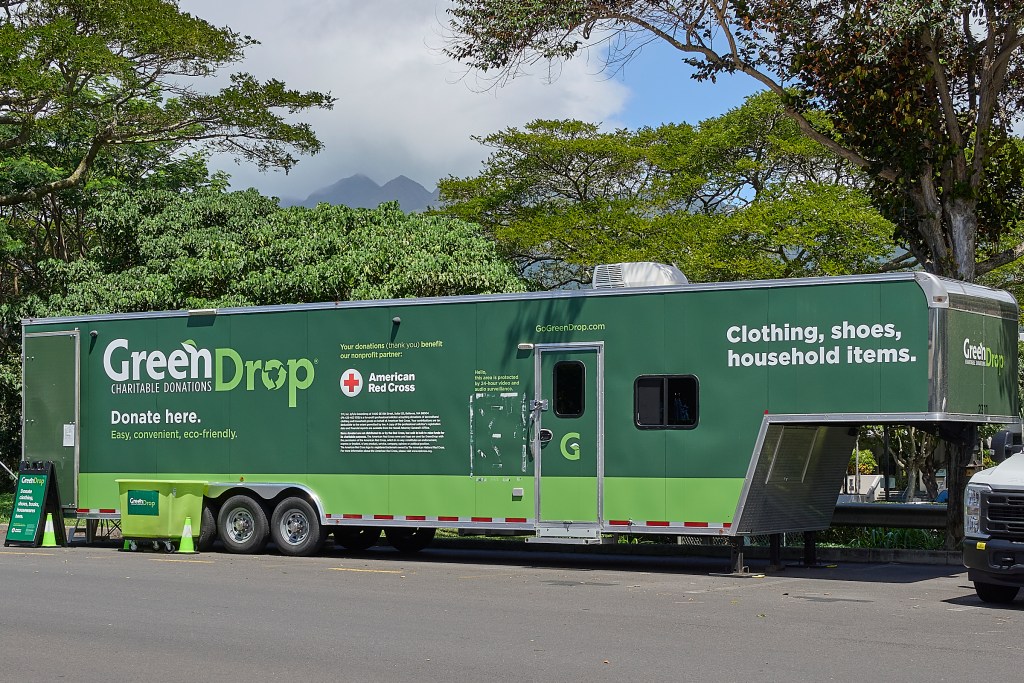
While GreenDrop donates some money from merchandise it collects to the Red Cross and other charities, the donations amount to a minuscule 2 to 5 cents per pound of goods collected — meaning an item that sells for several dollars at one of GreenDrop’s sister Savers stores might spin off mere pennies for the charity.
The GreenDrop collection centers are no doubt a convenience, typically located at popular shopping centers. Their trailers are bigger and inviting. Hawaiʻi law allows fundraising solicitors like GreenDrop to raise money for charities and take a piece of the action.
But GreenDrop leaves the profit split off of the disclaimers placed on the donation drop boxes in fine print, and its required filings with the state Attorney General’s office are murky when it comes to showing how much of the value of the public’s donations GreenDrop keeps.
The GreenDrop collection bins, which first showed up in Hawaiʻi in 2023, are squeezing true charitable thrift stores.
Mary Monohon, president of the board of the Assistance League of Hawaiʻi, which funds services for local women and children through the sale of donations to its Young Street thrift store, said when merchandise goes to GreenDrop, it means less for local charity thrift stores.
“It takes money out of an opportunity,” she said of GreenDrop. “I think that’s kind of disingenuous because you think you’re donating it to a good cause, and then they’re making money off of it.”
The Hawaiʻi Attorney General says it’s assessing a complaint it received about GreenDrop’s business practices and whether they comply with state laws governing charities.
“These nefarious actors are literally boxing out legit charities like Goodwill.”
Ohio State Rep. Sean Brennan
GreenDrop certainly takes steps to comply with Hawaiʻi law. It is registered as a fundraising solicitor with the state. It files its contracts with charity partners, as required by law. And its drop boxes include disclosures about its relationship with its charity partners.
But GreenDrop has drawn the attention and ire of lawmakers and regulators who say it is an increasing drain on charities. A bill that takes effect this month in Ohio requires companies like GreenDrop to say how much merchandise the drop bins collect and how much money the operators make from selling the items.
“These nefarious actors are literally boxing out legit charities like Goodwill and the veretans’ groups and others that are truly benefitting the neediest constituents we have,” said Ohio Rep. Sean Brennan, who co-sponsored the bill.
People think they’re donating to charity, he said, while the bulk of the money is going “to some rich dude in Miami.”
As Little As 2 Cents Per Pound
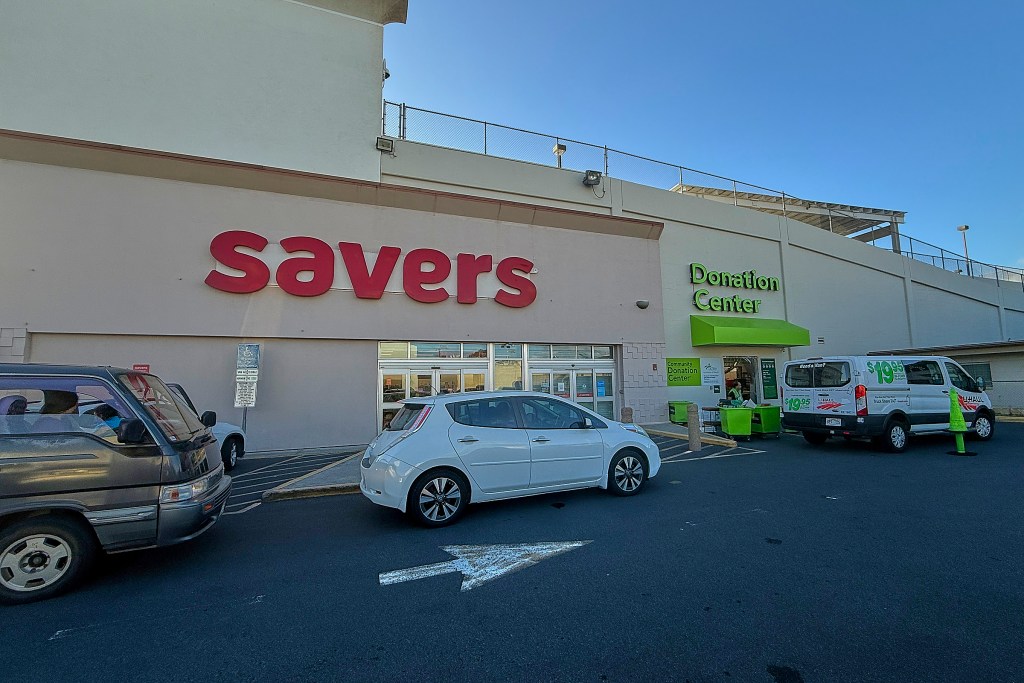
GreenDrop’s retail arm has been operating for years in Hawaiʻi as the Savers thrift store. But in 2023 GreenDrop planted its flag in Hawaiʻi, setting up four donation trailers on Oʻahu to collect donated merchandise to stock Savers’ shelves. Since then, GreenDrop has more than doubled its Hawaiʻi footprint to 10 locations.
Savers’ parent company, called Savers Value Village, Inc., has built an enormous retail empire based on the idea of getting merchandise for free and selling it for a profit. According to its most recent annual report, the company has approximately 22,700 employees and 351 stores in the U.S., Canada and Australia, operating as Savers, Value Village, Value Village Boutique, Village des Valeurs, Unique and 2nd Ave.
Savers defends its practice of using GreenDrop to collect merchandise. In an email, Sara Gaugl, a Savers spokeswoman, said GreenDrop accepts donations on behalf of “nonprofit partners,” then purchases these items “in bulk from the partners — regardless of the condition of the items — providing funding for their missions.”
In addition, she noted, the GreenDrop collection trailers have a disclaimer explaining that “Items donated are not distributed to or by the Red Cross, but sold in bulk to raise funds for its charitable purposes.”
What the disclaimer doesn’t say is how little the charities receive: as little as 2 cents per pound for merchandise. Instead it says merely, “Our nonprofit partners are paid negotiated rates for the donations collected at GreenDrop locations.”
GreenDrop’s relationship with its charity partners is so confusingly opaque that Red Cross regional spokesman Matthew Wells mistakenly described it in an email as one where “Green Drop accepts, handles, and resells donated items, then donates a portion of the proceeds to the Red Cross.”
Wells declined an interview request but in a follow-up email said GreenDrop actually buys items from the Red Cross in bulk. He said the donations “provide a good source of support for our critical programs and services, so we’re grateful to those who choose to give in this way.”
Required Reports Are Not Clear
The Hawaiʻi Attorney General, under Hawaiʻi law, requires registered professional fundraisers like GreenDrop to file financial reports that include gross revenue from Hawaii and national donors, and itemize expenses.
Other solicitors spell out their financials clearly. For example, a report for 2024 from American Civil Liberties Union fundraiser Telefund LLC shows it raised $12,953 for the ACLU in 2024 against $290 in expenses, leaving $12,663 for the ACLU. The report also breaks down Telefund’s national fundraising for the ACLU.
But GreenDrop’s report for the Red Cross, filed by the Savers affiliate TVI Inc., is far less clear. It includes none of the national data required by the state, and instead of revenue, the filing states “gross receipts” of $26,591. It claims Red Cross received 100% of that, even though the contract calls for the Red Cross to get just pennies per pound of donated merchandise. GreenDrop’s cut isn’t clear.
A book bought this week at Savers on King Street in Honolulu shows just how small the charity’s cut would be. A hardback copy of Cormac McCarthy’s novel “The Passenger” weighs in at 1.5 pounds, meaning GreenDrop would have paid the Red Cross 3 cents for it. Savers sold it for $4.99, leaving $4.96 for the retailer.
Savers Has Faced Problems In Other States
Long before GreenDrop’s donation trailers appeared on Oʻahu, Savers faced backlash in other states for its practice of collecting donations at its stores on behalf of charities.
A settlement agreement with Minnesota’s Attorney General for a 2015 lawsuit required Savers’ disclosures to explicitly state how much it was paying its charity partners per pound of merchandise donated. Regulators in Washington, California and Illinois also conducted inquiries.
In 2019, a Superior Court judge in Washington found that Savers had for years engaged in deceptive practices, including using advertising and marketing “to deceive customers into believing that their purchases in Value Village stores provided a direct benefit to charities.”
Whether Hawaiʻi regulators take a hard look at Savers’ GreenDrop boxes remains to be seen. Toni Schwartz, a spokeswoman for Hawaiʻi Attorney General Anne Lopez, said the office was assessing a complaint it received.
Civil Beat reporter Jeremy Hay contributed to this story.

