Could Kauaʻi’s Mayor Ride Wave Of Strong Fundraising To Statewide Office?
Mayor Derek Kawakami has not decided his next move, which may depend on a looming decision by Hawaiʻi Senate President Ron Kouchi, whom he calls a mentor.
Kauaʻi Mayor Derek Kawakami is sizing up his 2026 plans.
Kawakami, 47, has made no secret of his aspirations to jump into bigger contests, musing publicly over the years about a future run for lieutenant governor or governor. More recently he has sought to position himself as a successor to Senate President Ron Kouchi, who has held Kauaʻi’s only Senate seat since 2010.
But the higher offices he’s eyeing are ones held by incumbents, who are historically hard to beat. Political analysts say there’s no logical next move for the former state legislator, whose eight-year reign as Kauaʻi mayor ends next year due to term limits, unless one of those incumbents steps aside, creating an open seat.
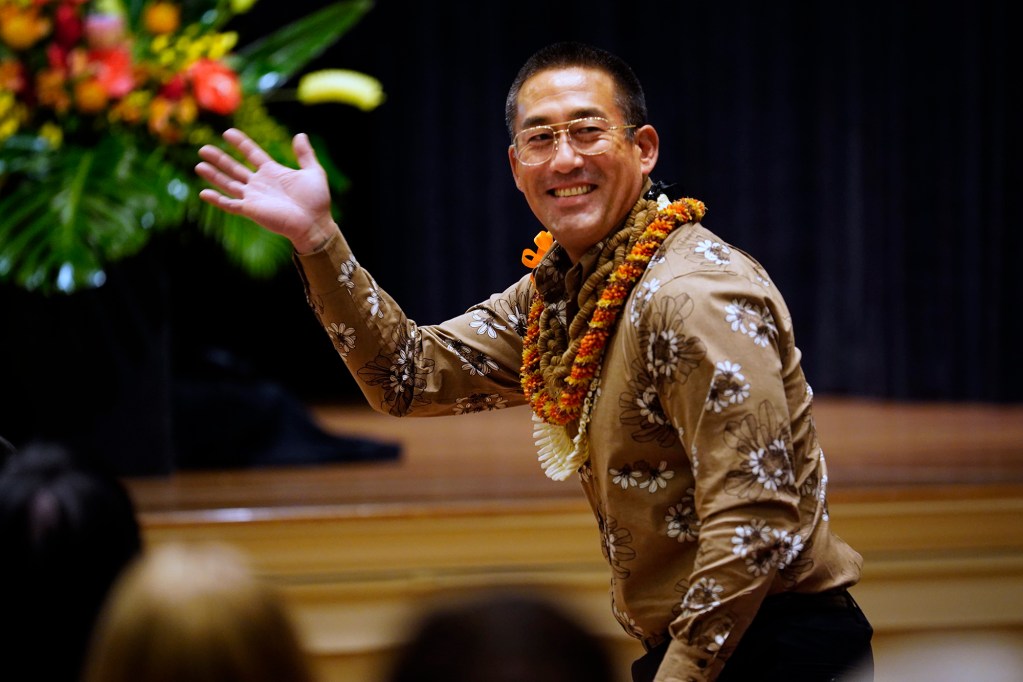
With months to go before it’s even time for candidates to register for the 2026 election, Kawakami said he’s waiting for an opening. Behind the scenes he’s quickly assembled a campaign war chest of more than a quarter million dollars and a who’s who list of major political donors already backing him for a run for Senate District 8 — a seat he’s not even sure he’ll ultimately seek.
The Senate campaign declaration Kawakami made last September in order to raise funds for his political future, to comply with state campaign finance law, appears to be a placeholder. He said he would not oppose Kouchi, who has helped him fundraise for the Senate but has not indicated any plans to retire.
Kawakami said he’s also unlikely to challenge Gov. Josh Green or Lt. Gov. Sylvia Luke but would jump at the chance to run for those offices in an open seat election. The kind of money he’s attracted — $277,000 in a span of six months — would be a solid springboard for a competitive run for either of the state’s top executive offices.
“I’m not looking to make a midterm run at things,” Kawakami, a Democrat, said. “And I don’t know if I’m going to be relevant in the future. To stay relevant in this ever-evolving landscape in the political realm is going to be a challenge. I come from the smallest island, the smallest community. But someday somebody from this island will lead the state. If it’s me, it was meant to be. If it’s not me, then it was meant to be.”
Some of his top donors include airlines, banks and influential lobbyists. Among them: HMSA CEO Mark Mugiishi; First Hawaiian Bank CEO Robert Harrison; Central Pacific Bank CEO Paul Yonamine; Matson chairman Walter Dods, Jr.; the influential Tradewind Group founder Colbert Matsumoto; the well-connected Hawaiʻi developer Jeffrey Stone, who is behind the luxury North Shore Preserve and Princeville at Hanalei projects on Kauaʻi and the revitalization of Ko Olina on Oʻahu; and Joelle Chiu, senior development director at Ahe Group LLC, which develops affordable housing.
Of the dozens of state Senate candidates who campaigned in the past two elections, only a few broke the $200,000 fundraising mark — Sen. Lorraine Inouye and Sen. Donovan Dela Cruz in 2022 and Sen. Jarrett Keohokalole in 2024. The average winning Senate candidate raised $104,000 in the 2024 election and spent an average of $61,000.
“It’s very clear he wants to be governor or lieutenant governor,” University of Hawaiʻi political scientist Colin Moore said, “but if Ron Kouchi is actually going to retire, then I think that would be a logical place for him to stay for a while and wait it out.”
Kouchi’s Looming 2026 Decision
Last year Kouchi held a pricey Honolulu fundraiser for Kawakami at The Pacific Club with $1,350-a-head tickets. In advance of the event, Kawakami declared his intent to run for Kauaʻi’s only Senate seat.
Kouchi, who has held that seat since 2012, said he agreed to support Kawakami’s bid for his office since campaign finance rules required Kawakami to declare candidacy for a specific office before he could fundraise. But Kouchi said he never agreed to vacate the seat and he’s still weighing whether to seek reelection in 2026.
It’s a delicate dance.

“It’s my hope that if I decide to run for reelection then he will pursue a different course of action,” Kouchi said, “but he has the right to do whatever he would like to do. But I told him I will certainly let him know when I decide.”
Kawakami, for his part, said he “would never” run against Kouchi.
“Our families are very close,” he said. “I consider him a mentor.”
Senate Presidency At Stake
As Senate president, Kouchi holds an influential role in state politics. The talk in Kauaʻi political circles is that many people on the Garden Isle would be disappointed to see him retire while he presides over the Senate with the power to cast tie-breaking votes.
“From the standpoint of wanting to ensure that my island has the best chance and the most opportunities for our community,” former Kauaʻi Councilman Mason Chock said, “it’s important that he stays in that seat as long as he can.”
Kouchi’s looming decision could also drive the candidate field for the Kauaʻi mayoral race.
Chock, the highest vote-getter in Kauaʻi council history, has begun putting out feelers for a potential campaign in 2026. He said he has not ruled out a run for Kauaʻi’s only state Senate seat. He’s also contemplating a bid for Kauaʻi mayor.

The Kauaʻi mayor’s race is on track to be a showdown between Bernard Carvalho, the longest-serving mayor in Kauaʻi history, and Mel Rapozo, a retired Kauaʻi police officer. Both of them are longtime public servants who represent Kauaʻi’s more conservative old guard. Both are also currently serving on the Kauaʻi County Council.
Candidate filing doesn’t begin until February, leaving room for a fresh face or a more progressive candidate to enter the race.
“I’ve got a couple months more before I’d be really pushing it if I didn’t make an announcement for something,” Chock said. “I think the third quarter of this year is going to be really telling in terms of where the chips land. I am keeping my options open until then.”
Chock, 54, is a competitive contender who has demonstrated high likability among Kauaʻi voters. He served eight consecutive years on the council, collecting a record 18,599 votes in the 2020 election. He stepped down from the council in 2022 due to term limits, which prevent council members from serving more than four consecutive two-year terms.
Another logical candidate for the Senate seat representing Kauaʻi and Niʻihau is Rep. Luke Evslin, who resigned from the council in 2023 to accept Gov. Josh Green’s appointment to fill an empty House seat that covers the island’s east side.
Evslin, 40, said he’s happy with his House seat and not thinking about playing musical chairs.
Kawakami’s Rising Star
Kawakami grew up working at the family-owned grocery chain Big Save until the business was bought out in 2011. For five years he represented the 14th House District, which runs from Wailua on the east side through Hanalei on the North Shore. He stepped down from the Legislature in 2016 to run for Kauaʻi County Council, where he served two terms before making a successful bid for mayor.
As mayor, he has prioritized the nuts and bolts of government services over flashy new investments — road improvements, infrastructure upgrades, an overhaul of the county’s archaic accounting system and an up-and-coming child care center for county workers.

His aggressive handling of the coronavirus crisis boosted his name recognition with voters beyond Kauaʻi’s shores. As he imposed the harshest Covid-19 restrictions in the state — a nightly curfew, highway checkpoints, electric monitoring bracelets to track the movement of tourists — he won statewide praise and even garnered some positive national press for entertaining residents during lockdown with his TikTok-style dance moves.
“He comes off as younger, smoother, a surfer, more contemporary, a smart kind of guy,” former legislator and Kauaʻi council member Gary Hooser said. “And, you know, he’s not some radical. He’s fairly establishment and conservative in his overall viewpoints.”
Kawakami has also made inroads on a more enduring Kauaʻi emergency: An islandwide shortage of housing that working families can afford.
Under his leadership the island’s affordable housing stock has increased roughly 26%, with 384 new units raising the islandwide total to 1,857, according to Kauaʻi Housing Director Adam Roversi. Another 310 affordable units are under construction and 1,130 units are forthcoming.
The Kawakami administration also has worked to incentivize private developers to commit units to long-term affordability to prevent them from being resold at market rates.
His critics point to the county’s failure to ever open the $7 million taxpayer-funded residential treatment center for youth and a lack of progress on the decades-long effort to find a new site for the island’s near-capacity landfill.
CORRECTION: Senate President Ron Kouchi has occupied the Senate District 8 seat since 2010.