

Foreclosure Off The Table At Black Sand Beach
A developer has come up with enough money to satisfy a $3.4 million debt and resolve a mortgage default, surprising those who had other plans for the area.
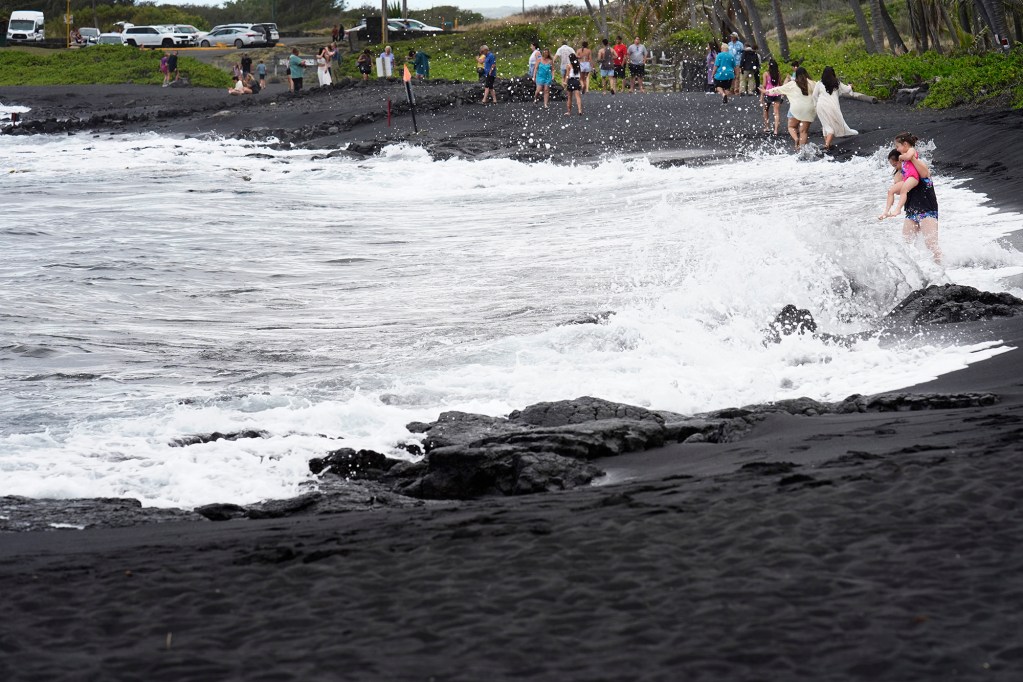
Big Island critics of a proposed housing and tourism development at Punaluʻu black sand beach say they’ll continue to fight to protect the remote area despite an unexpected turn of events.
“When it comes to our precious mountains, our precious coastline, we’re going to keep resisting,” said Curt Dela Cruz, who grew up in the Kaʻū District and works at the University of Hawaiʻi Hilo. “We remain steadfast.”
Dela Cruz and other opponents were caught off-guard when a court dismissed a May 15 foreclosure decision stemming from Black Sand Beach LLC defaulting on a $3.4 million mortgage debt. The foreclosure had offered what development critics thought could be a new chapter for Punaluʻu, which Native Hawaiians consider a wahi pana, a sacred place. Some were already plotting to get it set aside as a conservation easement or some other kind of protected status.
When the foreclosure decision first surfaced, the Center for Biological Diversity, ʻIewe Hānau O Ka ʻĀina and Native Hawaiian Legal Corporation celebrated the news with a May 19 press release.
“This foreclosure is a much-needed reprieve for Punaluʻu and the people of Kaʻū,” said Maxx Phillips, Hawai‘i and Pacific Islands director and staff attorney at the Center for Biological Diversity.
Ashley Obrey, staff attorney at the Native Hawaiian Legal Corporation, had called the foreclosure “a victory rooted in the voices of community members and cultural practitioners who showed up, time and again, to speak for the land and waters of Punaluʻu.”
On learning of the change, Obrey said via email: “I did see that the court entered the stipulation for dismissal yesterday. But I really do not have any other information about anything at this point. Will let you know if I do.”
Lincoln Ashida, a former Hawaii County corporation counsel who represents Black Sand Beach LLC, said that the company had secured new finances to pay off what it owed to creditor S M Investment Partners. Black Sand Beach now owns the 433 acres outright and unencumbered, he said.
The company had fallen behind on mortgage payments because it was pouring resources into making repairs and doing maintenance on an aging water and sewer system at Punaluʻu.
“Money is not infinite,” Ashida said.
As far as the controversial 225-unit development of a residential and short-stay housing complex that it planned to build on mauka lands at Punaluʻu, those plans are paused, Ashida said.

The company’s application for a Special Management Area permit to build the housing, retail and wellness center, seafood restaurant and fish market, is withdrawn. Ashida said the only immediate plans are to clean up the area, where dilapidated structures attract squatters and drug users, as well as improve parking and open a farmer’s market where locals can sell produce and crafts.
“These are people who really love and care about the area,” he said of Black Sand Beach LLC, owned by Eva Liu and two partners.
Dela Cruz and others are skeptical.
“It is no surprise why so many of us are so distrustful with anything that developers have shared with us because this is the fifth or sixth time that Kaʻū and Punaluʻu have tried to be developed,” said Dela Cruz. “These are threats to our lifestyle, to our medicine.”
By medicine, he means the ocean and ʻāina, the natural resources that have sustained generations of Hawaiians and other local people.
“We’ve been gaslighted long enough.”
Civil Beat’s coverage of environmental issues on Hawaiʻi island is supported in part by a grant from the Dorrance Family Foundation.
