

Honolulu’s Effort to Fast-Track Affordable Housing Projects Hasn’t Worked
Developers of much-needed affordable housing are supposed to get permits approved or denied within three months. It’s taking far longer.
It was a simple, ambitious goal: Honolulu would approve or deny building permits for affordable housing developments within 90 days.
Former Honolulu Mayor Kirk Caldwell touted the speedy turnaround when he signed Bill 7 into law in 2019.
“Ninety days,” he said during a press conference in the mayor’s office. “Quick, fast, and clean.”
Six years later, Bill 7 projects have been permitted as slowly — and sometimes more slowly — than other commercial projects. And the approval process has been far from clean, with permits often granted after a prolonged ping-pong match between the applicant and city employees.

More than 50 permit applications have been submitted through the program so far. None of them have been approved within 90 days, a Civil Beat review found.
Of the 18 projects that did get permits, the average time from application to permit issuance was nearly two years, according to an analysis of permitting records. That’s longer than the current median permitting time for commercial jobs.
Thirty-nine other applications submitted since 2020 still don’t have a permit, public records show.
Former Honolulu council member Kym Pine, who introduced the law authorizing the fast-track program, said she was “extremely disappointed” to learn how it has played out.
“I want leaders to think about that local family about to become homeless and have that feeling of urgency and just make things happen,” she said. “I don’t want to hear excuses anymore. We put the plan together for you. Just make it happen.”
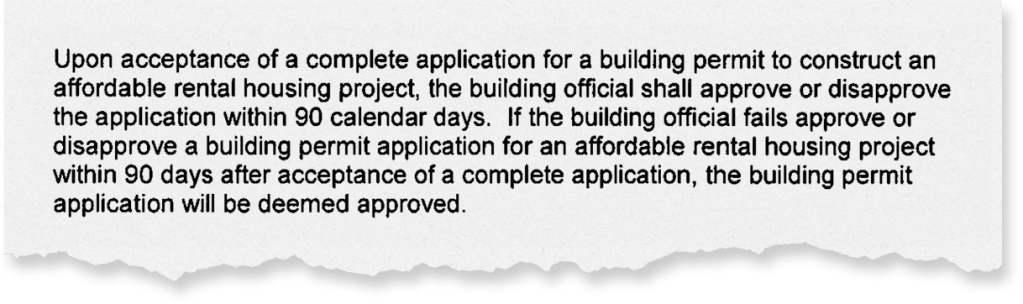
According to the law, if the city fails to make a decision on a permit by the 90-day deadline, the permit is automatically approved.

In reality, the Department of Planning and Permitting has been reviewing plans, offering feedback and asking for further information far past the deadline.
“If we complied with the letter of the law, we would have disapproved these applications before the 90-day deadline, as the majority are with the applicant, not DPP,” a statement provided by DPP and attributed to department director Dawn Takeuchi Apuna said.
That means developers would have to resubmit their plans and start the process from scratch, which according to the statement from Takeuchi Apuna “would be very costly to the developer and further delay the project.
“Instead, we allow the developers and their design professionals to continue working on the plans in an effort to come up with a project that meets code requirements,” the statement said.
‘Stuck On Some Of The Code Stuff’
At a recent Civil Beat event, Mayor Rick Blangiardi acknowledged that affordable housing projects have run into the same permitting delays as many other developments on Oʻahu.
“We’ve gotten stuck on some of the code stuff,” Blangiardi said.
DPP has had a backlog of permit applications for years for commercial and residential projects. The median permitting time for commercial projects was nearly 13 months as of the first quarter of 2025, according to a Civil Beat analysis.
Department officials say they’re hamstrung by understaffing, outdated technology and onerous regulations. The mayor said DPP is known to nitpick building plans, which he said is indicative of a cultural problem within the agency.
“People got carried away with the power,” the mayor said at the Civil Beat event. “Honestly, the rules need to be changed, a lot of them, and that’s what we’re looking to do.”

New technology, including artificial intelligence, should speed up permitting, Blangiardi said.
“We need more help from DPP,” the mayor said. “Dawn knows that, and we’re working on that.”
Despite its faults, the mayor said Bill 7 succeeded in other ways. It relaxed zoning and building rules, allowing greater density. It offered incentives to developers to target low- and middle-income tenants, such as property tax exemptions and waivers of wastewater and permitting fees.
The program has resulted in the development of a half-dozen affordable housing projects, all fully occupied, according to the mayor. And there are more on the way. Permits have been approved for 573 units, records show.

Geena Thielen, president of the project management company Complete Construction Services, said she is a strong supporter of the program. Her company has developed two projects under it; a third is under construction. Those three buildings will add 141 affordable housing units to the island, she said.
But she’s been frustrated by how long it took to get those projects approved: between 14 months and two years for each one, records show.
“We would be able to start sooner, finish sooner and have occupants in sooner if we could compress the permitting time,” Thielen said.
Takeuchi Apuna said in the written statement that she understands the desire for faster permitting. According to the director, her department is working to improve review times, prioritize Bill 7 projects and in some cases allow self-certification, in which applicants pay an expert outside DPP to review their plans.
“For Geena, time is money,” the statement said. “For DPP, our concern is quality plans and construction that meet code to protect the public’s health and safety.”
‘Wait In Line Like Everybody Else’
In City Councilman Tyler Dos Santos-Tam’s view, the law is clear. It says the building department “shall approve or disapprove” affordable housing permit applications within 90 days.
That means a developer should be able to “march down to the Fasi building and walk out on Day 91 with an approved permit in hand,” he said. If DPP doesn’t make that happen, “they’re not following the law.”
DPP did not directly respond to his criticism, but in her written statement Takeuchi Apuna said most of the Bill 7 projects that are still being processed are with the applicant following comments and questions from the department. Some building plans have been sitting with applicants for years, according to a breakdown she provided. Civil Beat asked if the city considers those projects to be abandoned, but DPP did not respond.
Developers whose projects haven’t been approved within 90 days have the option of declaring them approved. But according to Takeuchi Apuna, developers generally don’t want to demand a permit for a project that isn’t up to code.

“They are aware that the completed structure may not pass final inspection because we would not allow a building to be occupied if it is unsafe and a risk to its occupants,” the statement said.
In explaining the cause of permitting delays in general, Takeuchi Apuna has assigned a measure of blame to applicants, arguing that some submit subpar building plans.
Dos Santos-Tam, who previously served as the executive director of the Hawaiʻi Construction Alliance, said he doubts that is an issue with these projects.
“I find it hard to believe a Bill 7 developer who is reading the rules of the program carefully is going to come in with incomplete plans,” he said.
And if there are problems, he said, any issues should be resolvable within 90 days.
There aren’t that many affordable housing developments, he said, and most of them fit the same mold. They don’t have unique, complex safety considerations like a tunnel or a power plant would have. Plus, their approval achieves a stated priority for the city, he said.
“For affordable housing,” he said, “it shouldn’t be, ‘just wait in line like everybody else.’”
The Honolulu City Council is now considering expanding the Bill 7 framework to business districts. Dos Santos-Tam said that may provide an opportunity to fine-tune the program.
Faster Permits A Key Part of Affordable Housing Bill
Bill 7 was a big deal when it was passed unanimously by the Honolulu City Council in 2019.
On the day he signed Bill 7 into law, Caldwell called it the island’s “Marshall Plan” — a reference to the effort to rebuild Europe after World War II and a nod to retired Honolulu developer Marshall Hung, who helped craft the fast-track legislation. (Hung declined to comment for this story.)
Caldwell said the bill was aimed at redeveloping properties like the aging, walk-up apartment buildings erected in neighborhoods such as Kalihi, McCully and Mōʻiliʻili in the 1950s, ’60s and ’70s.
Blangiardi supports the legislation signed by his predecessor. It makes more sense to redevelop those properties than to seek out undeveloped land, Blangiardi said, because they’re already hooked up to electricity, water and sewer.
“What Bill 7 is designed to do is, for the first time, have the city financially incentivize private landowners to knock down those buildings and build according to the codes,” he said.

Bill 7 projects are entitled to relaxed development rules in exchange for renting to tenants with incomes at or below the area median income. In 2025, that’s $129,300 for a family of four.
The 90-day deadline was included to address what developers cited as a major obstacle to building more housing, according to Pine.
“The permit time was one of the key things,” she said. “If they don’t build according to a certain timeline, they could lose their low-interest loan.”
Since Bill 7 was passed and the Covid-19 pandemic came and went, the cost of construction has skyrocketed and interest rates have soared.

Pine said Honolulu blew its chance to capitalize on favorable conditions to build affordable housing.
“Government screwed this up so badly during a good time to build,” she said.
As Hawaiʻi’s housing crisis persists, so-called “shot clock” legislation like Bill 7, which require approval within a certain timeframe, is appealing to policymakers.
This year, the state Legislature passed Senate Bill 66, which allows single- and multi-family homes to get permits within 60 days after the county receives a completed application. In the preamble to the bill, lawmakers wrote that permit delays are one of the largest obstacles to addressing the state’s housing shortage.
Honolulu’s permitting department opposed the bill, citing safety concerns. And Gov. Josh Green has indicated he intends to veto the measure. It would undermine regulatory agencies, he said, and allow developers to declare that their own projects are in compliance with historic preservation rules, which could put iwi kūpuna — Hawaiian ancestral remains — at risk.
Pine said Honolulu’s permitting department needs to simplify its thinking: Create a standard checklist, make sure a project has what is necessary, and move on.
“I don’t think this is hard. If we were able to do this when my grandmother was my age with ease, why can’t we do it again?” she said. “Or else we are at risk of local people not being able to live here.”

