Not So Public: City Officials Mum On HPD Chief Request For Extra Cash
Soon-to-be retired Honolulu Police Chief Joe Logan says he wants to be paid for two more years to cover retiring sooner than he’d anticipated.
City officials won’t release a letter they apparently received two weeks ago from Honolulu Police Chief Joe Logan in which he asked to be paid through what was supposed to be a five-year term as chief.
Logan announced his retirement on June 2, moments before Honolulu Mayor Rick Blangiardi held a news conference to announce the same thing. Even though the police chief does not report to the mayor in Honolulu, Blangiardi had made no secret of the fact that he was unhappy with Logan’s performance and wanted him out.
Now, according to a story Hawaii News Now broke on Monday, Logan is demanding an extra two years’ pay — nearly $500,000 — to cover the time remaining on his five-year term as chief. He’s contending he’s owed the money because he’s being forced out, even though he voluntarily retired and will be on the job until Aug. 1.

Honolulu spokesman Ian Scheuring told Civil Beat in an email on Tuesday that the city won’t release any letters from Logan or any city response back to the chief “because they constitute government records which, pursuant to state law (HRCP Rule 408), are protected from disclosure under 92F.”
Rule 408 is a section of state law that covers settlement talks and mediation proceedings and 92F is the public records law.
But Brian Black, executive director of the Public First Law Center, says Rule 408 is not a legally valid exemption to Hawaiʻi’s public records law, the Uniform Information Practices Act. Last year, Black filed a lawsuit against Maui County challenging its refusal to release unredacted records showing how the county negotiated a fine in a property development case. The county initially argued the records were protected under the public records law as part of negotiations.
“The public interest in how (notices of violation) are negotiated and reduced behind closed doors outweighs any privacy interests the Defendants may have in documents and e-mails related to the NOV reduction,” the lawsuit in that case said.
Maui County released the records — unredacted — before the case went much further.
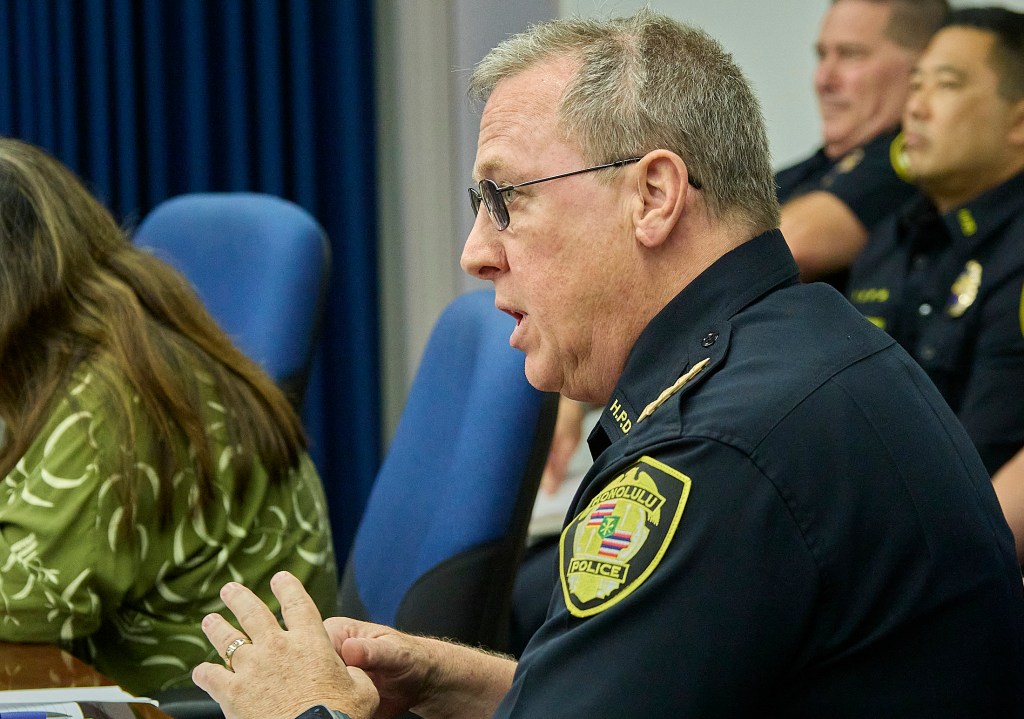
Joseph Rosenbaum, who is representing Logan in his request for a payout from the city, also declined to release the demand letter. In fact, he won’t even talk about what the letter says or provide any other details about what’s going on.
“This is not just about money,” Rosenbaum said Tuesday, “it’s about the principle for the chief.”
Logan was named chief in May 2022 by the Honolulu Police Commission and under the city charter the commission, not the mayor, has the authority to hire and fire the chief. The commission accepted Logan’s resignation at a meeting in June and has already selected an interim chief to take over while commissioners search for a new permanent chief.
So if Logan is now claiming wrongful termination, it would seem the commission, not the mayor, would be the one to consider the complaint. But commission chair Ken Silva said Tuesday the letter went to the city, not the commission — and referred questions about it to the city.
Meanwhile, the commission intends to move forward with its final job review of Logan, Silva said, and has that on the agenda for Wednesday’s 2 p.m. meeting.
The situation is shaping up to be similar to what happened when former chief Louis Kealoha got a big payout amid his rocky departure from HPD in 2017, one step ahead of a federal conspiracy and corruption conviction. That year, it was the commission that voted to give Kealoha an extra $250,000 on top of his retirement package for him to leave the job quietly even though he was under investigation for — and would soon be convicted of — framing a family member for a mailbox theft in order to get a leg up in a civil lawsuit.
The commission announced the $250,000 payout but declined to disclose details about how it came to the decision, which all happened behind closed doors. Black went to court to get minutes from the meeting that showed how the commission handled negotiations for Kealoha’s extra money. In 2019, in a landmark decision, the Hawaiʻi Supreme Court ruled that public boards and commissions have to conduct hiring, firing and evaluations of top officials openly and not in executive session.
Ultimately, city officials — including Police Commission Chair Max Sword, Corporation Counsel Donna Leong and city Managing Director Roy Amemiya — all were charged criminally for violations of federal law relating to how they arranged for Kealoha to be paid. Sword and Leong pleaded guilty earlier this year and Amemiya acknowledged his part in the crime but got a deferred plea so the charges will eventually be dismissed. They have to pay back the $250,000 but taxpayers also paid for their legal defense.