

ʻEwa Developer Settles Marina Case For $40 Million
A 14-year legal battle over a disappeared marina in ʻEwa has finally ended
Matt and Julia LoPresti thought they were buying a home located next to a marina, with boat slips, posh sailing yachts and access to the ocean, when they purchased at Haseko Hawaiʻi’s Ocean Pointe/Hoakalei development in ʻEwa in 2010.
“I thought, ‘I’m going to take my kids out and teach them to sail on a little dinghy, and we’d go out and go fishing, and it would be this amazing thing,’” said Matt LoPresti, a university professor and former state lawmaker. “We were sold hook, line and sinker.”
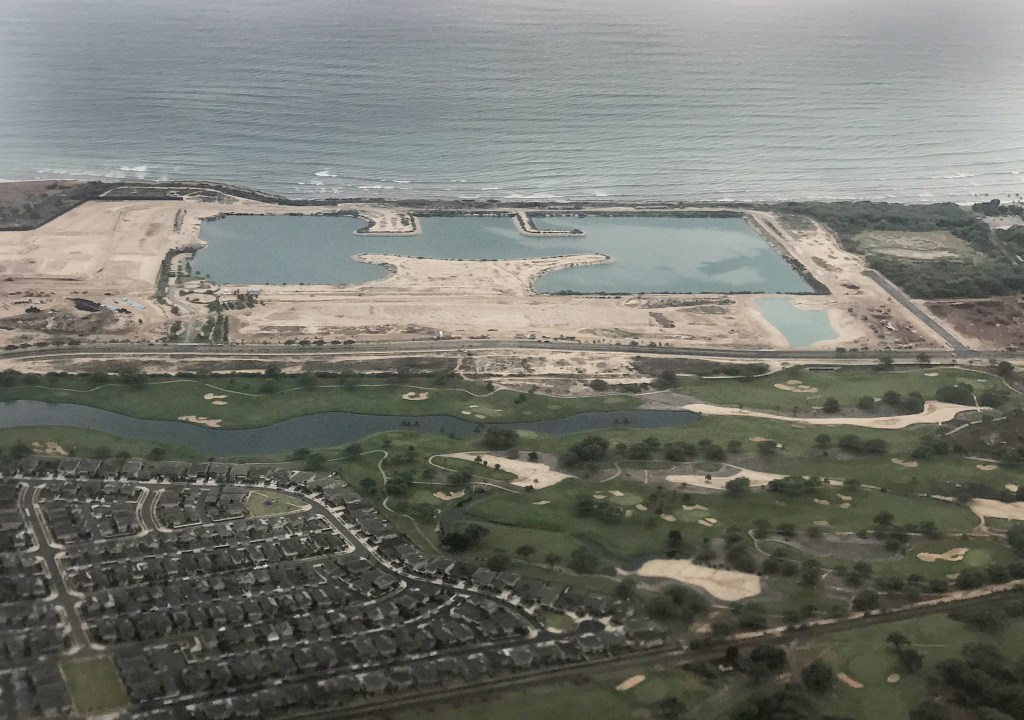
But instead of the promised marina, the LoPrestis and thousands of other buyers got a lagoon: no slips, no ocean access, no way to sail a little dinghy out to sea from the oceanside planned community. This week, Haseko agreed to pay a group of homebuyers including the LoPrestis $40 million to settle a class action lawsuit that triggered more than a decade of litigation and extensive media coverage.
After 14 years, the case of the disappearing marina is over.
Under the deal approved Wednesday, the LoPrestis and other homeowners will each receive more than $8,600 to settle the class action lawsuit accusing Haseko of what the homebuyers said was a massive bait and switch. The settlement amounts to twice the $20 million previously awarded by then-Hawaiʻi Circuit Court Judge Karen Nakasone, which both parties had appealed to Hawaiʻi’s Intermediate Court of Appeals.

In an interview, Matt LoPresti, the suit’s lead plaintiff, said he was generally pleased with the outcome, even though he said the settlement amounted to less than what Haseko saved by not building the promised marina.
“I never doubted that we would win,” LoPresti said. “My biggest concern was about how much we could get for the members of the class. Because, you know, $9,000 – I’m rounding up – $9,000 is great. It’s double what we won in court. But frankly, I think it’s nothing compared to what we were owed for the amount of money they took from us and what they promised.”
A request for comment from Haseko’s president was referred to its public relations firm, Becker Communications, which issued a statement saying, “This settlement does not constitute an admission of wrongdoing by Haseko but reflects a shared commitment to resolving the claims and avoiding prolonged litigation.”
Haseko’s attorney, Steven Chung, said the company denied liability but declined further comment.
Jury Initially Awarded $20 Million In Punitive Damages
The settlement approved by the court lays out the 14-year history of the case.
The developer of the 1,100-acre project known as OceanPointe/Hoakalei, Haseko “represented in its marketing material that the development would include a marina,” the court said. “On November 6, 2011, after several thousand homes had been sold, HASEKO announced that it would build a recreational lagoon instead of a marina.”
The plaintiffs sued in 2013, represented by Honolulu attorneys Terry Revere and Michael Green, alleging that the plaintiffs had been harmed by the change. Haseko denied liability and said homebuyers hadn’t been harmed.
“Who says a marina is an option? FOOL … It’s lagoon versus nothing, dumb-ass.”
Paul Brewbaker, economist for Haseko
Meanwhile, Haseko also mounted a public relations campaign to show the lagoon was not just cheaper but better for the public than a marina, which was originally sold as being suitable for deep-draft America’s Cup-style racing yachts.
Becker Communications drafted rebuttals to news articles critical of the abruptly changed plan and wrote canned talking points and responses to anticipated questions from reporters and lawmakers, trial exhibits show. The company even drafted fake letters from fictional supporters of the lagoon. A “Community Relations Plan” drafted by Becker asserted that “a preliminary exploration of the potentials related to a lagoon indicates that a lagoon would benefit a public much larger than
the boating community.”
Haseko hired Kailua economist Paul Brewbaker to produce reports showing the economic benefits of the lagoon. In an email to then-Haseko executive Sharene Tam, who expressed concern that the City and County of Honolulu wanted the marina to remain an option, Brewbaker wrote, “Who says a marina is an option? FOOL. Ain’t nobody going to build one, yo. You be dreaming. It’s lagoon versus nothing, dumb-ass.”
A Honolulu jury didn’t buy Haseko’s arguments. It awarded $1,300 per household plus $20 million in punitive damages against Haseko after finding the developer engaged in unfair and deceptive trade practices. Hawaiʻi Circuit Court Judge Gary Chang set aside the verdict, saying the home buyers hadn’t been harmed and that the trade practices law didn’t allow punitive damages.
Still, the case remained alive, transferred to Hawaiʻi Circuit Judge Karen Nakasone, who found Haseko had been unjustly enriched by breaking its promise to the buyers and awarded the plaintiffs $20 million. Both sides appealed. In September, the Hawaiʻi Intermediate Court of Appeals affirmed in part and vacated in part Nakasone’s ruling and remanded the case to the trial court, where the parties eventually settled.
Plaintiff Says Lawsuit Was ‘The Right Thing’
The court noted the protracted, complex legal battles when approving the settlement.
“The parties participated in more than a decade of hard-fought litigation, two separate trials, and a five-year cross appeal,” Judge Steven Nichols wrote. “Further, this matter involved novel legal issues and theories under Hawaii law that has resulted in new legal precedent for Hawaii consumers. Accordingly, the parties and the Court have ample information to weigh the relative merits of settlement and continued litigation.”
LoPresti said fighting Haseko for years took a toll on him. Hawaiʻi’s politically powerful construction unions in particular weren’t happy about him fighting a major construction project. He served in Hawaiʻi’s House of Representatives from 2014 to 2018, when he mounted an unsuccessful campaign for the Hawaiʻi Senate. In a highly publicized incident, LoPresti in 2018 apologized for taking an opponent’s flyer off a door after a video of the incident went viral,
He went back to the House in 2020, but lost the seat in 2022.
“I paid a heavy political price,” he said of his decision to pursue the lawsuit. “I paid a heavy personal price, and I still actually do, in some ways, partly because of this lawsuit. But I’m proud of the work that I did for my community, because it was the right thing to do.”

