

Investigator: Vocal Red Hill Whistleblower Faced Pushback For Speaking Out
One of the military’s loudest critics amid the Red Hill fuel contamination fiasco said her boss tried to keep her quiet.
After Oʻahu military families were sickened by drinking fuel-contaminated water in 2021, Army Maj. Mandy Feindt became a crusader for their cause.
She posted online, attended town hall meetings and communicated with members of Congress about faults in the military medical care system. It was personal. Feindt, her husband and their two children all suffered serious health impacts after drinking water tainted by fuel that leaked from the Navy’s Red Hill storage complex.
Feindt’s supervisor, however, was displeased with her advocacy, and discouraged her from contacting members of Congress, according to a June report from the the Department of Defense Office of Inspector General. The agency substantiated a whistleblower complaint Feindt made in February 2022.
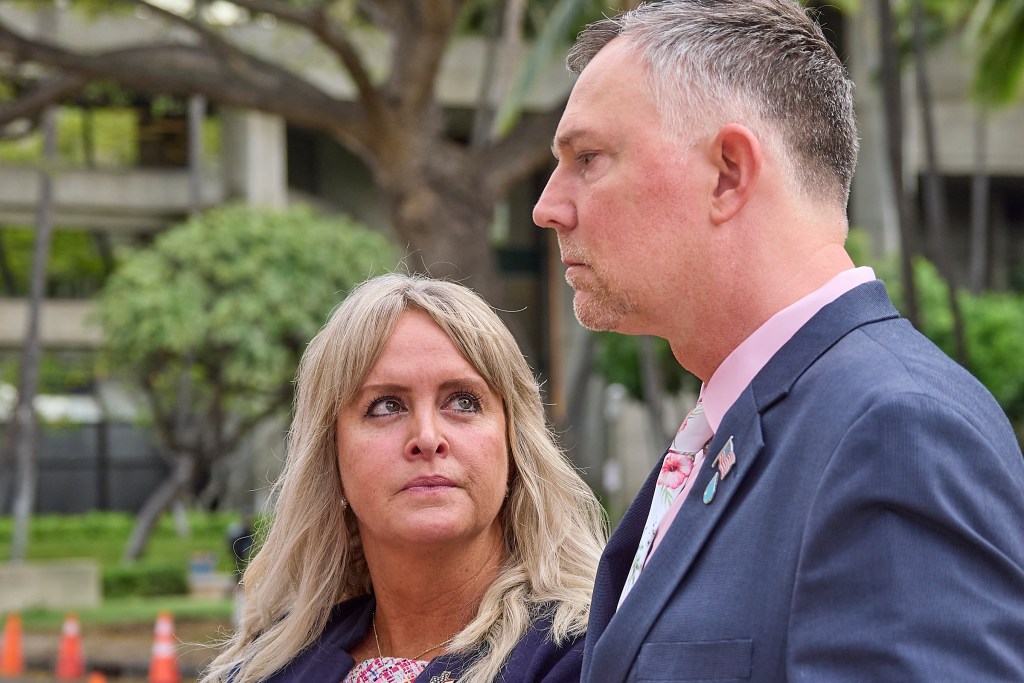
In an interview, Feindt said she feels vindicated but also frustrated that a complaint was necessary at all.
“I am literally doing what you trained me to do, which is when you see something, say something,” she said.
“I just felt this huge conviction to speak out, but folks did not like it. We like people to bury their head in the sand and fall in line and not speak out. My command completely turned their back on me.”
Supervisor: Get ‘Back To Work’
The week of Thanksgiving 2021, residents around Pearl Harbor started to report concerns about their drinking water. The public later learned that two consecutive leaks at the Navy’s World War II-era fuel storage complex at Red Hill had tainted the water serving some 93,000 people.
Thousands of people reported health impacts, including rashes, vomiting and neurological impacts, and the Feindts and others were hospitalized. Several survivors report ongoing health impacts to this day, including the Feindts, who went on to become the lead plaintiffs in a lawsuit that went to trial last year.
The military initially sought to downplay the disaster, with officials denying there was a problem, but following months of public outrage, the Department of Defense agreed to drain and ultimately close the facility.
In February 2022, a few months into the contamination disaster, the report states Feindt attempted to return from an administrative leave but was told she might not be invited back to work. After Feindt expressed concerns about a hostile work environment, her boss “basically said (it) was all of my fault, that I brought this all on myself,” she told OIG investigators.

Her supervisor specifically mentioned Feindt having taken her concerns to Congress, the report states. Military members’ communications with Congress are specifically protected under federal law.
“And what I took from the conversation is: If you stop doing all of these things that you’re doing to protect yourself and your family, then things can go back to being normal,” Feindt told the OIG. “And I basically told (him) that that wasn’t going to happen. … And (he) said it wasn’t my job. That none of these things that I was doing (were) part of my job description.”
Feindt asked her boss what he would do if he were in her shoes. She recalled him saying something to the effect of: “I would drop my kids off at a daycare and I would get my ass back to work.”
A reasonable person would infer that negative consequences would cease if only she would stop communicating with Congress, the report states.
“The Subject’s rank and position of authority,” the report states, “combined with (his) apparent reference to congressional engagement being the source of negative actions and (his) display of a dismissive attitude and demeanor toward (her) concerns, would deter a reasonable Service member from lawfully communicating with a Member of Congress or an IG.”
Officer Now Retired
The OIG report redacts the officer’s name, but a letter sent to Feindt and shared with Civil Beat identifies him as Col. Kenneth McAdams of the U.S. Air Force.
McAdams has since retired from the military. He did not respond to the OIG’s conclusions for the report or a message from Civil Beat sent on Monday seeking comment. His LinkedIn profile says he now works for a contractor supporting the Air Force.
U.S. Special Operations Command Pacific, where Feindt and McAdams worked, did not respond to a request for comment either.
The Office of Inspector General interviewed Feindt, McAdams and other witnesses and reviewed documents, including emails and personnel records. The agency found Feindt’s account “plausible and credible” and noted she reported it contemporaneously to senior leaders and a military hotline.
The OIG found no evidence that McAdams was successful in restricting Feindt’s communications, but an attempt alone is a violation, according to the report. The agency recommends the Air Force “consider appropriate action against” him, but the report does not say whether any such action was taken.
Feindt said it’s unlikely the military would call McAdams back into active duty to punish him for his misconduct. The fact that the investigation took so long that he retired by its end is part of the problem, she said. These reviews are supposed to take 120 days or less. Instead, hers took over three years.
“He’ll never be held accountable,” she said.
‘Hero To Zero’
When U.S. Navy fuel contaminated Oʻahu’s drinking water in 2021, sickening hundreds of military families, most of the Navy’s most vocal critics were military wives, not active duty members. Feindt was the exception.
Her experience is proof of why speaking up is so rare, she said.
“It’s because of this, because of fear of retaliation,” she said. “It’s so corrupt, and it runs so deep, and they can destroy you.”
“I went from like hero to zero overnight”
Mandy Feindt
Before the fuel leaks, Feindt said she was in good professional standing and had a positive rapport with her command, with whom she was on a first name basis. While Feindt’s complaint was being investigated, she said she was passed over for promotion and iced out by her colleagues who now refer to her formally as Maj. Feindt.
“I went from like hero to zero overnight,” she said.

Kristina Baehr, an attorney for the Feindt family and other Red Hill survivors, said the OIG report confirms her client was punished for doing the right thing.
“Mandy Feindt deserved credit – not retaliation – for asking the tough questions of the military and for engaging Congress in trying to help protect families affected by the Navy’s failures at Red Hill,” she said. “I know that she would do it again. Because the Army teaches that people are our greatest asset. They’re worth protecting. And so now our job as a country is to protect truthtellers like Mandy who take a stand for all of us.”
After the Red Hill spill, Feindt was granted a compassionate medical reassignment and moved to the mainland.
Feindt is now urging the Department of Defense to establish improved protections for whistleblowers while their claims are being investigated. She would also like to see a change in culture.
“I can’t tell you how morally degrading it’s been,” she said, “to see my peers get promoted and know if I would have buried my head in the sand, just stayed quiet, I would’ve been too.”
Civil Beat’s coverage of the environment is supported by The Healy Foundation, the Marisla Fund of the Hawai‘i Community Foundation and the Frost Family Foundation.

