Kauaʻi Police Chief Job Posting Gets Tepid Response
On Kauaʻi, job applications for chief of police are down 68% as a department with sinking morale and recruitment and retention issues seeks its next leader.
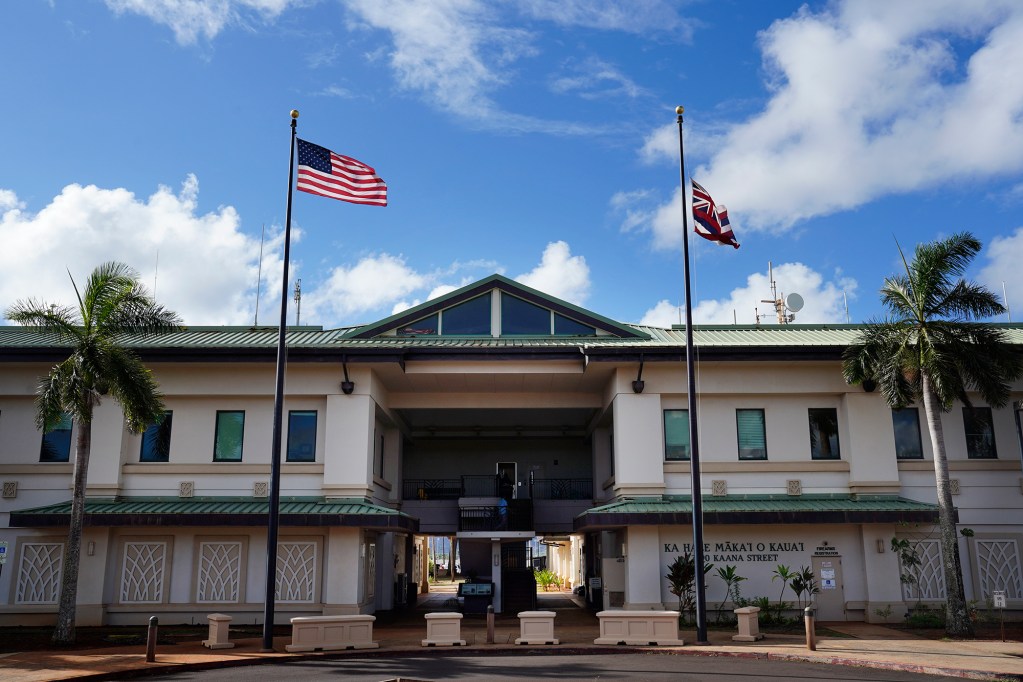
The Kauaʻi Police Department has for years struggled to find promising men and women to fill its ranks, a problem that appears to be complicating the hiring push for Kauaʻi County’s next police chief.
As the application deadline closed Monday, 42 people had applied for the chief position. That’s down considerably from the 133 applications that the job vacancy garnered in 2018 when the Kauaʻi Police Commission hired former chief Todd Raybuck, who retired last month after a six-year tenure clouded by controversy. The 2007 chief search attracted 66 contenders.
For the first time, Kauaʻi’s next chief will be required to have a four-year college degree and 15 years of police experience. The new requirements kicked in after 72% of county voters passed a charter amendment in 2020 to add these minimum job requirements in a county governing document that offered few hiring specifics.
The seven-member county Police Commission charged with hiring, firing and evaluating the performance of Kauaʻi’s chief of police recently debated whether the new job criteria could be eliminating quality candidates.
But the plunge in the number of applicants for Kauaʻi’s vacant chief position may not have anything to do with the criteria. State of Hawaiʻi Organization of Police Officers spokesman Dustin DeRollo said a college degree is the norm for police chiefs nationwide and requiring it shouldn’t hamper the county’s search.
“Police chiefs are akin to CEOs,” DeRollo said. “There are a lot of employees, you’re responsible for huge budgets. These are complex departments. So a college degree is more the rule than the exception now.”
The decline in applicants might instead be related to KPD’s well-publicized struggles with sinking morale and a high rate of officer vacancies, DeRollo said.
The Kauaʻi Police Department has a $41.5 million annual budget and 236 full-time staff, including 135 sworn officers. Another 30 officer positions are unfilled, creating an 18% officer vacancy rate. Staff recruitment and retention difficulties have long plagued the department.
Morale also is an issue. A police union survey in 2022 found more than half of the 113 officers surveyed said the department does not care about them personally. A 2024 workplace Gallup survey found that 49% of employees aren’t just unhappy at the department — they’re resentful that their needs aren’t being met.
“We shouldn’t be hiding from the fact that the last chief left behind a police department that has serious morale and trust issues,” DeRollo said. “If you come take the job on Kauaʻi, the department needs to be rebuilt from the ground up. You’re not just going to show up as the chief and find that things are running smoothly.”
The union spokesman for the State of Hawaii Organization of Police Officers noted, however, that the right candidate for the job would view the troubled state of the department as an opportunity to dig in and make a meaningful difference.
Raybuck, who left the state last month after he turned in his badge, has criticized the union for making personal attacks on police chiefs statewide and not offering viable solutions to problems.
In an interview on the eve of his last day on the job, he cited this adversarial relationship as a deterrent to the Kauaʻi Police Commission’s efforts to install a new chief.
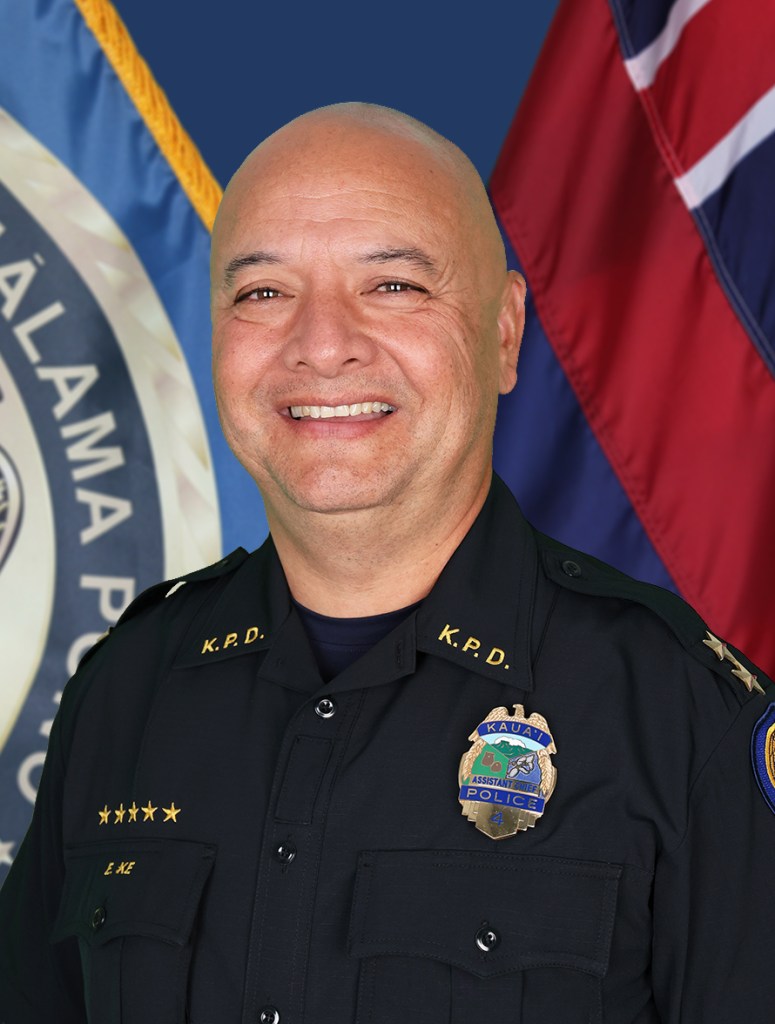
Interim Chief Elliott Kalani Ke was initially reluctant to accept the interim chief job, according to Raybuck, but agreed to serve as the county’s top cop out of a sense of duty to the Kauaʻi community and its police force.
“I hope that the police commission is successful in identifying the next chief of police that wants to do it for the right reasons, because it’s not going to be easy,” Raybuck said. “It’ll only be a matter of time before … the target’s on their back and the arrows are being flung.”
Ke declined to be interviewed for this story.
There’s also a concern about pay. The county job posting for the chief position lists a $164,192 salary and effective July 1 the pay rate jumped by 14% to $181,800. However, police chiefs in Honolulu, Hawaiʻi and Maui counties earn a base salary of $239,000, $196,000 and $183,889, respectively.
DeRollo doubts that the fact Honolulu is also searching for a new chief of police could be harming Kauaʻi’s recruitment efforts. The two departments are vastly different in terms of size, budgets and the makeup of the communities, he said.
The Honolulu Police Department is an urban police force on an island with a population of nearly a million people, whereas KPD polices a small, rural island of 74,000 residents. The two jobs, DeRollo said, would likely appeal to different fields of candidates.
Commission Rethinks Education Standards
Kauaʻi voters five years ago overwhelmingly supported a bid to raise the qualifications for their police chief.
The Kauaʻi Police Commission advocated for the stricter criteria in part to close a loophole in the county charter that would have allowed someone who had worked a civilian job in a police department, such as a clerk or dispatcher, to be eligible for the chief of police position — even without police officer experience.

The commission also wanted to protect the integrity of the hiring process against favoritism and politics, according to Jan TenBruggencate, who serves on the county Charter Commission.
The Police Commission, he said, sought to “make it less likely that an unqualified person who had a lot of political clout could ascend the list and outrank better qualified candidates.”
Now, as recruitment falters, the Police Commission is considering a campaign to lower the education standards.
Commissioners debated at a recent meeting whether mandating a four-year degree might eliminate quality candidates, especially those from within KPD who aspire to one day lead the department. Members discussed course correcting by putting forth another charter amendment for voters to consider on the 2026 election ballot that would loosen the education requirement.
Specifically, the charter currently requires the police chief to possess a four-year degree in a relevant administrative field, such as administration of justice or business administration.
Ke, the interim chief, has a bachelor’s degree in criminal justice. So does Raybuck. Former chief Darryl Perry, who served a decade as Kauaʻi’s top cop until his retirement in 2018, had bachelor’s and master’s degrees in justice administration and management at the time of his hiring.
“A four-year degree is valuable and I think that it would make somebody well-qualified,” Kauaʻi County Council Member Felicia Cowden said. “But in a small community like we have it probably is too limiting relative to growing our own. These people have children, they’re working 12-hour shifts and so by the time someone realizes they might have aspirations for leadership, it almost closes the door.”
County Council Chair Mel Rapozo, a former Kauaʻi cop with a bachelor’s degree in criminal justice, said a degree should be a guideline, not a mandate.
“In the classroom you learn the fundamentals of criminal justice and that has value but you’re not learning how to manage a squad of eight or 10 guys, you’re not learning how to manage the local culture — all of that, you can only learn it on the job,” Rapozo said.
Most of the 133 candidates who applied for the Kauaʻi chief job in 2018 had degrees.
Nationally, 29% of police chiefs and sheriffs have a bachelor’s degree and 32% have a master’s degree, according to the National Policing Institute.
Rather than a mandate, DeRollo said Kauaʻi County might want to consider incentives for officers who pursue higher education, such as bonus pay for officers with relevant degrees. Nearly three-quarters of police departments nationwide offer bonus pay up to 7.5% to police officers with a bachelor’s degree, according to the National Policing Institute.
“The issue is you really handcuff yourself when you put it in the charter,” DeRollo said. “When it’s a preference, you preserve that flexibility if the right candidate comes along and doesn’t check that box.”