

Waikīkī Restaurant War Reveals Gaps In Hawaiʻi Business Protections
The dispute between two restaurants with the same name on the same block underscores a weakness in the state’s trademark system
For Mona Wong, finding the original Me Korean barbecue restaurant in Waikīkī — a family-owned hole-in-the-wall with a 30-year following of locals, foreign tourists and even influential food bloggers — wasn’t as simple as looking up the address on Yelp.
There are currently two Korean barbecue restaurants operating on the same block with the same name. One is the original Me, which lost its lease in 2023 and reopened in a new location across the street earlier this year. The other is an unaffiliated restaurant that opened in Me’s old location around the same time, using the same name and a similar menu.
To figure out which one was the original Me, Wong says she had to peruse the Yelp reviews carefully.

“I totally see where it would confuse people,” said Wong, a 35-year-old financial services worker and member of Yelp’s “Elite Squad” of avid reviewers. She noted that even some other Yelp contributors appeared to be confusing the two restaurants in their reviews.
“If the one across the street would just change their name,” she said, “it would cause less confusion.”
Each restaurant claims it has the right to the name, not the other. Both sides have hired lawyers.
The dispute might seem trivial, but reputation is everything for small restaurants operating with razor-thin margins because of escalating food, labor and rent costs. Restaurants can live and die based on online reviews, and the goodwill attached to a restaurant’s name can have a big impact on its bottom line.
That’s the main purpose of trademarks to begin with: to help ensure “customers recognize you in the marketplace and distinguish you from your competitors,” as the U.S. Patent and Trademark Office puts it.
But Hawaiʻi has a less rigorous approach to trademark registration than the federal trademark office.
Rather than researching potential conflicts on the front end, the state opts to essentially rubber stamp applications and then sort out any problems down the line. Businesses can address disputes by bringing legal cases before the state Department of Commerce and Consumer Affairs, which regulates trademarks and trade names.
DCCA data indicates Hawaiʻi’s system generally works if businesses are willing to sort out problems between themselves. But in this instance, neither Me appears willing to budge. In the meantime, consumers like Wong are left scratching their heads over why the parties can’t just fix things.
“It’s just a name change,” she said.
What’s In A Name?
Trademarks have been used on goods sold to the public for thousands of years, dating back to ancient Greece. In the Middle Ages, craft guilds required their members to use marks to identify the maker of an item and guarantee quality. In modern times, trademarks have taken on lives of their own, emblazoned as design elements on apparel and handbags.
People don’t need to register a trademark to own it, as long as they’ve been doing business using the name long enough to establish a following, said Kristin Holland, a trademark litigation lawyer with the Honolulu office of Dentons.
Another issue is whether someone else using the same or similar mark could create a likelihood of confusion among consumers, Holland said. An infringing mark doesn’t have to be exactly the same as the protected mark.
Over the years, Hawaiʻi’s Department of Commerce and Consumer Affairs has seen all manner of struggles between trademark owners and alleged imposters using confusingly similar marks or trade names.
Hospitals, wedding planners and donut bakers have engaged in disputes refereed by the department. Even rival factions of a motorcycle club fighting over the trademark used on their jackets opted to settle their beef before a DCCA administrative judge rather than the old-fashioned way.
Disputes over federal trademarks, such as a complaint filed in April by Monster Energy beverage company against Ice Monster Hawaii, Ltd., a Taiwanese ice cream and frozen drink shop, often end up in federal court.
Original Me Opened In 1992, New Me In 2025
In the Me matter, the original restaurateurs opened Me BBQ at 151 Uluniu Ave. in Waikīkī decades ago. The owner, Seawang Kim, declined interview requests through a spokesperson. But the restaurant’s website says it opened in 1992.
Not only did the company use the name, it also registered the trade name Me’s BBQ with the Hawaiʻi DCCA in 2014 and has renewed the trade name twice over the years, records show. Its latest registration is good through Aug. 2029.
In 2023, the original Me lost its lease at 151 Uluniu and informed customers that it would reopen at a new location.

Meanwhile, Honolulu entrepreneur Mohamed El Gabry, owner of the nearby Blue Ocean Seafood and Steak food stand, took over the space at 151 Uluniu.
El Gabry declined interview requests. But records show he registered the trade name Hanul Bar-B-Que as a fast food Korean barbecue restaurant in November 2024, using the 151 Uluniu Ave. address. He also registered Me Bar-B-Que LLC.
“Since March 7, 2025, these entities have been lawfully operating a restaurant business at 151 Uluniu Avenue in Waikiki,” El Gabry’s lawyer, Andrew Stewart, said in an email.
In April, El Gabry registered the trade name Me-Bar-B-Que.
The same month, the original Me opened at its new location across Uluniu at the other end of the block at the corner of Uluniu Avenue and Prince Edward Street.
In May, El Gabry registered another company, MEBBQ Waikīkīki LLC and registered the trade name MEBBQ Waikīkī.
Both Me Barbecue Joints Claim To Be The Original
Not only are the names similar, so are the menus. Both serve basics like barbecued kalbi beef and chicken, noodle dishes, fried chicken katsu, oxtail soup, and big plate lunches with rice and side dishes.
Both restaurants also have laid claim to be the original. The original Me has a sign explaining to customers that it is actually the first Me, while the new Me has a sign over its doorway calling itself the “Original Me Bar-B-Que.”
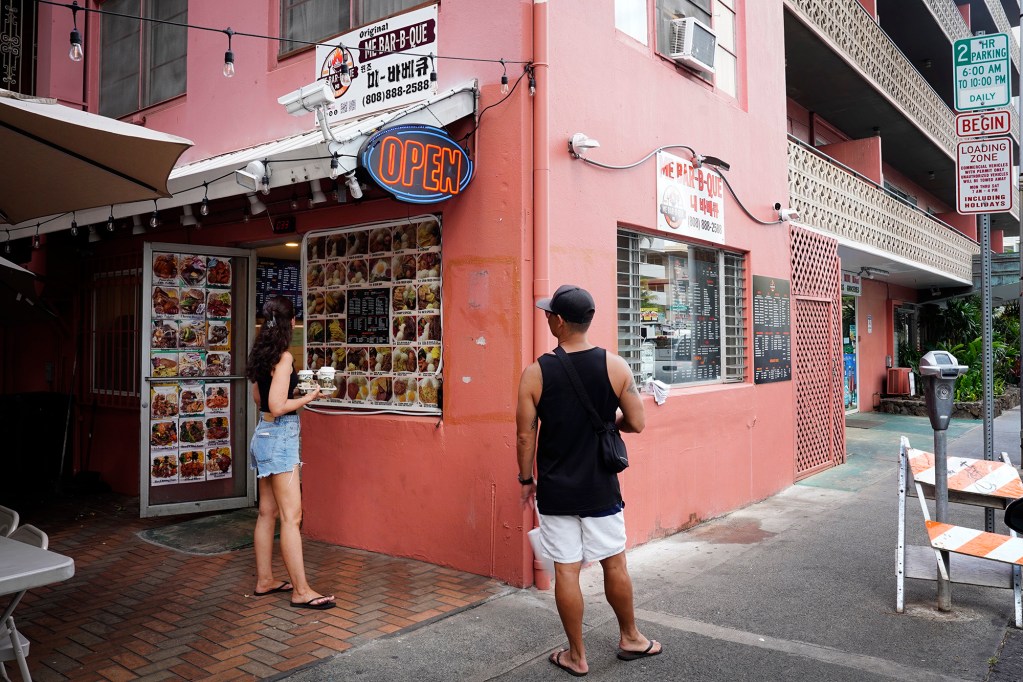
While consumers like Wong might be confused by having two restaurants with similar names and similar menus on the same block, El Gabry’s lawyer, Stewart, points to DCCA’s registering the trade names “MEBBQ Waikiki” and “Me-Bar-B-Que” as an indication that DCCA officials saw no likelihood of confusion between those names and the original Me’s BBQ registered trade name.
“The proposed names were not deemed confusingly similar to any existing or protected trade names,” Stewart said.
In truth, the DCCA didn’t deem anything about confusing similarity to an existing trade name when it let El Gabry register trade names almost identical to the original Me barbecue’s registered name, said William Nhieu, a spokesperson for the department.
Such approvals are merely ministerial, Nhieu said, generally rubber-stamped as long as the proposed names don’t match an existing registered trade. It would be up to the industry and marketplace to later determine whether the new Me’s registered trade name was confusingly similar to the original Me’s name.
“Nobody at DCCA has made that determination,” he said.
DCCA Grants Trademarks First, Settles Problems Later
When business owners can’t resolve issues between themselves, Hawaiʻi law lets an owner petition the DCCA to order the alleged infringer to quit using the trademark or trade name.
A recent case similar to the Me dispute involved two poke shops using the name Ry’s.
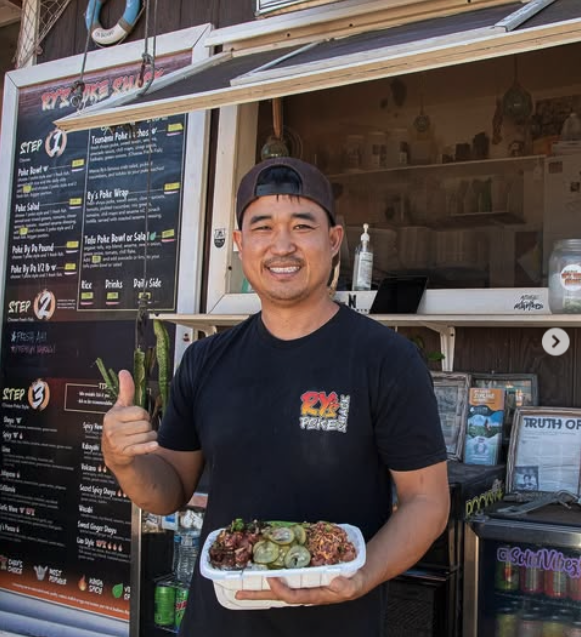
Ryan Ching registered the trade name Ry’s Poke Shack in January 2021 and soon after opened his food truck at the Kahuku Sugar Mill on Oʻahu’s North Shore, the order in the DCCA case shows. In July 2022, Ching heard from a vendor that Ryder Yamaguchi was opening Ry’s Poke and Shave Ice in ʻAiea.
Ching offered to help Yamaguchi come up with a new name, but Yamaguchi declined, registered the trade name Ry’s Poke and Shave Ice with DCCA on July 9 and opened the business later that month, according to case documents.
Ching brought the dispute to the DCCA.
Ruling for Ching, DCCA used the same factors federal courts use to determine whether two trademarks are likely to cause confusion. Those include similarity of the trademarks, proximity of the goods or services, evidence of actual confusion among consumers and whether there’s evidence that the alleged infringer intended to benefit from the plaintiff’s mark.
Ching’s lawyer, Aaron Mun, showed that Ching had established a strong name among customers, advertising on social media and even landing a featured spot on the Netflix series “Street Food USA.”
The agency ordered Yamaguchi to operate under a new name.
Is It Deceiving Customers?
Holland, the trademark lawyer with Dentons, said intent is important in the dispute between the Me restaurants.
“Is there evidence of bad faith or intent to deceive here?” she said. “This is something I’d like to look at more closely. Are they trying to pass themselves off as the original Me’s barbecue?”
Stewart, the new Me’s lawyer, said in an email that his client believed the original Me had abandoned the trade name.
Although the new Me knew about the original Me and its stated intention to reopen, Stewart said the original Me had been closed for two years before the new Me opened using its registered trade and business names.
“In light of this extended period of nonuse, our clients reasonably concluded that J Sejong LLC had abandoned any rights to the trade name,” Stewart wrote, referring to the original Me by its corporate name.
But abandoning a trade name requires more than simply not using it for a period of time, Holland said.
Under Hawaiʻi’s trademark statute, a mark can be abandoned when a person quits using it with no intent to resume use. In addition, the statute says, “nonuse for two consecutive years shall constitute prima facie evidence of abandonment.”
“They were working diligently to find a new location.”
Jordan Inafuku, attorney for the original Me barbecue
Although that favors the new Me, Holland said prima facie evidence is typically open to rebuttal if the original Me can show evidence it was trying to find a new place while it was closed.
“The key question is, ‘Did Me barbecue discontinue without intent to continue use?’” she said.
Jordan Inafuku, a lawyer for the original Me barbecue, said the restaurant didn’t abandon its mark.
“They were working diligently to find a new location,” said Inafuku, a litigation partner with the firm McCorriston Miller Mukai MacKinnon. And there’s ample evidence to show that, he said.
For the original Me’s owner, it’s a matter of protecting the goodwill he and his family have worked hard to build over three decades, Inafuku said.
“It’s a lot of trust capital with his customers that he’s trying to protect,” he said.
Disputes Can Be Costly And Time-Consuming
Mun, the lawyer who represented Ching on the poke case, said Hawaiʻi’s process generally works well enough because business owners in Hawaiʻi are usually willing to work out solutions or avoid using conflicting names to begin with.
But when business owners dig in their heels, it can be expensive and time-consuming for rightful trademark owners to rectify the matter.
“It sucks because of the emotions, too,” Ching said.
If he hadn’t fought for the rights to his trade name, Ching said, it might have complicated his current work to open two new Ryan’s Poke Shack locations in California.
The state of Hawaiʻi might be able to avoid such disputes if it used a system similar to the federal trademark registration process, which involves a rigorous search for existing uses before applications can be approved.
The U.S. Patent and Trademark Office also publishes notice of registrations in its weekly Trademark Official Gazette and gives third parties a chance to object before a trademark is issued.
Regardless of whether DCCA’s registration process is a root cause of the dispute between Me and Me, Wong, the avid Yelp user, says the solution should be simple. She suggested the new Me simply change its name.
“I would call them Ne BBQ instead!” she wrote in her review. “Change that M to an N that way it wouldn’t confuse people!”

