What If HOAs, Not Government, Enforced Wildfire Prevention Rules?
A Kauaʻi County planner thinks homeowners associations should be the first line of defense when it comes to wildfire risk.
Hundreds of homes in a string of old plantation camps in parched, wildfire-prone south and west Kauaʻi provide some of the island’s most affordable housing rentals.
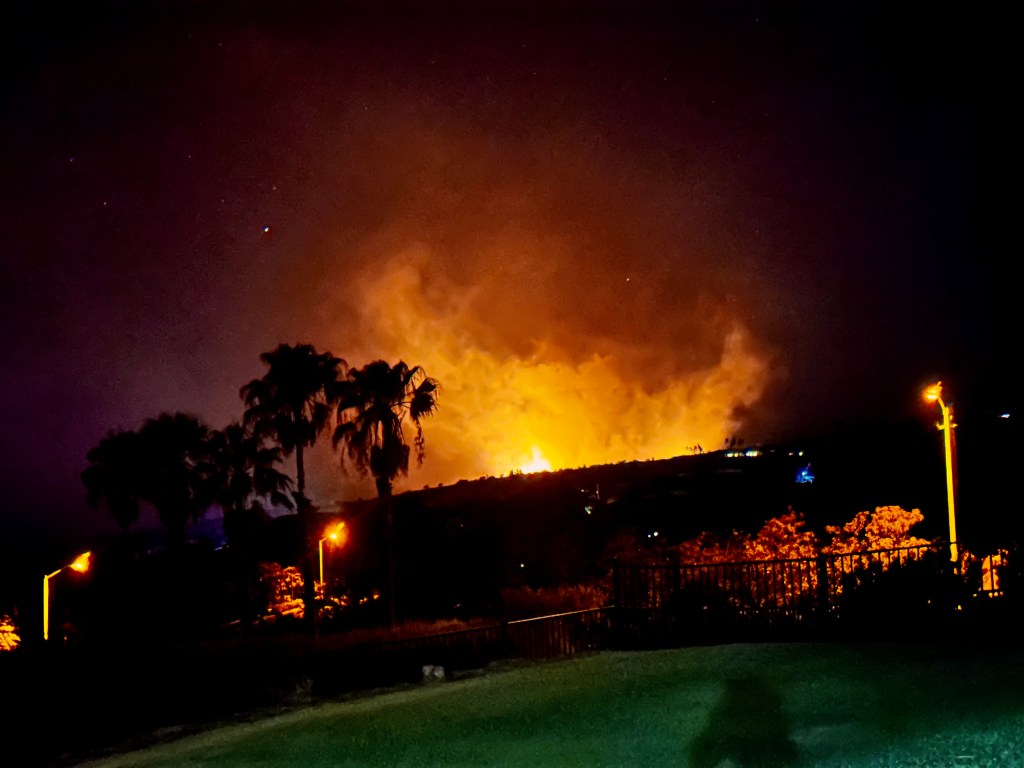
But they’re also in the path of what could be fast-moving flames like those that forced residents of Kaumakani Village to evacuate last July. To protect them from the danger, Kauaʻi County planners are pushing forward a bill to impose new landscaping and construction restrictions on five heritage plantation camp properties.
The proposal that the Kauaʻi County Council is expected to take up Wednesday would task county zoning inspectors with enforcing a ban on landscaping within 5 feet of a residence and a prohibition on invasive, fire-prone shrubs and grasses, among other restrictions.
As wildfire risk grows in Hawaiʻi, Kauaʻi Planning Director Kaʻāina Hull said he’d like to see all new development in high wildfire risk areas adopt similar standards.
But the county lacks the resources to conduct routine residential landscaping inspections beyond the small footprint of the plantation camps. So Hull wants homeowners associations, rather than government, to take on the job of enforcement.

With a focus on preserving property values, homeowners associations typically concern themselves with setting aesthetic standards. But what if they retooled their construction and landscaping rules to promote wildfire mitigation rather than comeliness?
“If they could enforce and actually run a fairly strong wildfire resiliency program within the paradigm of their HOA, it could be a really wonderful thing, I think,” Hull said.
Doug Green, an urban wildfire policy analyst, said homeowners associations can be powerful vehicles to promote wildfire resiliency. Green, who works for the Montana-based nonprofit research organization Headwaters Economics, said it’s an innovative idea that’s gotten traction on the West Coast, especially in new, higher-end communities where residents tend to have a lot of disposable income.
Meaningful wildfire regulations require community buy in and boots on the ground, not only to promote enforcement but to educate homeowners about the potential cost to life and property of not adhering to regulations that can be daunting, time-consuming and costly.
“We’ve seen it implode in other places,” Green said. “The main reason was that the public wasn’t brought to the table early. It doesn’t work when people feel it’s being forced down their throat.”
About 1 in 4 people in Hawaiʻi, or roughly 360,000 residents, live in a community governed by a homeowners association, from skyscraper condominiums to rural subdivisions. The associations are typically created by the developer. Buyers sign a contract and agree to follow the rules.
The associations can dictate decisions about the color of a home, the number and type of pets permissible on a property and whether children can make sidewalk chalk drawings. Those who defy the rules can face fines. In extreme cases, homeowners associations can seize possession of a house and sell it for nonpayment.
Situated adjacent to defunct sugar mills and cane fields in an area at high risk for wildfire on Kauaʻi, Numila Camp, Kaumakani Village, Kaumakani Avenue, Kaʻawanui Camp and Pākalā Camp make up a new plantation zoning area formed last year to help preserve heritage plantation neighborhoods.
The camps today offer some of the most affordable housing options for retired plantation employees and other agricultural workers, with some residents paying a couple hundred dollars or less in monthly rent for a three-bedroom 1940s plantation home. But prior to the adoption of the new plantation camp zone, county rules had barred home renovation and new construction in the camps due to outdated zoning restrictions.
Now the county has its sights set on taking steps to make the camps more resilient to fire risk. Unlike the more typical fire construction standards baked into the wildfire mitigation proposed zoning amendment, setting meaningful rules for vegetation upkeep would require routine inspection.
In addition to landscaping restrictions, the bill proposal would add numerous new building standards, including a ban on certain combustible construction materials and mandatory gutter covers to prevent debris accumulation.
The cost of adhering to these proposed restrictions would be absorbed by the landowners, not camp residents.
The proposal has the potential to work, Hull said, because it has the support of the landowners and the scale is small enough that it wouldn’t overwhelm county zoning enforcement officers.
Land management company Gay & Robinson owns 350 affordable homes across four of the plantation camps affected by the proposed ordinance. Keith Yap, chief financial officer and treasurer of the company, said the wildfire that forced the evacuation of Kaumakani Village last July has deepened anxieties about the danger posed by wildfire.
“The fire was an eye-opener for us,” Yap said. “The fire was literally on the doorstep of our houses and could have burned 200 homes and we got lucky because everybody came to our aid. It’s going to cost us more money to try to comply with some of these things but we don’t oppose it because we want to do the right thing.”
Whether individual homeowners would support the cost of adopting similar standards for their own homes remains to be seen but there are a small number of homeowners associations statewide that have already taken such steps.

Last year the homeowners association that governs Kohala by the Sea, a gated community of 76 multimillion-dollar homes and vacant lots on the Big Island, imposed a rule last year that cracks down on the fire risk posed by overgrown vegetation by mandating owners to trim invasive grasses to four inches or less at least once a year. The mandate followed a series of fire resiliency measures incorporated into the HOA governing documents in 2018, including property-wide bans on haole koa trees, dead palm fronds and brush piles.
For those that aren’t already keeping a tidy lawn, the new rule is expected to cost owners an average of $800 to $1,200 a year, according to Jeanne Cooper, a member of the committee that proposed the regulation.
“I’m in an area of $2 million homes on up, so from my perspective that’s a small price to pay to preserve property and life,” Cooper said. “Most people here do have a professional gardener or landscaper.”
The neighborhood has not achieved 100% compliance and the HOA has favored the approach of hitting offenders with violation notices rather than fines. So far, the number of overgrown lots has dropped to about 24 from 36 since the rule went into effect, Cooper said.
On the same day that wildfire engulfed Maui’s historic town of Lahaina in August 2023, brush fires in North and South Kohala burned over 1,500 acres, forcing the closure of three major highways and sending Kohala by the Sea residents into a frantic evacuation before sunrise.
Kohala by the Sea has a record of being fire-conscious. In 2004 the neighborhood became the first in Hawaiʻi to be recognized as a Firewise USA community. The initiative run by the National Fire Protection Association encourages communities to take steps to reduce their wildfire vulnerability.
“I think if homeowners associations are going to enforce regulations such as the color of your door and the shape of your windows,” Cooper said, “then they’re certainly entitled to enforce regulations that can have profound consequences for life and property.”