Honolulu Is Canceling Its Empty Homes Tax Study. Will That Kill The Bill?
The yearlong study was supposed to help inform a now-stalled bill that would have increased property tax rates on unoccupied homes.
After years of failed attempts, the Honolulu City Council came closer than ever to approving a higher tax on homes left vacant for at least six months of the year as part of efforts to increase the availability of housing for local residents.
The controversial empty homes tax bill was on the brink of being rejected again during a final vote in December, but Council Chair Tommy Waters threw it a lifeline. He proposed tabling the bill until a city-commissioned study on how to implement the tax could be completed.
But the city is quietly canceling that $500,000 study even though final results had been due in mid-September, according to budget director Andy Kawano. The decision surprised Waters and council member Radiant Cordero, who co-introduced the bill. They said they didn’t know about the plan until Civil Beat asked them about it.
Waters said he still plans to reintroduce the measure “at the appropriate time,” but it’s unclear how it would fare differently considering opponents had said they were waiting for the study’s results.
University of Hawaiʻi political scientist Colin Moore said the termination of the study could be a way of letting the bill fizzle out.
“Not having the report out there means it just kind of quietly disappears,” he said.
Kawano said he decided to cancel the study because he believed it lacked support from the council members who he said didn’t reach out or ask questions after the consulting firm Ernst & Young, also known as EY, presented initial findings in April.
Council Members Not Informed
“It was very quiet after that,” Kawano said last week in a telephone interview. “And ‘quiet’ meaning that we weren’t receiving any inquiries from council members.”
Cordero said that’s flawed logic.
“If Director Kawano didn’t hear back from any members, it’s because we were waiting to see the rest of the report,” she said.
Kawano said EY finished the feasibility portion of the study in February, and at the time, he told the consultants to stop working. EY presented its findings to the council in late April, and after gauging a lack of council member interest Kawano told them he was canceling the study in mid-June.
Kawano said EY invoiced the city for $300,000 for work including Phase 1 and part of Phase 2, but he wants to see proof of the work before agreeing to the price.
Honolulu has stepped up efforts to increase the affordable housing supply for local residents in a market that has seen the median sales price for a single-family home rise to over $1.1 million.
Part of the problem, Waters has long said, is that the city’s low property tax rate makes housing an attractive investment for offshore buyers who don’t intend to live on the island but hope to sell the properties for profit.
Waters and other supporters think a solution is to tax empty homes at a higher rate, providing an incentive for owners to either rent them out or put them back on the market.
Opponents said the empty homes tax could hurt local families who may have inherited second homes, that it would be an administrative burden and would violate the U.S. Constitution.
A coalition of local real estate groups sued San Francisco over its empty homes tax, and a judge ruled against the city last fall. The city appealed, and in the spring its Board of Supervisors voted to pause implementation of the tax unless the city prevailed in court. However, a version of the vacancy tax also exists in Washington, D.C., where it targets both residential and commercial properties.
Last year, the City and County of Honolulu awarded a $500,000 contract to EY that Kawano said started in mid-September, although the state’s contract award webpage pegs the start date to Aug. 1. The consultant to study the feasibility and implementation of an empty homes tax for Honolulu and provide revenue and cost projections and recommendations for the council to consider in deliberations over the bill.
Initial Findings
Some of those questions were answered in an initial presentation in April.
The contractor said a gaping loophole and two of the bill’s many exemptions — which had proven politically necessary to advance that far — were unusual compared to other cities’ empty homes taxes, leaving up to $150 million of revenue on the table over the course of a decade.
Meanwhile, the city could expect about $290 million in revenue and about 1,100 homes returned to the market, assuming a consistent 3% tax rate, in that time period, EY representatives told council members. The study’s second phase was supposed to tackle granular administrative questions like what tools the city would need to implement the tax.
Cordero said she was upset Kawano didn’t tell her ahead of time that he was terminating the study.
“It ticks me off,” she said. “That’s not in the spirit of being collaborative.”
Waters also had not been informed about the decision, his spokesperson Aron Dote said in a phone call. Waters declined to be interviewed but said in a written statement that the decision was understandable, given gaps in data and that it doesn’t have to rely on results from the study’s second phase, which covers administration.
He said he still intends to eventually schedule the empty homes tax bill for a final vote “at the appropriate time,” without elaborating.
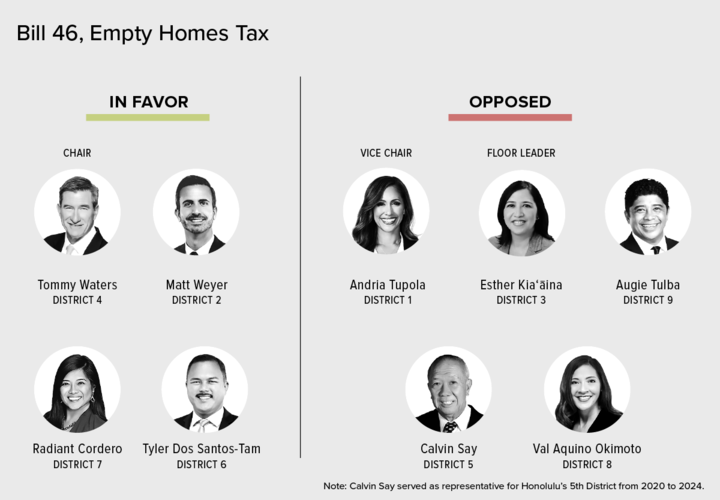
Council members have tried to pass an empty homes tax at least three times in the past decade. The current bill is the closest the effort has come to fruition. Last December, it reached its final vote before passage, only to derail when it became clear former council member Calvin Say would vote against it, depriving it of the tie-breaking vote it needed to pass.
Rather than let the bill die — which would require starting back at square one if they were to try again —Waters successfully proposed postponing a final vote until the study yielded results. Dozens of opponents suggested this exact move in their testimony.
“The most prudent decision is to defer this vote,” Honolulu Board of Realtors CEO Suzanne Young testified at the time. “At a minimum, wait for the study from Ernst & Young.”
It’s too late to schedule the vote for the council’s August agenda, so the earliest it could come is September. Council member Scott Nishimoto hasn’t had to vote on the empty homes tax since replacing a retiring Say in January, so it’s unclear where he stands. He did not respond to a request for comment.
Is The Juice Worth The Squeeze?
Kawano said he had hoped to reach a settled payment with EY in June, but the company has been slow to work with the city, which is asking for proof of work. EY Canada, the team leading the study, didn’t respond to a message left on its media inquiry webpage.
“They’re saying that they actually had started on some of the implementation phase,” Kawano said of consultant EY, “so they feel they should be paid for it.”
The money comes from the federal government’s Covid-era State and Local Fiscal Recovery Funds program, and its due date to be obligated was at the end of 2024.
Whatever isn’t spent will be returned to the U.S. Treasury, Kawano said later in a text. He also said if the study is completed but the council doesn’t pass an empty homes tax, “there is more risk to the City that the US Treasury would require a return of all or a portion of the funding.”

EY’s April presentation to the council estimates it would cost about $2.3 million to implement an empty homes tax and about $4.4 million to operate it each year.
The current version of the bill doesn’t specify what the tax rate would be — it only creates a new property tax category — but a previous version pegged the rate at 1% of a home’s assessed value for the tax’s first year and 2% for the second year before leveling out at 3%. That’s almost 10 times the rate of an occupied home.
While campaigning for his first term in 2020, Mayor Rick Blangiardi said he was interested in taxing vacant homes, citing Vancouver as a successful model to follow. His office referred questions to Kawano.
Kawano said the mayor has been “lukewarm” on an empty homes tax since their consultant’s April presentation, but the administration is keen to add more units of housing to Oʻahu through enforcement against illegal short-term rentals and fast-tracked construction of low-rise affordable rentals.
Civil Beat’s reporting on economic inequality is supported by the Hawaiʻi Community Foundation as part of its work to build equity for all through the CHANGE Framework; and by the Cooke Foundation.