

Struggling And Lost On Oʻahu’s Streets, Woman Says Yes To Help
A psychiatrist set out to find a 33-year-old Hilo woman who battles homelessness and addiction after a failed medical intervention.
Chad Koyanagi, a psychiatrist who’s spent decades treating Honolulu’s homeless population, arrived Monday at an oceanside encampment in the city’s Sand Island area to search for a woman with mental health struggles who seemed to think she was on the Big Island.
A man who sleeps in an abandoned red Mustang pointed to a patch of sidewalk covered by a gray tarp. The tent was empty. But it didn’t take long for Koyanagi to find its nightly occupant talking to herself while walking alone on a nearby beach.
Within days, the psychiatrist’s crisis intervention would lead the woman to agree to move off the streets and into an emergency care facility in Iwilei that could connect her with housing and mental health care, if she’s willing to receive it.
“Something magical happened,” Koyanagi said. “She agreed.”
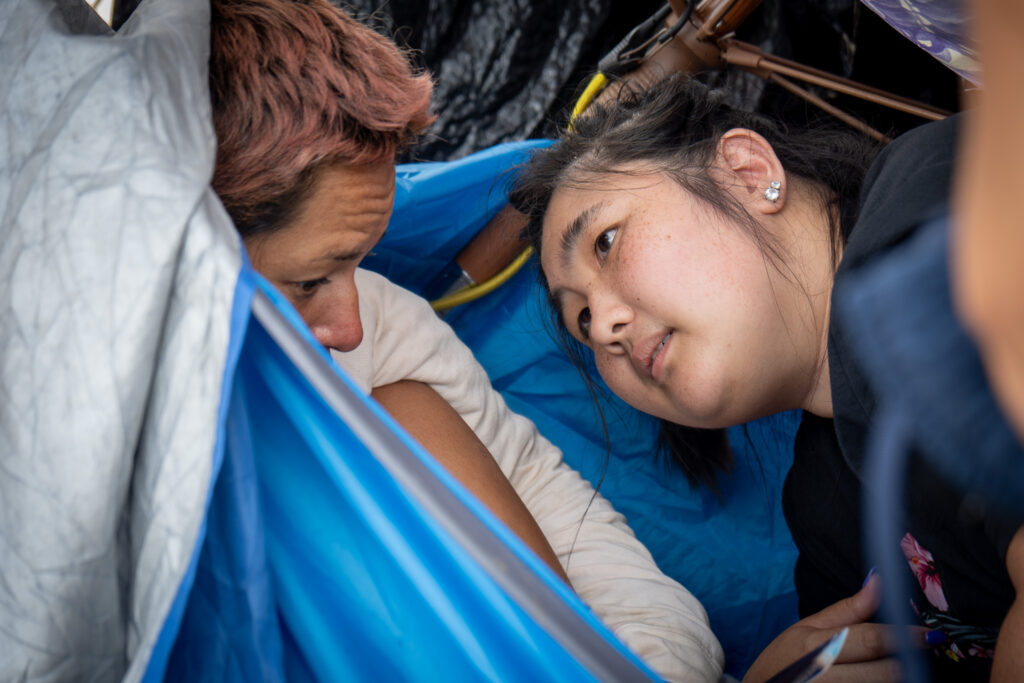
A primary hurdle to helping some of the hardest to treat homeless mentally ill people is their unwillingness to accept help in the moment when it’s offered. This is typically due to a lack of insight of how well they’re functioning, either due to mind-altering drug use or mental illness.
The woman, 33-year-old Kuuipo Surls-Kane, had been living on the streets of Hilo when a midnight assault in a county park earlier this month landed her on a medical flight to The Queen’s Medical Center in Honolulu. In Hawaiʻi, rural hospitals frequently transfer patients needing higher levels of care to better-equipped facilities on O‘ahu.
At Queen’s, Surls-Kane, who suffers from drug addiction and frequent bouts of psychosis, was combative and refused care for a broken jaw and head trauma, her family said, so the hospital staff discharged her. When an adult patient is adamant about their refusal to receive care, doctors have little choice but to let them go.
After she walked out of the Punchbowl Street medical facility wearing blue hospital scrubs on Aug. 3, it took Surls-Kane’s family in Hilo 13 days to track her down on the streets of an unfamiliar city. But, to their surprise when they found her, Surls-Kane said she didn’t recognize her cousin or her niece. She refused their pleas to check into a hospital or board a flight back to the Big Island, where, even if she insisted on staying on the streets, her family could at least check on her.
When Koyanagi learned about the family’s plight from reading the Aug. 20 Civil Beat story about her, he felt compelled to help. It’s not in his job description as the person who manages the state’s behavioral health services for people on Medicaid to search the streets of Honolulu for people in crisis. But his extensive experience administering care to people who struggle with chronic homelessness and severe mental illness has made him uniquely adept at navigating mental health law and the patchwork of resources available to people in desperate situations.
On the beach Monday afternoon, Surls-Kane refused Koyanagi’s help in returning to Hilo because, in her mind, she had never left her Big Island home. But she said she wanted help to replace her EBT card — a small opening that, over time, could be leveraged to help her with more urgent problems, such as finding shelter, mental health care or substance abuse treatment.
On Wednesday, Koyanagi set out again for Sand Island to introduce Surls-Kane to a case manager from CARE Hawaiʻi, a private provider for people with serious mental illness. He said he found her in rough shape, talking to herself on the crash from a high off an illicit street drug.
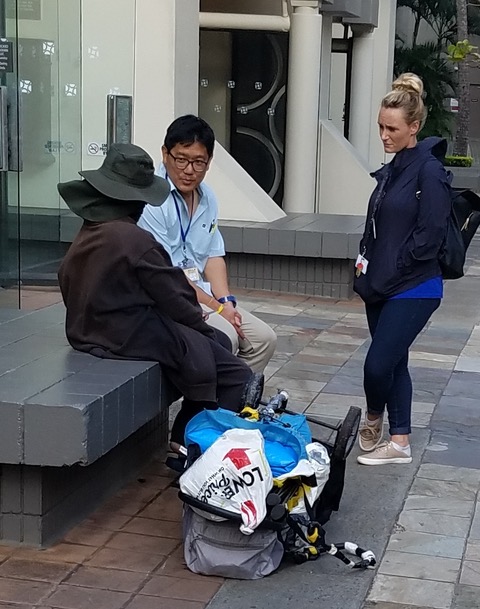
On a park bench, Surls-Kane sat between the psychiatrist and the case manager.
“Are you hungry?” Koyanagi recalled asking Surls-Kane. “Would you like to take a shower?”
The case manager explained there was a place he could take her where she could clean up and get a bite to eat, she just had to agree to go there.
Families of people with severe mental illness sometimes wait years for an opening like this — an invitation to provide care to a person who’s suffering from an illness they may not understand or acknowledge. For some families, this moment never arrives or it comes too late.
“I was extremely surprised that she agreed to go,” Koyanagi said. “It’s a great outcome for now.”
For case managers, a key to addressing the complex web of issues that beset many people who live on the street with severe mental illness is to build trust by delivering on a person’s desire for small improvements — a replacement EBT card, a shower — and then leverage that trust to address more difficult and enduring problems.
Back in Hilo, Surls-Kane’s 24-year-old niece Kylee Ramirez received a series of text messages from the psychiatrist with the promising news: Her aunty was on her way to the Behavioral Health Crisis Center in Iwilei. The state-run facility — the first of its kind in Hawaiʻi — opened last spring to provide a nurturing space for people struggling with chronic homelessness and severe mental illness to receive stabilizing care while minimizing the strain on law enforcement and hospital emergency rooms.
Surls-Kane, the psychiatrist said, would be able to stay in the facility for up to 10 days, so long as she remained willing to receive care. After that, the program could help her find housing or ready her for a flight back to Hilo — if that’s what she said she wanted.
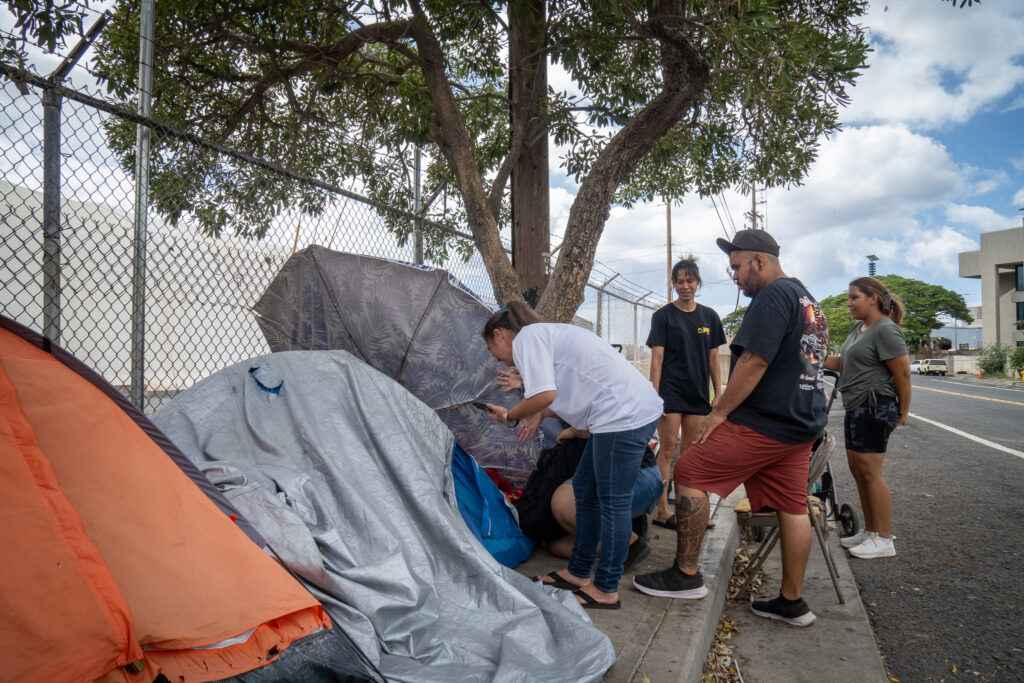
It was the best news Ramirez had received since she flew to Honolulu two weeks ago to trace Surls-Kane’s steps to a Sand Island homeless encampment, only to find her distressed and unwilling to cooperate. Surls-Kane was adamant that she had no family at all.
It broke Ramirez’ heart to have no choice but to walk away that day, leaving her aunty alone on the streets. It was the first time in over a decade of mental illness that Surls-Kane failed to recognize her.
For people with serious mental health diagnoses, a common and damaging issue is a lack of insight into their illness. People who don’t know they’re sick are unlikely to agree to receive help.
It’s unlawful to treat someone with mental illness against their will unless they pose a danger to themselves or others. Yet many mental health advocates say it’s inhumane to allow someone to go without help when they aren’t well enough to know they need it.
On Wednesday afternoon, Ramirez was hopeful again. If her aunty’s condition improved, perhaps she could rekindle their connection. She’d start with a phone call. Then, a visit.
“Maybe when she comes down from the drug she’ll remember me,” Ramirez said. “Maybe she’ll come back home to Hilo.”
For now, all Ramirez can do is wait.
Civil Beat’s reporting on economic inequality is supported by the Hawaiʻi Community Foundation as part of its work to build equity for all through the CHANGE Framework; and by the Cooke Foundation.

