Why Honolulu Bus Fares May Be On The Rise
A monthly pass would go from $80 to $90 under the proposal in what would be the first increase in three years.
Honolulu transit fares could go up starting next year to help make up for lower ridership and pay for escalating costs as bus service is increased and new labor contracts are negotiated.
For some riders who have been using the system for years, the price increases are just another example of an increasing cost of living to which many feel resigned.
“The gas prices, the food prices – it’s ridiculous,” Pacific Heights resident David Hartwick said on a recent Tuesday while waiting for Route 123 to take him home from Alapaʻi Transit Center. “But it is what it is, and you cannot change anything.”
The City Council is scheduled discuss the new rates at a budget committee hearing Tuesday morning. Along with raising the monthly adult fare from $80 to $90, Bill 54 would raise the cost of an annual adult fare from $880 to $990, seven-day passes from $35 to $45, the monthly youth fare from $40 to $45 and the annual fare for kūpuna from $45 to $50, among other changes.
Single fares would still be $3, but riders who pay with cash would be charged an extra 25 cents to encourage Holo card use. TheHandi-Van fares would go from $2.25 to $2.50 for a single ride.
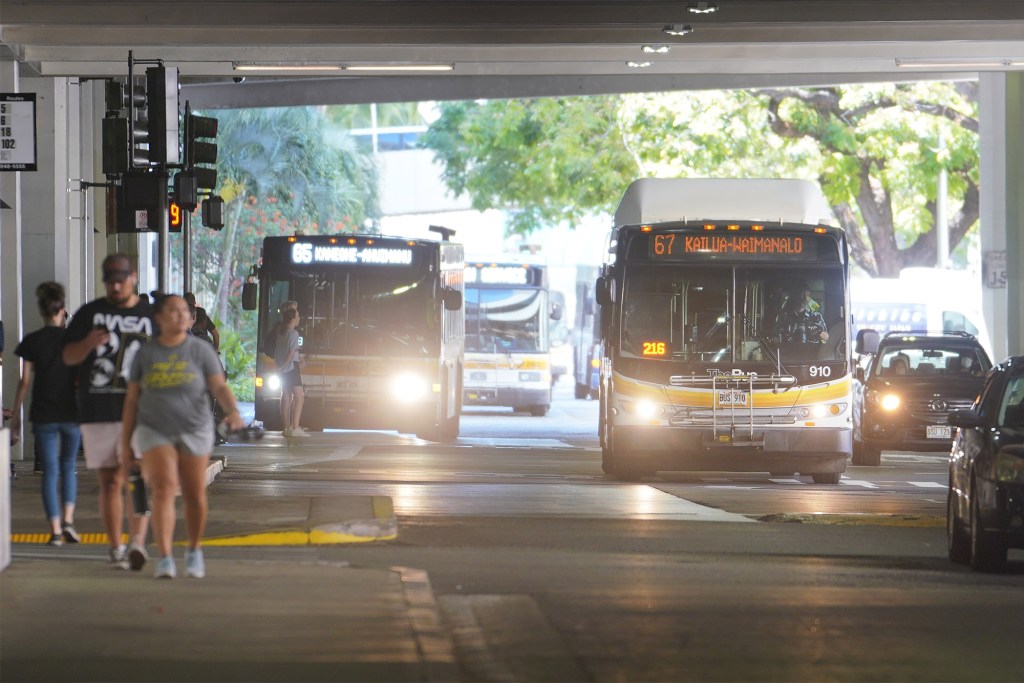
The bill has already passed its first two votes by the full nine-member council, which could give final approval as soon as its next monthly meeting on Oct. 1. The increases would take effect on Jan. 1.
Hartwick, who works at a furniture shop in Ala Moana, had heard the cost would increase but wasn’t clear on how much. After being informed of the exact cost, he said the fare increase is doable for him since he doesn’t have kids, but he’s frustrated by the feeling that the government keeps raising rates.
Fares Have Increased Faster Than Inflation
Since the city started offering monthly bus passes in 1979, fares have climbed faster than inflation. An adult monthly pass cost $15 back then, the equivalent of $64.03 today. But rather than today’s monthly pass costing $64.03 — which would put it on par with inflation — the proposed increase would push it to $90.
The reason for this mismatch between inflation and fare cost is complex. A more affluent society that drives more cars means TheBus has to raise its standards to compete, even as its per-capita ridership declines, Department of Transportation Services director Roger Morton said.
“In order for us to compete with cars,” he said, “we have to make our service better and better than the sardine cans that we used to have where we crammed 75, 80, 85 people into a bus.”
It’s not a competition the city is winning. Ten years ago, about 5.5 million people rode TheBus during the month of July. This July, the ridership was only about 3.2 million, so higher fares are needed to maintain revenues, according to Morton.
In addition, Morton said, TheBus operates more frequent service and longer routes than it used to, pushing operating costs higher since that means having to pay for more labor. When measured by miles of service, Morton said, “the amount of service that we put out now is actually more than we had pre-Covid.”
For Holo card users, the system automatically caps fares at the same rate as a monthly pass, which would be $90 under the proposed increase. At the current price of $80, the cap means a commuter who rides the bus twice a day for five days a week essentially gets the last week for free.
On a recent Friday, Pearl City resident Sahlee Rimonos was waiting for a Route 54 bus to take her home from her job at a skilled nursing facility along Kalākaua Avenue. She often wakes up at 5:30 a.m. to carpool with her brother as he drives to his job, but on the way home she’s on her own.
Asked whether a higher fare would be a hardship for her, she laughed and said she would just have to pay it.
“Eh, what can I do?” she said. “I don’t drive.”
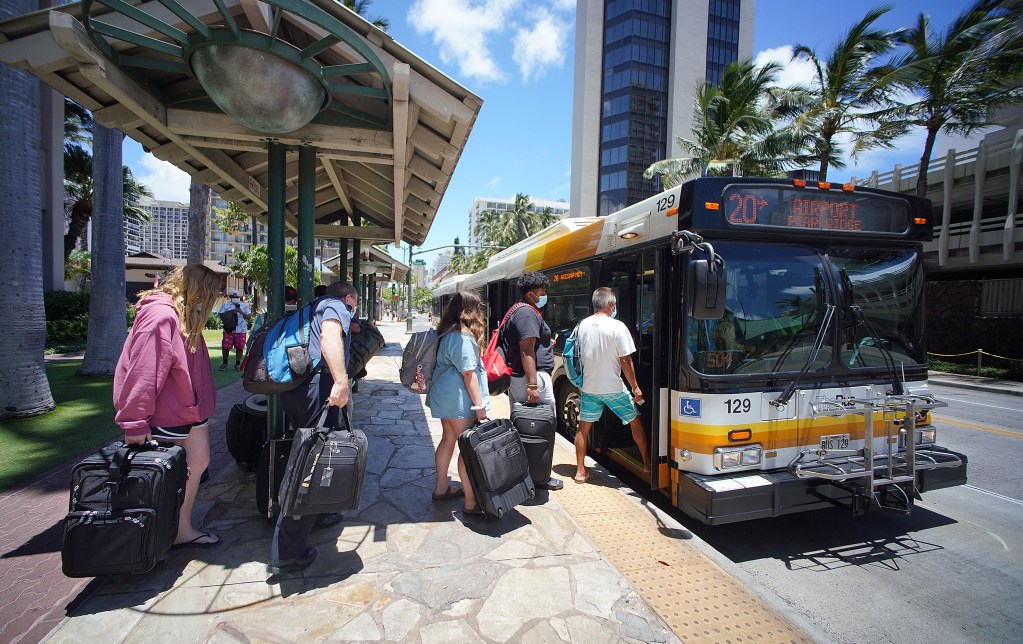
How Much Should TheBus Be Subsidized?
Fare prices generally don’t provide enough revenue to operate transit systems in the United States. Because of this, the question for local governments often isn’t whether to subsidize them but instead how much to subsidize them.
The Honolulu City Council set a non-binding goal in 2001 that bus riders would provide between 27% and 33% of operating costs, although that goal was lowered in 2019 to between 25% and 30% to reflect lower fare revenue.
The Skyline rail system, which debuted with partial service in 2023 and is due to open more stations later this year, is covered under separate operating costs, Morton said.
Rather than fiddle more with the numbers, council member Tyler Dos Santos-Tam thinks the city should scrap that metric completely. He introduced a resolution this month to do so, saying it puts the city in an awkward position of either having to raise fares to reach its goal or cut service to reduce costs.
Dos Santos-Tam voted against the fare increases during the council’s most recent hearing on them earlier this month, noting that the council is considering cutting property taxes at the same time.
“There’s a whole lot of people who own no properties and sit on TheBus every day just to get by,” he said. “Like, who are we really serving here?”

Riders contribute about $45 million to the system each year — out of more than $300 million — and the proposed fare increases would raise their contribution by about $4 million.
Morton doesn’t agree with Dos Santos-Tam that the ridership contribution goal should be scrapped. Property taxes help subsidize bus service, Morton said, along with federal funds and other revenue like vehicle registration fees, but raising property taxes to pay for bus service is a political nonnegotiable in Honolulu right now.
Fare increase proposals don’t always come to fruition. Council members rejected a bill in 2018 that would have raised TheHandi-Van rates and bus fares.
CORRECTION: The fare increase for TheHandi-Van was misstated and has been corrected. The current price for a one-way trip is $2.25, which would increase to $2.50 under the proposed changes.
“Hawaiʻi’s Changing Economy” is supported by a grant from the Hawaiʻi Community Foundation as part of its work to build equity for all through the CHANGE Framework.