

‘Complete Failure’: Honolulu Permit Workers Say Tech Upgrade Is A Bust
The permitting director insists the new program is working and problems are being fixed, but some staff are begging for a return to the old system.
A multimillion-dollar overhaul of Honolulu’s building permit software in early August was a disaster for staff who reported in the weeks after it launched that the dysfunctional system was making their jobs harder, slowing down already glacial permit reviews and raising concerns about the safety of newly permitted construction.
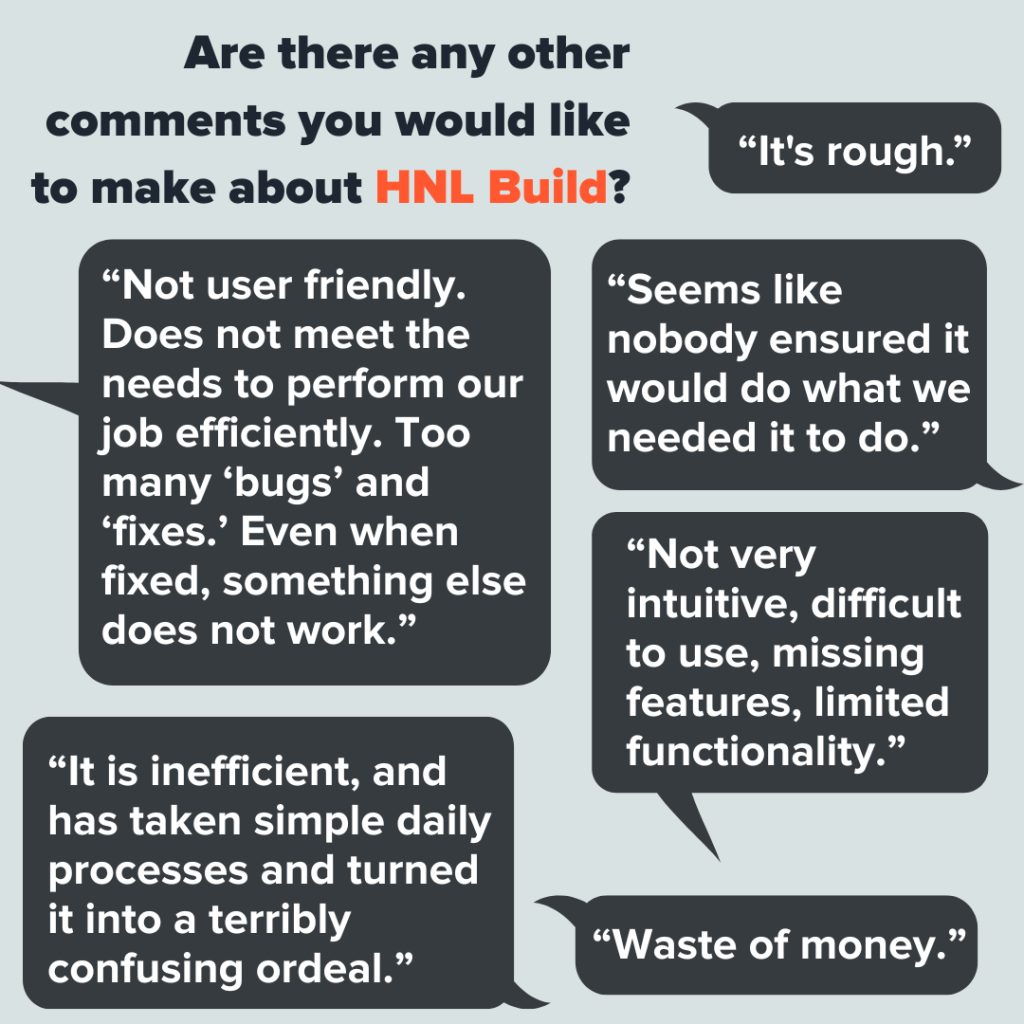
In an anonymous survey of more than 150 employees — half the staff — respondents delivered almost universally negative feedback with many suggesting the entire transition to the new system was a mistake.
The city replaced a longstanding custom program with an off-the-shelf solution from Salesforce that was immediately met with an avalanche of complaints, leaving the city’s software contractors scrambling to establish workarounds and fix bugs. While the permitting department says some complaints have been addressed and the overall tech transition was necessary, multiple employees said in the survey that the new program is fundamentally ill-suited for the city’s regulatory needs.

Tasks that used to take minutes suddenly took hours, they said. Data that was accessible before became impossible to find. And information could be changed without a log showing who edited what. One engineer went so far as to say they would refuse to enter a building that was reviewed under the new system because they can’t trust it is safe.
“I am absolutely terrified of what the Department will be approving with this barely-complete workflow in place,” the engineer said.
“These types of landmines that are being planted by incomplete and ill-informed reviews – because the correct data and information was not accessible to reviewers – are only going to be discovered years or decades down the line when people are severely injured or killed.”
That employee likened the transition to a bus careening towards a cliff whose passengers are “screaming to no avail.”
“I am absolutely terrified of what the Department will be approving with this barely-complete workflow in place.”
An anonymous Honolulu permitting department engineer
Mayor Rick Blangiardi and DPP Director Dawn Takeuchi Apuna have been defending the bumpy rollout, asking for patience and characterizing critics on staff as being resistant to change.
The mayor scolded a Honolulu city councilman for holding a hearing that spotlighted the system’s shortcomings. And Takeuchi Apuna has insisted the overall program is a step in the right direction, even if some staffers are struggling to adapt.
But in their own words, the staff painted a picture of problems that go far beyond a handful of bureaucrats stuck in their ways, and many asked the city to return to the old system. One staffer said in their survey they’ve never heard DPP’s workers speak with such a “unified voice.”
The survey asked staff to rank the system on a scale of 1 to 5. In each of the first three weeks of use, the largest group chose 1. No one ranked it a 5.
The new system, HNL Build, launched on Aug. 4. The survey was conducted at the end of that month. In a statement, Takeuchi Apuna said the responses reflected a “particularly difficult stage” in the transition.
“However, since that time, both the system and the overall user experience have improved,” she said, “and they continue to do so as we resolve issues, enhance functionality, and provide additional training and guidance to staff.”
While the department issued far fewer permits in August than it did a year prior, the director said it gained speed in September and issued a comparable amount, year over year — about 1,300.
“This steady, positive trajectory reflects improved familiarity, confidence and momentum among staff,” she said. “Yet, we know the work is far from over. We continue to experience growing pains throughout the department as part of this transformation.”
Staff: Speed, Security And Safety At Risk
Streamlining Honolulu’s Department of Planning and Permitting was a key campaign promise when Blangiardi first ran for mayor in 2020 and remained a pledge during his reelection last year.
However, as of earlier this year, average permit processing times — the gap between application and issuance – were higher than when the mayor first took office, with many taking months or years.
The mayor and DPP director hyped the technology upgrades as a major solution.

But since the launch, the survey shows, the staff’s complaints have been numerous and wide-ranging, from mistakes in migrating data from the old system to the number of steps it takes to process a permit. An engineer in the customer service division called the implementation “a complete failure.”
“HNL Build requires many more clicks than before to complete the same job,” a clerk wrote.
DPP spokesman Davis Pitner said an initial slowdown is to be expected as new HNL Build users get used to the new program, though he acknowledged some operations require extra steps.
The most impassioned survey response came from the engineer who reported concerns about the safety of construction approved under HNL Build.
Under the old system, POSSE, every action by staff was permanently recorded and timestamped and could be pulled from the system “like a string of beads.” Not so with HNL Build.
“‘Show me what this permit looked like on August 24, 2013’ is possible with POSSE,” the engineer said, “but ‘Show me what this permit looked like yesterday’” isn’t even possible with Salesforce, let alone going years back. There is no confidence in actually knowing what happened, who did it, or why it happened.”
The system tracks the history of a limited number of fields, the staffer wrote, but tracking can be silently disabled and re-enabled. Takeuchi Apuna acknowledged in a recent interview that could be a problem in a department that was rocked by a bribery scandal that in recent years sent six people to prison.
Pitner told Civil Beat earlier this month that the system allows the agency to track all data fields related to process decisions and fees, and tracking can only be modified by a system administrator, such as an IT professional.

An additional concern cited by the engineer: HNL Build allows staff to bypass certain reviews.
“The entire point of the permit process is preserving health and life safety, and this system is a huge step away from that primary responsibility,” the worker said.
“As someone who ‘sees how the sausage is made’ I will not be stepping foot inside anything that was reviewed or processed through the department after August 2025 unless there are additional non-DPP layers of oversight as it is clear the process has been so severely fractured it can no longer be trusted to keep people alive and breathing,” the employee said.

In this ongoing series about Honolulu’s notoriously troubled permitting department, we seek to explain the failures, inequities and inefficiencies in O‘ahu’s permitting process and explore solutions that would make the system work better for everyone.
Asked about this, DPP officials have not denied that some reviews can be skipped in HNL Build, although they have not specified which those are.
The city is trying to strike a balance between maintaining internal controls and allowing staff the flexibility to do their work without slowing them down, Pitner said earlier this month. Personnel have ethical obligations to do what is proper, he said.
Asked again about workflow vulnerabilities last week, Pitner said no system is foolproof and there will be opportunities for errors, which were present in the prior system as well.
Nevertheless, he said, the agency is “confident the quality of our reviews meets the appropriate standards.”
‘A Monumental Undertaking’
The foundation of HNL Build is a Salesforce platform that is overlaid with a workflow system called Clariti. Another company, Speridian, was hired to install and customize Clariti for Honolulu.
Between Clariti and Speridian, the new system cost $7.3 million in federal and city funds.
It replaces a program called POSSE that was in place since the late 1990s and was custom-designed and continuously upgraded to DPP’s needs over more than two decades. The new system uses “templates and modular design,” Pitner said — more of a one-size-fits-all approach. DPP pursued this kind of “out-of-the-box” solution purposely, he said, in the hopes that more uniformity could avoid maintenance issues down the road.
The transition, the impassioned engineer said, is not like switching from Windows to Mac.
“This would be more akin to switching from a multi-thousand-piece LEGO set (with complete instructions, years of design invested, and best practices carefully considered and implemented) to using hand-carved lincoln logs,” they said.
Salesforce is a customer relationship management tool and was not specifically designed to act as a regulatory database. Problems could be “chipped away at” over time, the employee said, but the structure is not tailored for this purpose.
Several other survey respondents said the same, and Takeuchi Apuna acknowledged the difficulty.
“This is, without question, a monumental undertaking — replacing a highly customized, 28-year-old legacy system with a modern, out-of-the-box solution,” Takeuchi Apuna said.
“Change of this magnitude is never easy, but it is necessary. We are confident that, together, we will continue to build on this progress and achieve lasting improvement.”
It was necessary to replace POSSE in the first place because it was “several years past its supportable lifespan,” Pitner said, and budget limitations meant upgrades were prohibitively expensive.
A committee that helped to choose the new software vendor did consider POSSE’s upgrade, he said, but it didn’t make the final selection round. Hiring another vendor to create a new system from scratch would’ve been too costly.
In a statement, a Clariti spokesman said the company is working with Honolulu and Speridian to ensure the platform “delivers as intended.” The company serves permitting departments elsewhere, from Albany to Phoenix.
“Large-scale technology transformations always involve an adjustment period, and real-time user feedback plays a key role in shaping and improving the experience,” Jeremy Bosch, the company’s vice president of marketing and communications, said.
“Having partnered with over 160 municipalities across North America, we know that what Honolulu is experiencing is a normal part of the process as staff and the development community become familiar with the new system and application processes.”
Civil Beat reached out to Speridian for comment but did not receive a reply.
Speridian has agreed to provide a period of “hypercare” to ease the transition, but several staffers expressed concern that the vendor does not understand the scale of the problems and isn’t adequately addressing them.
Many complaints, they said, are met with a no-can-do response: “That’s a system limitation.”
“If the point was to make our permitting easier, we have missed the mark,” an engineer in the site development division said. “It will take years to develop HNL Build closer to what we had …”
Old System Was Better, Staff Says
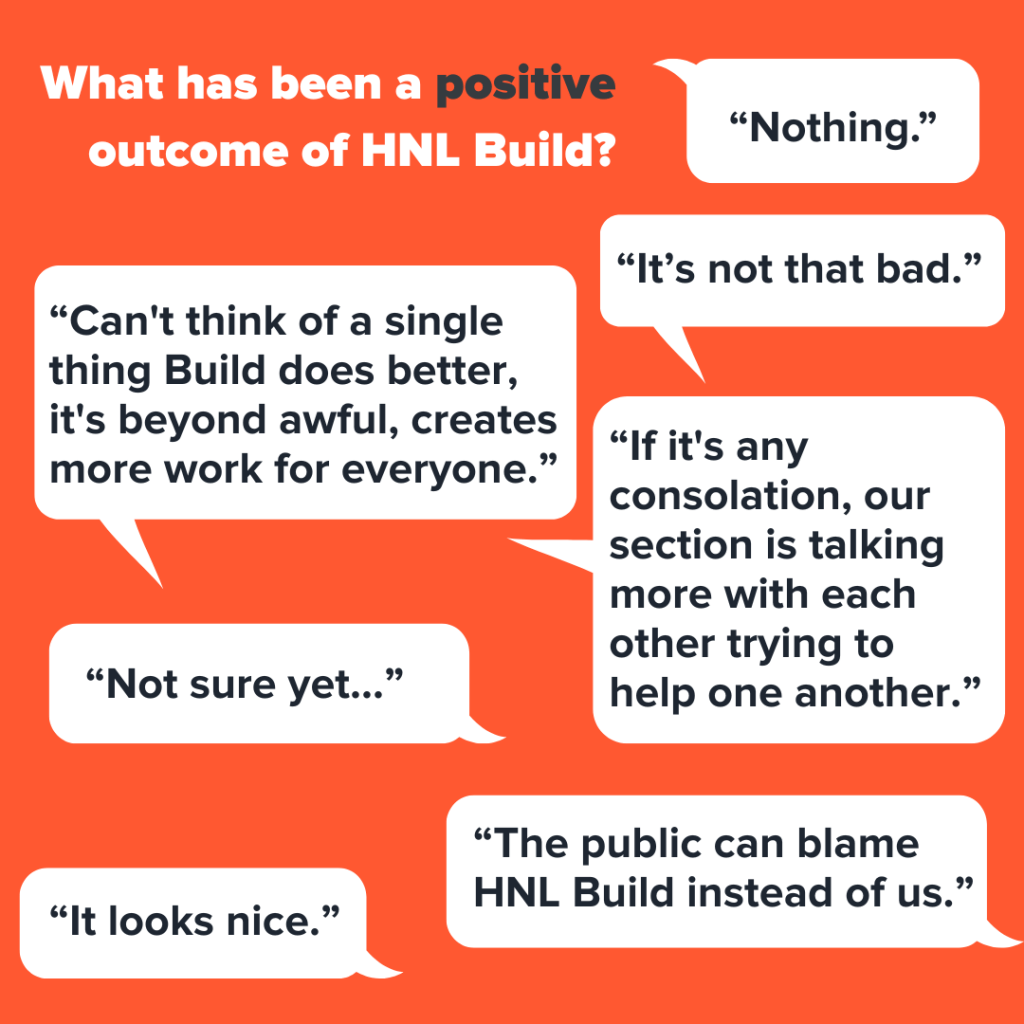
Asked to name something positive about the new system, many employees came up empty.
“ZERO,” one engineer said. “It only added more to the backlog and confusion to staff and the public.”
The only benefit several workers cited was a newfound appreciation for the old system, which they said was fine to begin with. Another pro from a building plans checker: “The public can blame HNL Build instead of us.”
Some workers did list some aspects they like, including that it allows property owners to view their application, and several expressed hope that the system would become better over time.
The system was chosen in collaboration with staff, but at least one of those involved in the selection has buyer’s remorse.
“I have a lot of regrets in life,” a building plans checker wrote, “but not as big as voting for this system.”
Employee after employee asked for more training, technical support and written guidance.
But some felt the city should just cut its losses.
“Cancel it and go back to posse,” an inspector said.
“Additional training and guidance won’t help if the system does not work,” a city planner said. “Almost a month has passed it’s still not functioning correctly.”
The system will eventually integrate artificial intelligence to help review building plans, according to DPP, but that feature is not yet widely available.
Following the survey, Takeuchi Apuna said DPP continues to work with Speridian to address problems, many of which have been resolved. Others are in progress, she said.
“We understand that levels of satisfaction vary, and that some staff who want to go back to POSSE may still feel uneasy with this change,” she said. “It is our responsibility to ensure that every staff member feels safe, supported, and capable within this new environment. That requires listening, training, consistent communication, and time.”

