

OHA May Have Found A Way To Build Housing In Kakaʻako Makai
After years of failing to get building approval, the office may look to another Hawaiʻi government agency to jumpstart construction.
The Office of Hawaiian Affairs has long struck out on efforts to lift a ban on residential development that would allow it to construct housing units on lands it owns in Kakaʻako Makai.
Now, OHA and the state Department of Hawaiian Home Lands are in preliminary discussions to use DHHL’s special development powers granted to it by Congress to move housing development forward.
OHA trustees said the goal of such an agreement would be to build housing targeted at Hawaiian homelands beneficiaries instead of the market-rate homebuyers OHA planned to market to in the past.
DHHL projects are generally exempt from zoning restrictions because of its mission to develop housing units for qualifying Native Hawaiians who can prove a 50% blood quantum under a more than 100-year-old federal law.
“Having residential housing is very important for whatever the future of Kakaʻako Makai looks like,” OHA Board of Trustees Chair Kai Kahele said in an interview Wednesday morning. “We strongly believe that Native Hawaiians should be able to live in the urban core, and that they should be able to live in Kakaʻako Makai.”

OHA gained control of about 30 acres of land in Kakaʻako in 2012 through an agreement with the state to settle decades-old claims over land revenues owed to OHA. The land was valued at $200 million at the time, but OHA has never been able to access the full financial benefit from those lands.
Kahele said that OHA is considering a range of options for development in Kakaʻako, and that DHHL is one avenue. Developing the area was a key goal for Kahele when he was elected chair of the board last year.
DHHL Chair Kali Watson alluded to a partnership with OHA on a housing project Tuesday morning during a panel on Hawaiian political progress. He later confirmed with Civil Beat that OHA was considering the partnership but that no agreement had been reached yet. Kahele also described the negotiations as preliminary.
Any deal would need approval by both the OHA Board of Trustees, composed of nine elected officials, as well as the nine-member Hawaiian Homes Commission, whose members are appointed by the governor and confirmed by the Senate.
OHA and DHHL haven’t identified a specific lot or lots yet, according to Trustee Keoni Souza, who heads the OHA board’s land management committee. The office has previously pointed to two parcels along Ala Moana Boulevard where it would want to have residential buildings.
“The next step is identifying what we would want to work on,” Souza said.
In 2006, state lawmakers banned residential buildings in Kakaʻako Makai after proposals from Alexander & Baldwin to construct luxury high-rises in the area drew enormous community opposition.
In the past, OHA has proposed developing two 400-foot towers of mostly market-rate units that could sell for upward of $1 million. With DHHL, such a proposal would seem unlikely as the department’s projects require input from beneficiaries who can prove a 50% Native Hawaiian blood quantum and Souza said OHA “wouldn’t anticipate doing market-rate units” with the department.
How exactly DHHL would come to control the land — through a direct purchase, land swap or another mechanism — still needs to be worked out once a lot is identified, Souza said. The Hawaiian Homes Commission recently stalled another land swap over environmental concerns.
Kahele said that if a partnership with DHHL gets the green light, the goal wouldn’t be to make money for OHA, which was the aim under previous development proposals.

“This is not a revenue-generating opportunity … but it is mission driven,” Kahele said. He added that addressing the housing shortage for Native Hawaiians is one of the goals for OHA, created in 1978 to specifically improve the condition of Hawaiians.
Development proposals have generated significant pushback from Kakaʻako residents and some users of a nearby waterfront park.
Sharon Moriwaki, a community activist who pushed for the residential ban and is now the area’s senator, raised concerns that the housing projects would be in an area prone to sea level rise and coastal flooding.
She also feels as though new housing proposals in Kakaʻako Makai may be premature. The Hawaiʻi Community Development Authority, a semi-autonomous state agency that oversees development in Kakaʻako, is updating a plan with community input to guide development in the area. The plan’s last iteration found “vehement opposition” to residential development in Kakaʻako Makai.
“The community would be and has been very much against any kind of development on the coastline,” Moriwaki said.
Moriwaki would like the state to consider another option: offering OHA land along the rail line that is already designated for high-density, market-rate housing in exchange for giving up the Kakaʻako Makai lands.
The Senate has generally been supportive of OHA’s development efforts in recent years, advancing bills to lift the 2006 residential ban only for the legislation to later die in the House. Former House Speaker Scott Saiki, who lost his seat in last year’s election, was a staunch opponent of OHA’s high-rise proposals.
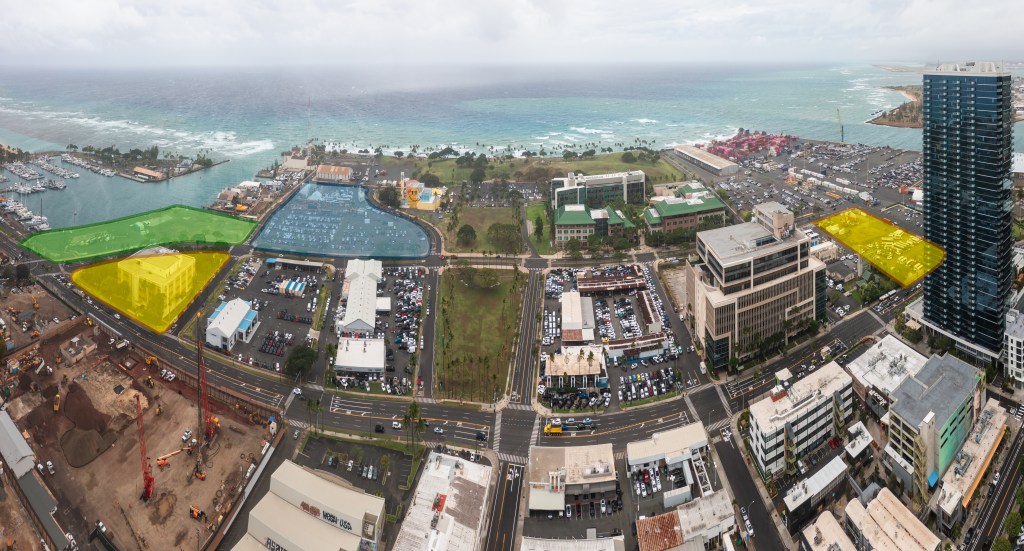
There are also environmental concerns with the lands there in Kakaʻako — the area was once a landfill and previous studies have turned up evidence of contaminants. OHA has an environmental management plan for Kakaʻako Makai pending before the state health department.
Another complication for any building plans could be the Hawaiʻi Community Development Authority, which controls permitting in the area. Though DHHL projects are exempt from zoning laws, it’s unclear what — if any — say DHHL could have over the development authority’s permitting decisions.
Peter Apo, former vice chair of the HCDA’s board, said the Hawaiian homelands department should be able to pursue residential development in spite of the state law banning such projects, “but it will be subject to a lot of scrutiny.”
HCDA could also face pressure from state lawmakers to put up additional roadblocks, he said.

Apo, who is also a former OHA trustee, said he’s disappointed OHA hasn’t yet completed a strategic plan to guide development in the area. A report from the state auditor in 2023 said that OHA had spent more than $6 million on plans for Kakaʻako Makai that have not been put to use.
“It’s really kind of disappointing that after all these years, there’s been nothing significant,” he said.
DHHL is a state agency with a federal mandate to provide housing lots to qualifying Native Hawaiians. But it’s struggled to fulfill that mission because of a lack of funds and usable land.
The state and Congress have granted it powers to pursue development on lands it owns, irrespective of zoning laws. At least that’s the conclusion the state Attorney General’s Office reached in a 1972 opinion issued to the department.
The Legislature could enact new laws to specifically rein in DHHL’s development powers, but such changes would also require federal action by the U.S. Interior Department and possibly Congress.

