

They Signed Up For Co-Living In Honolulu And Got A ‘Hell Hole’
Dozens of people have been living in a downtown office building without kitchens, air conditioning and proper ventilation. The landlord says he is working to address safety concerns and plans to convert the building to student housing.
Christina Jordan was desperate for a place to live in February when she found what seemed a solution: a three-room office suite for $2,500 a month in downtown Honolulu.
It had no bathrooms, kitchen or windows — and she later learned, no certificate of occupancy. But there would be room for herself and two of her kids. Plus, she says, the building’s co-owner, developer Chad Waters, told her he had grand plans for transforming it into a mixed-use housing and entertainment hub and said she could do work around the building to help cover her rent.
Jordan now says life at 1136 Union Mall was a nightmare. She moved out in May.

For the last year, dozens of people have been living in the office building without kitchens, air conditioning and proper ventilation — and limited access to showers, multiple current and former residents told Civil Beat. Despite complaints to city and state agencies, conditions for residents have deteriorated. A police officer noted the building was totally unsecured in April, the same month a tenant reported a teenager had been sexually assaulted in the family’s unit.
Waters has admitted the building is plagued with health and safety issues: air conditioning failures, elevator malfunctions, security deficiencies, potable and wastewater leakages, pest infestation and electrical hazards.
On Saturday, the day after responding to Civil Beat’s request for an interview about the building, Union Mall Development Group posted announcements that everybody — even commercial tenants — had to move out by Tuesday for repairs.
The notice said no rent would be due on Oct. 1, and this month’s rent would be prorated until the repairs were completed. It didn’t say how long that would take. Tenants expressed concern that the repairs are just a way to get rid of them.

The building is a grotesque version of what policymakers have described when calling for adapting vacant office buildings to be residences. Part of the vision is to address critical housing needs while revitalizing Honolulu’s flagging central business district, where small businesses are struggling as office workers increasingly work from home.
An ardent champion of converting underused downtown office buildings into residences, Honolulu City Councilman Tyler Dos Santos-Tam helped pass an ordinance allowing such reuses, leading to big investments by developers. But, Dos Santos-Tam noted, permits are still needed, which the Honolulu Department of Planning and Permitting confirmed Waters doesn’t have.
“It’s not like you can take an office,” Dos Santos-Tam said, “and shove a lot of people in there and call it a day.”
Waters declined interview requests for this story. In a written statement, he stressed that he is planning a complete overhaul of the building.
“We are designing plans right now that will convert the building to residential use,” he said.
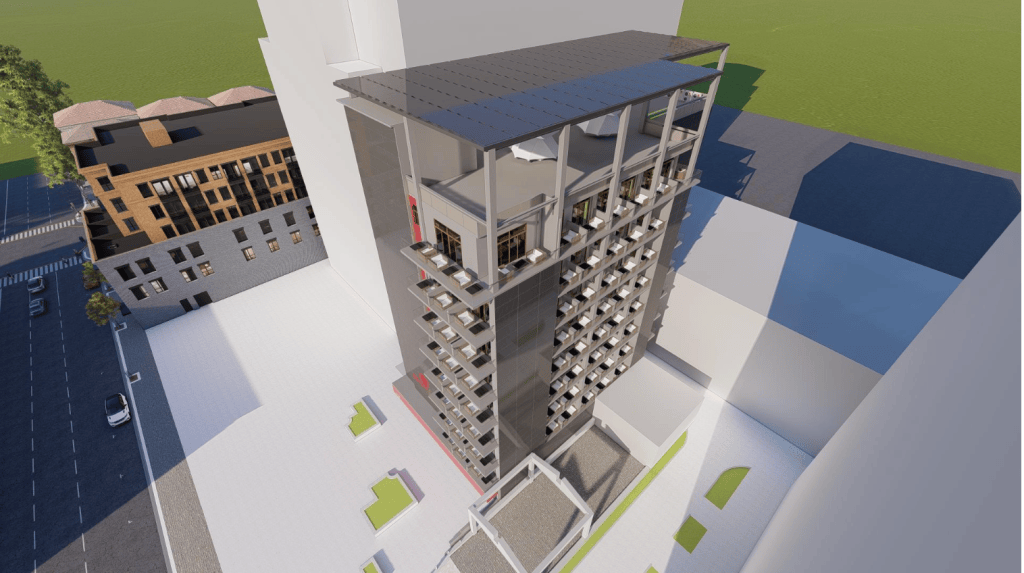
“Our redevelopment plans include a full-scale renovation — stripping the building down to its structural core and completely rebuilding all mechanical, electrical, and plumbing systems to meet modern codes and sustainability standards,” he said.
In his statement to Civil Beat, Waters said his company is working to move tenants out.
“The process of vacating the remainder of the building will continue through mid next year,” he added. “The building wide renovation will start when the building is 100% vacant and the plans are approved by the DPP.”
An ownership entity for the project has committed $8.5 million for the project, he said.
Davis Pitner, a spokesman for the Honolulu Department of Planning and Permitting, said Waters and co-owner Scott Bingo haven’t applied for a permit needed for a group living facility or to change the use from office to residential.
Zoning Allows Offices, Group Home, Hotel
Located just off Bishop Street, 1136 Union Mall is a white, 50-year-old building tucked into a pedestrian lane in downtown Honolulu’s central business district. Tenants once included the state Judiciary’s Office of Disciplinary Counsel; Orig Media, a high-end video production firm; a pilates studio; the nonprofit Mental Health America of Hawaiʻi, and a handful of lawyers.
The building is owned by Waters and Bingo through an entity called Union Mall Development Group LLC. Property records indicate they bought the building for $6.5 million from Tomoya Tsuruhara in April 2024. They financed the acquisition with a $5.2 million loan from Tsuruhara, which was secured by the building, court documents indicate.
Tsuruhara has now brought a foreclosure action against Waters, Bingo and their company, which they’re fighting.
The building’s business-mixed use zoning classification, which existed before Dos Santos-Tam’s ordinance, allows for a range of uses, including office, residential and even a hotel.
But zoning isn’t enough. An office-to-residential conversion would also require a use permit allowing the conversion, as well as a building permit to address potential issues like increased plumbing needs. Construction permitting and work usually requires considerable back-and-forth between the developer and the department. Once the department determines everything is in order and meets basic health and safety codes, the developer can get a certificate of occupancy allowing people to move in.
In a written statement, Waters said that when they bought the property, he and Bingo envisioned turning it into student housing. Architectural renderings of their plans show lanais on three sides of the building to “provide natural light, ventilation, and usable outdoor space for future residents.”
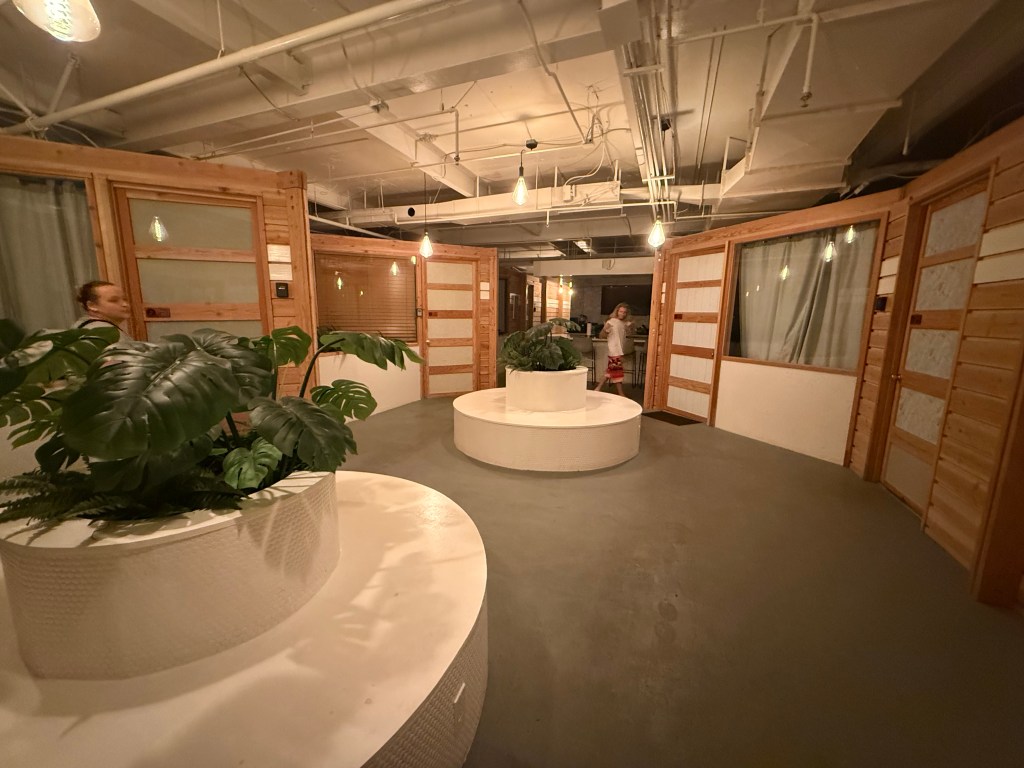
Some parts of the nine-floor building already are clean and tidy, marketed as DoHo Suites vacation rentals. One floor, a former co-working space now leased by DoHo Suites, has an impressive foyer with potted plants and a kitchen area.
But the floors Waters has been renting out as unpermitted “co-living” spaces are another story: warrens of windowless former offices where residents resort to running long extension cords for lights. Shared kitchens consist of microwaves, rice cookers, coffee pots and other appliances on counters in vacant units. Shared bathrooms feature water pipes placed above urinals serving as makeshift showers. There’s little to no ventilation and, on a recent visit, no air conditioning.
That tenants have been willing to live with the conditions at 1136 Union Mall underscores the challenges Hawai‘i residents face in a market where the median housing cost is 2.7 times the national average.

Jordan moved her family into 1136 Union Mall out of desperation. She had moved to Hawaiʻi in October 2024 for a maintenance job at the Hilton Hawaiian Village in Waikīkī, she says. She landed at her brother’s place, while her two kids stayed behind in Tennessee, living with friends while they finished the school term.
By February, her kids needed to move to Hawaiʻi, so she needed a bigger place. Panic set in when she saw what so many in the state experience: no responses to dozens of inquiries about places for rent.
She found 1136 Union Mall through her son’s friend Brian Foehrenbach, who was living there.
She remembers Waters marketing the building as a residential co-living space. The photos he showed her looked nice, Jordan says. And Waters seemed professional.
“The man looks so official,” she said.
Jordan says she signed the lease without seeing the unit and was disappointed from the outset.
“I should have waited until I saw the unit, but there was a sense of urgency,” she says. “I had to have a place.”
The lack of windows, bathroom and kitchen, it turns out, was the least of her problems.
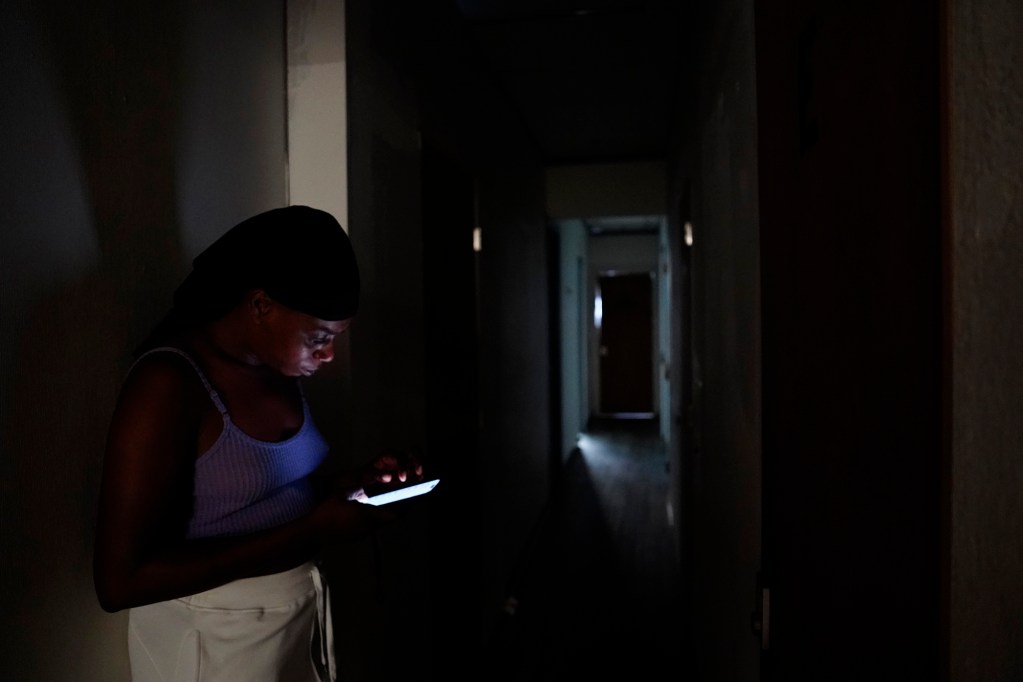
A recent tour of 1136 Union Mall’s co-living spaces showed a building in disarray.
Jordan, who moved out of the building in May, was joined by Foehrenbach and Enshaquawa Moore, a current tenant who says she was one of the first to move her residence into a vacant office around October.
They led the way through long, poorly lit and unventilated hallways connecting former offices where sand-like construction debris lay scattered on carpeting. The heat was stifling.
‘It’s like a hell hole.'”‘
1136 Union Mall tenant Enshaquawa Moore
Moore said the building has slouched into disarray since she first moved there. At the time, she said, the place still had business tenants, some of which said they left as the building fell into disrepair.
“Now,” she said, “it’s like a hell hole.”
The trio told of faulty elevators and threats of electricity shut-offs, which they documented with photos showing notice of an impending power shut-off. A photo and video show sparks coming from an electrical panel on the building’s second floor.
It was the heat and lack of ventilation, one tenant says, that led to an alleged incident in April involving a 16-year-old girl. The family was sleeping with the door to the unit ajar to allow air to come in, another tenant came into the unit and assaulted the girl. A tenant called the police; a trial is set for Dec. 1.
In an email, Waters said he at times has employed licensed security contractors but now has none.
In place of the door and lock on the building’s back door is a rusting metal rectangle. The neat rows of mailboxes can’t be used, they said, because the landlord never gave them keys.
Residents can’t use the mailboxes assigned to their units, Waters confirmed, saying the boxes are only for commercial tenants.
Beyond the problems with power, showers and kitchens was what tenants described as the emotional damage that came with the broken promise of a safe, healthy place to live.
John Serrano, who lives in the building with his wife and 9-month-old baby, sat shirtless in the heat of his unit’s common area, talking about the lack of air conditioning. He was lucky, he said, to have access to a water faucet so he could bathe his baby in a plastic tub.
In addition to the unsafe living conditions, Jordan and Serrano both allege that Waters also stiffed them for work they did on the building.
Not being paid by Waters was especially hard, Serrano said, because he has a criminal record that makes it hard for him to get a job.
Waters, however, said in his written response that he has no record of hiring Serrano to do work. And he said Jordan was compensated.
Government Officials Have Done Little
Some tenants said they fear retaliation for complaining about health and safety violations to management or reporting problems to authorities.
Kamaka Pahinui is a former Union Mall Development Group administrator who rents what she describes as a “glorified storage locker” for $1,300 a month for her and her four cats. She said she was threatened with eviction after she complained about the lack of a lock on a bathroom door — an accusation Waters denies.
Others like Lacey ʻĀina, staffing supervisor for Alliance Personnel Inc., formerly located on the building’s seventh floor, said they have complained to multiple city and state agencies to no avail.
In April, ʻĀina outlined her efforts in a letter emailed to Dos Santos-Tam.
According to the letter, she said she contacted the Honolulu Police Department regarding “a registered sex offender currently living and working in the building” who “claims to be a manager and has access to all tenant spaces and restrooms.”
She told Dos-Santos Tam she had contacted the fire department to report that, “Fire exits are either locked or blocked by cars, trucks, or trash. All fire extinguishers are expired. The sprinkler and fire alarm systems are non-functional.”

She contacted the Occupational Safety and Health Administration “after witnessing a man throwing metal poles from the second floor into a rubbish truck. I have video and photo evidence.”
According to ʻĀina, “OSHA responded but did not act, stating the individual could not be tied to any company.”
The Honolulu Department of Planning and Permitting has issued seven notices of violation against the property since March. These include two for using the building as housing without a certificate of occupancy; three for performing alterations without building permits and two for operating an unpermitted bed and breakfast and advertising the rental for less than 30 days.
Pitner, the DPP spokesman, said the short-term rental citations have been addressed, although a $10,000 fine remains outstanding.
Pitner said, “the Department will be reaching out to the property’s mortgagee to notify them of the violations that may be in violation of terms of the mortgage.”
Rex Matsuo, owner of DoHo Suites, said he had taken down any advertising indicating the units could be rented for less than 30 days, in accordance with the law. He also said Waters hadn’t notified him about any outstanding fine.
Matsuo said he had believed he could use the building as a short-term rental because the building is not in a residential area, there’s a new hotel located nearby and the building’s zoning allows it to be used as a hotel.
Police Investigations Have Gone Nowhere
Complaints to the police also have borne few results. The Honolulu Police Department sent an officer to the building in April after Neighborhood Board Chair Ernest Caravalho reported alleged illegal drug use and prostitution in and around the building, including an allegation that part of the building was being used as a brothel.
The officer reported people using offices as homes, scattered between offices undergoing demolition. The building, he reported, appeared to be “completely unsecured.”
He found no evidence of a brothel but added: “I think it would be naive to think that there is no criminal activity happening.”
In his statement, Waters deflected the issues to tenants and said he’s been trying to get rid of occupants deemed to be problems.
He said he has 12 pending evictions, “primarily involving tenants engaged in activities that pose risks to the building and its occupants,” the statement says.
He said he had tried to work with tenants.
“However, in situations where those efforts failed and public safety became a concern,” he said, “we have had to take appropriate action to ensure the integrity and future of the building.”
Issues Playing Out In Court
On Sunday, many tenants awoke to find the notices acknowledging the health and safety problems residents say they’ve been living with for months. But they were shocked to have just a few days’ notice to relocate.
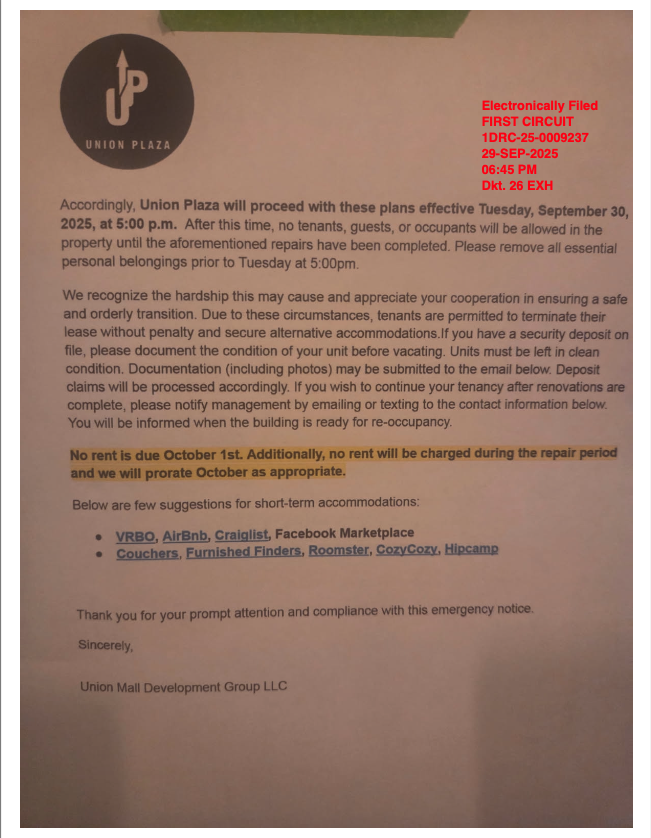
Titled, “Notice of Health and Safety Repairs,” the document explained that the building’s utilities and elevators must be shut down to do the repairs. As a result, after 5 p.m. Tuesday, “no tenants, guests or occupants will be allowed in the building until the aforementioned repairs have been completed,” the notice said.
Matsuo, the owner of DoHo Suites, blames Waters for the problems he says Waters is citing to justify removing everyone from the building. The two already are embroiled in litigation.
Waters in September sued to evict Matsuo and take over the DoHo Suites, alleging Matsuo hasn’t paid approximately $35,000 in rent for June and July. Matsuo says he was never repaid for $35,000 he contributed to prevent the building’s power from being shut off in April. The case has been sent to mediation.
On Monday, Matsuo filed a request for a temporary restraining order asking the court to prevent Waters from shutting off the utilities. The request says Waters’ move amounts to an illegal “constructive eviction” that occurs when a landlord makes a property uninhabitable or unfit for its intended use.
In a declaration filed with the court, Matsuo asserts Waters said he wanted DoHo Suites to leave so Waters could rent the building to Hawaiʻi Pacific University. Matsuo also says Waters has not done repairs required under multiple agreements.
The filing includes text messages between Waters and Matsuo as exhibits. In them, Matsuo asserts he has paid Waters $200,000 since January and has canceled checks to prove it. Waters has denied Matsuo paid that much.
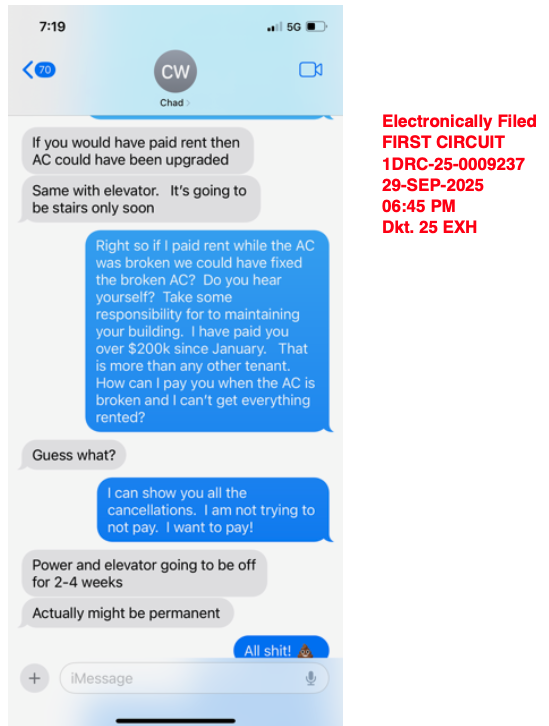
“Guess what?” Waters says at one point in the text exchange. “Power and elevator going to be off for 2-4 weeks. Actually might be permanent.”
Waters is also in a legal battle facing allegations from the building’s former owner. Tomoya Tsuruhara, who loaned Waters and Bingo $5.2 million to buy the property, filed a lawsuit in June alleging Waters, Bingo and their company have defaulted on the loan he gave them.
Waters and Bingo have responded in court documents that an underground property encroachment of a neighboring building — which they allege Tsuruhara didn’t disclose — amounted to a known material defect that prevented them from refinancing the loan.
Also pending is an eviction case that Waters and Bingo’s company has brought against Moore for not paying $837 in rent for an office suite.
During a hearing on Sept. 12, Moore alleged Waters engaged in retaliatory harassment by shutting off her power. District Court Judge Denise Kawatachi ordered the parties to try to settle the matter through mediation. In the meantime, the judge ordered Moore to pay $837 a month into a rental trust fund.
Moore acknowledges she quit paying rent, but says it was only after Waters cut off the building’s air conditioning and she was prevented from using the building’s ninth-floor shower, a clean facility used by DoHo Suites.
“I don’t know where to go with this,” she said. “Can he make it right? Can he make it livable? If not, how can he make it right for the people who have been paying rent?”
For Christina Jordan, the Union Mall experience is in her rearview mirror. She now lives in a five-bedroom house in Makiki Heights, which she shares with her children, Foehrenbach and another roommate. They pay $3,100 a month, a deal Jordan says she was able to get because the house is slated to be torn down soon to make way for a new high-rise.
Jordan and her roommates had to scrape together $9,000 to move into the new place, which Jordan says wiped out her savings.
Still, she says, she’s glad to be out of 1136 Union Mall and, where she hopes her continued willingness to speak out will lead to changes.
“There’s just so much happening,” she said, “ to so many people that don’t know how to stand up for themselves,” she said.
Civil Beat’s reporting on economic inequality is supported by the Hawaiʻi Community Foundation as part of its work to build equity for all through the CHANGE Framework; and by the Cooke Foundation.

