

Can A New Tax Save Downtown Honolulu’s Small Businesses?
The proposed fee could improve safety and cleanliness in the area, but critics say it won’t fix the underlying challenge facing downtown.
The Honolulu City Council is considering imposing a new fee for downtown properties to help revitalize what was once a bustling commercial center. But some small downtown business owners say the proposal won’t address what they need: more customers, specifically office workers who previously were the lifeblood of the area’s economy.
“You can do whatever you want, it’s not going to bring people here,” said Zareh Abrahamian, property manager of the Arcade Building on Merchant Street. “You can stand on your head and do somersaults, it’s not going to happen.”
Abrahamian’s comments underscore the challenge facing Hawaiʻi’s biggest business district. The Covid-19 pandemic popularized working from home, which decimated demand for office space. While occupancy has stabilized, that’s partly the result of office space being taken off the market.

The bottom line: as many as 20% fewer workers on a given day than before the pandemic, said Mike Hamasu, who studies downtown Honolulu as consulting and research director for Colliers Hawaiʻi.
“It’s basically that you have a bunch of people working from home,” he said.
The City Council’s proposal is to expand the special improvement district currently governing Fort Street Mall. Property owners will have to pay a new fee to fund what proponents envision as a 14-person crew of roving security guards, custodians to pick up litter and remove graffiti and a pressure-washing team to clean public spaces throughout the day.
The City Council will hold a public hearing Sept. 3 on the bill establishing the new business improvement district, which is bounded by Richards, Bethel and King streets and Nimitz Highway.
Improvement District Has Powerful Supporters
The measure has support of some of Honolulu’s most powerful players, including Colbert Matsumoto, co-founder of the real estate and private equity firm Tradewind Capital; Honolulu lawyer William McCorriston; real estate investor Stephen Metter and Duane Kurisu, a real estate investor and chairman of the company that owns “Hawaiʻi Business” and “Honolulu” magazines.
Christine Camp, whose Avalon Group has been leading the charge to redevelop underused downtown office buildings, recently held a series of town hall meetings at her new indoor pickleball facility in the old Walmart building. Others supporting the bill include Kamehameha Schools, Bank of Hawaiʻi and Pacific Resource Partnership, which represents the powerful Hawaiʻi Regional Council of Carpenters construction union.
A number of individuals have also voiced their support, several in largely identical written testimony submitted to the City Council. Among them is Paula Caracol, who runs a small bookkeeping business out of Topa Financial Center at Fort Street Mall.
“The Downtown Honolulu neighborhood is in jeopardy and has experienced a decline in the impression of safety, security, and cleanliness over the last few years,” Caracol wrote. “This has resulted in a wave of retail store closures and depressed office occupancy, among other impacts, which will only continue to get worse unless community action is taken.”
In an interview, Caracol declined to discuss her testimony, saying it was “just a letter that someone had given me.”
“I try to stay off the mall as much as possible … It just doesn’t seem safe.”
Downtown small business owner Paula Caracol
Still, she said, she is concerned about safety on the pedestrian mall.
Located in the heart of downtown, the pedestrian mall once brimmed on weekdays with hordes of office workers going to Walmart, the closed-down Ross store and the now-shuttered Honolulu Satellite City Hall office. Some Fort Street Mall survivors, including the Friday farmer’s market, aren’t what they used to be, said Jay Pitts, who recently oversaw the Balsamic Hawaiʻi stand at the market. The office workers just aren’t there, he said.
Instead, Caracol said, the mall is now a haven for homeless people.
“I try to stay off the mall as much as possible because of that,” she said. “It just doesn’t seem safe.”
Fort Street Mall already has its own business improvement district. Despite her supportive testimony, Caracol acknowledged that simply expanding the district to include all of downtown wouldn’t necessarily bring the customers that the small mom and pop businesses need to survive.
But, she said, “I guess people would come down if it was safer.”
Others aren’t convinced.

Three blocks from Fort Street Mall, between Merchant and South King streets, is the Arcade Building at 212 Merchant St. It’s typical of the historic, low-rise buildings from the early 20th century that decorate the cityscape: architectural gems like the old Hawaiian Electric Building and King David Kalākaua Building, located nearby.
The Arcade Building takes its name from an arcade of small retail spaces occupying the ground level below two floors of newly renovated offices, many of them vacant despite new flooring, immaculately painted walls and natural sunlight from large windows. Before the pandemic and the work-from-home trend it spawned, the building’s businesses buzzed at lunchtime during the week with office workers filling cafe tables, lining up for takeout and buying gifts at the specialty tea and coffee shop that occupied a prime corner space.
Now the corner space is vacant, along with many others in the arcade, their big windows decorated with “For Lease” signs symbolizing the plight of downtown.
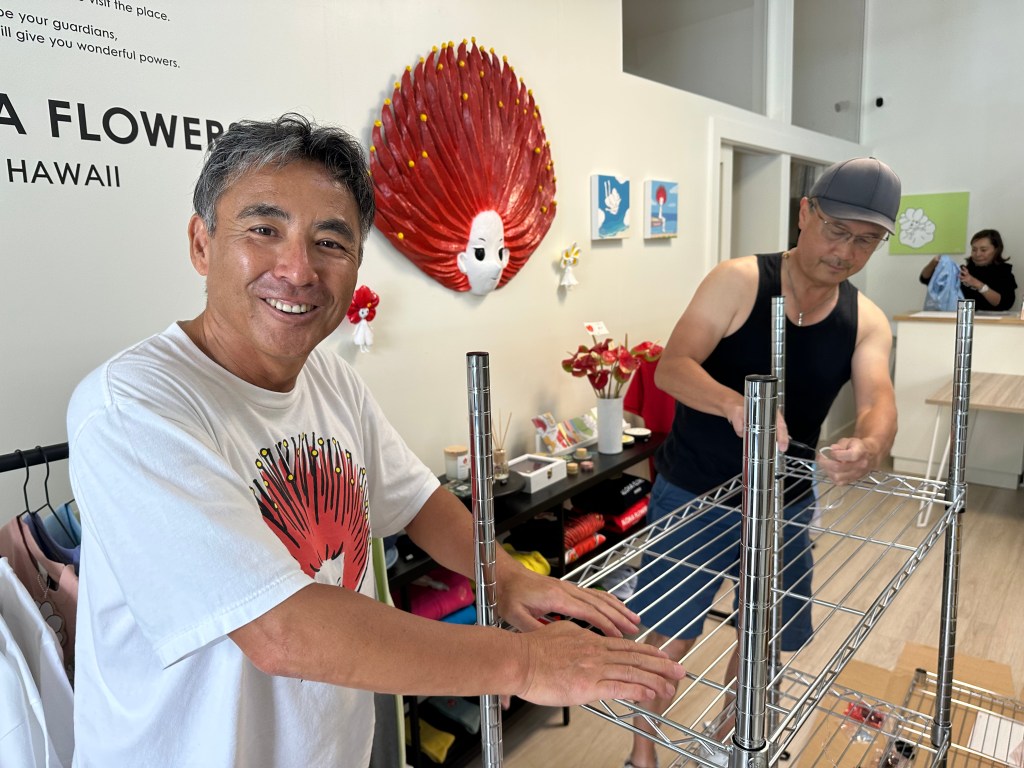
Some in the arcade are doing fine. Katsu and Keiko Takahashi’s Aloha Flowers Hawaiʻi occupies a tiny space at one end of the arcade, where they sell T-shirts, dresses, stickers, coffee mugs and other merchandise emblazoned with “fairies of Hawaiian flowers” designed by a friend in Japan.
Still, Takahashi had three words in response to the idea of a new special district fee for his landlord — potentially passed on as higher rent for him: “No, no, no,” he said.
Another business hanging on is Ernesto and Celeste Limcaco’s Prime Roast Cafe at the opposite end of the arcade. The rich smells of roasting beef and herbs filled the small dining room on a recent Friday morning, but customers were scarce. The couple helps make ends meet with catering and “whatever it takes to survive,” Ernesto Limcaco said.
“It’s tax after tax after tax.”
Ernesto Limcaco, Prime Roast Cafe
The Limcacos welcomed the idea of extra neighborhood security. Customers have stolen from the cafe’s tip jar on more than one occasion. Poi Ishii, who works at the Natural Mystic smoke shop next door, recalled the time her husband helped the Limcacos chase down a customer who tried to dine and dash.
Ishii sees the City Council’s bill as a mostly political move.
“Maybe it would deter some bad behavior,” she said, “but as far as addressing the root of the problem — not really.”
Ernesto Limcaco questions whether small building owners should have to pay a new fee on top of existing property taxes, especially if it means the owners will have to pass costs to tenants.
“It’s tax after tax after tax,” he said.
A better solution to help small businesses, he said, would be for the large corporate landlords to attract some anchor tenants to replace the Macy’s, Walmart, Ross and Long’s stores that have all closed.
“It’s not going to attract more people,” Limcaco said of the expanded business improvement district.
Meanwhile, Celeste Limcaco offered a solution covered by existing taxes.
“How about police policing the area?” she said.
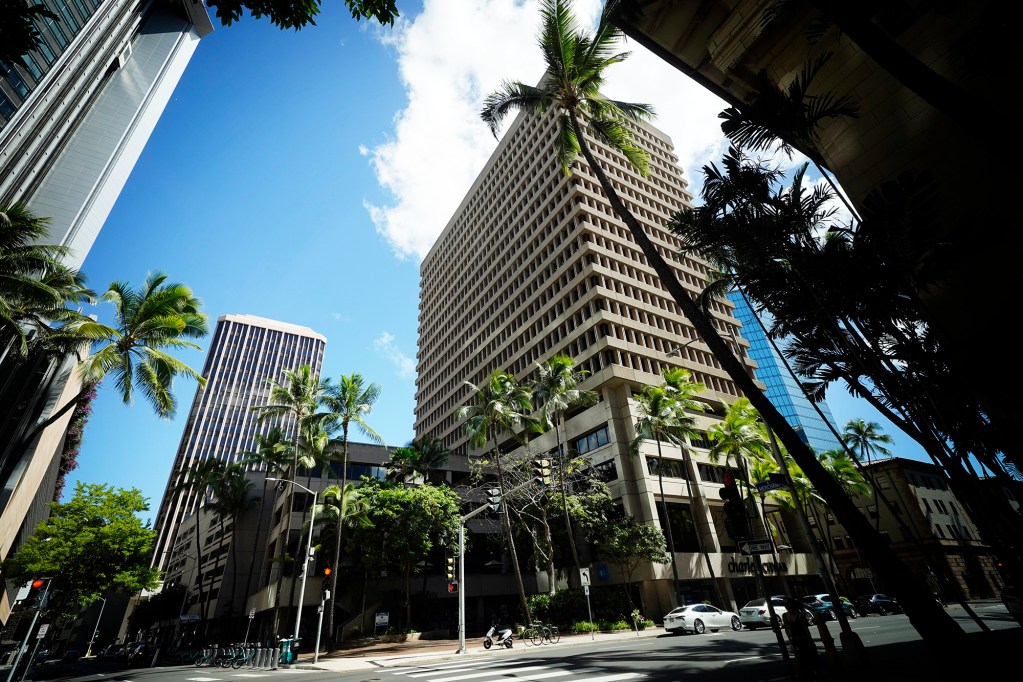
Regardless of whether the City Council decides to impose the new fee, it could take years for downtown to rebound, said Hamasu, Colliers Hawaiʻi’s commercial real estate expert.
While occupancy has stabilized, that’s partly because 1.3 million square feet of space – the equivalent of three to four large towers – has been eliminated as owners seek to redevelop offices into homes.
It’s hard to say how many fewer workers are working downtown every day, Hamasu said. Some people might still be working in the office, he said, but only three days a week. As a result, he reckons that on any given day, there might be 10-20% fewer people to dine and shop downtown.
All that could change over time, he said, as developers convert offices into homes and residents replace workers.
But, he said, “If you’re looking for an immediate fix, I don’t think there is one.”
“Hawaiʻi’s Changing Economy” is supported by a grant from the Hawaiʻi Community Foundation as part of its work to build equity for all through the CHANGE Framework.

