Will 4 New Stations And A $1 Million Ad Campaign Attract More Rail Riders?
Mayor Rick Blangiardi says the city must overcome “almost two decades of negativity and cynicism.”
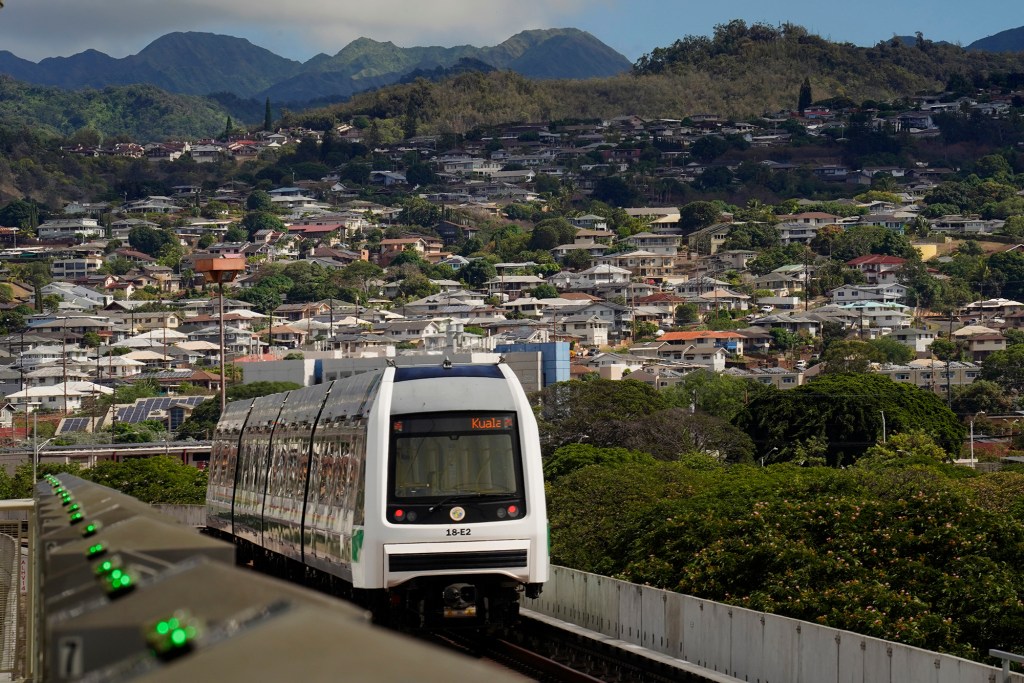
This week begins a crucial test of Honolulu commuters’ appetite for rail transit, which remains one of the great unknowns for the city’s unfinished, fabulously expensive Skyline system.
Starting Thursday the city will operate 16 miles of rail line and 13 stations, a route that could become the transportation backbone from East Kapolei to Middle Street. But no one knows yet how many people will ride it.
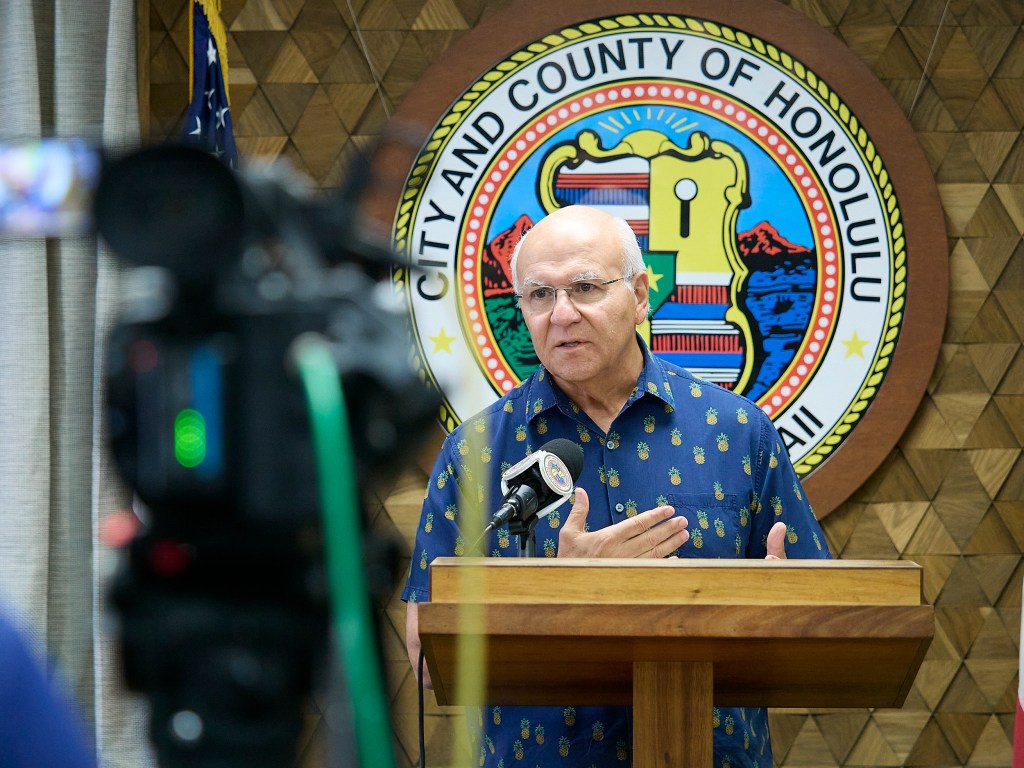
Honolulu Mayor Rick Blangiardi said he hopes to have 25,000 boardings per day a year from now but acknowledges the city is “in uncharted waters.”
Blangiardi said Monday in an interview that he intends to seize the moment by launching a yearlong, $1 million public relations campaign to sell the benefits of rail to weary highway commuters to get them on board.
“You have to remember, we’re trying to overcome almost two decades of negativity and cynicism about this system,” he told Civil Beat. “So, we also have a different cultural challenge. We have to change the attitudes and the mindset that people have held for a long time about the quote-unquote rail into a positive.”
The updated Honolulu rail plan that was finalized three years ago projected a ridership of 84,000 daily boardings once the Skyline system is extended from East Kapolei to Kakaʻako, but that target is still years away. The last three miles of the route to Kakaʻako won’t be finished until 2030.
Until then ridership will be significantly lower, in large part because of the rail line’s limited reach.
Honolulu’s Mostly Empty Trains
Skyline has provided on-time service more than 99% of the time for 11 of the past 12 months, according to city data, but the trains ran mostly empty because the system does not extend to any employment hubs.
Last month, for example, daily ridership on the East Kapolei to Aloha Stadium rail segment ranged from a low of 1,842 boardings on Sept. 21 to a high of 7,519 on an exceptionally busy Saturday, Sept. 13.
Blangiardi said he anticipated that. The city chose not to focus on ridership early on, he said, because the first segment ending at Aloha Stadium did not take people directly where they needed to go.
Instead, the city has focused on finishing construction of the next segment to the Daniel K. Inouye International Airport and Middle Street, he said. With that section opening to the public Thursday, the system will be 83% complete. The new stations include:
- Makalapa Station at Joint Base Pearl Harbor-Hickam
- Lelepaua Station at the Daniel K. Inouye International Airport
- Ahua Station at Lagoon Drive
- Kahauiki Station at the Kalihi Transit Center
The expansion will serve two major employment centers — Pearl Harbor and the Honolulu airport — and people who work at the airport will have an incentive to use the train to avoid paying for parking at work. They can also get to the airport in 32 minutes from East Kapolei.
Blangiardi also expects significant numbers of University of Hawaiʻi Mānoa students traveling from West Oʻahu will use rail to reach the Lagoon Drive station, then transfer to a new U Line express bus route that takes them directly to the Mānoa campus.
A new W Line express bus route will carry rail passengers from Lagoon Drive through Chinatown to destinations that include Ala Moana Center and the Waikīkī tourist district.
For people already comfortable with transit who ride city buses, the new rail line may be a no-brainer. But merely attracting existing bus riders to rail won’t do much to ease the city’s traffic congestion, which last year was ranked 19th-worst in the nation.
That’s where the mayor’s rail pitch and his advertising campaign come in. “We’ve been waiting for this moment in time, and we want to seize it as smartly as we can in making the public aware,” Blangiardi said. “A lot of education has to take place here.”
Persuading Them To Ride
The pool of potential riders is substantial. One state study estimated more than 133,000 workers commute into urban Honolulu each day, although many thousands of those commuters come from areas such as East Honolulu and Windward Oʻahu that won’t be served by rail.
Honolulu was criticized by the City Auditor’s Office earlier this year for doing a poor job of marketing the first segment of rail. Blangiardi, a former television executive who spent more than 40 years in brand and product development, is determined to change that.
He plans a promotional and educational campaign that targets West Oʻahu residents and people who live along the rail line, and includes statewide and islandwide advertising as well as video games.
Blangiardi said $1 million is a tiny fraction of the hundreds of millions of dollars the city spends on the Skyline, TheBus and TheHandi-Van systems each year. The operating budget for TheBus and TheHandi-Van systems is nearly $342 million this fiscal year, and the budget for Skyline is $120.7 million.
The funds for the advertising effort will come from the city’s Department of Transportation Services budget, he said.
“We’re going to promote ridership, we’re going to drive ridership, we’re going to educate the public on all the benefits, from comfort, ease, predicability, efficiency,” he said.
Blangiardi enthusiastically rattled off the benefits to rail, describing it as a way to travel that is more predictable than Oʻahu’s often-jammed highway system.
“This idea that when you add certainty to people’s lives — we think is a real valuable proposition,” he said. Predictability may be especially compelling for tired commuters headed home from work at the end of a long day.
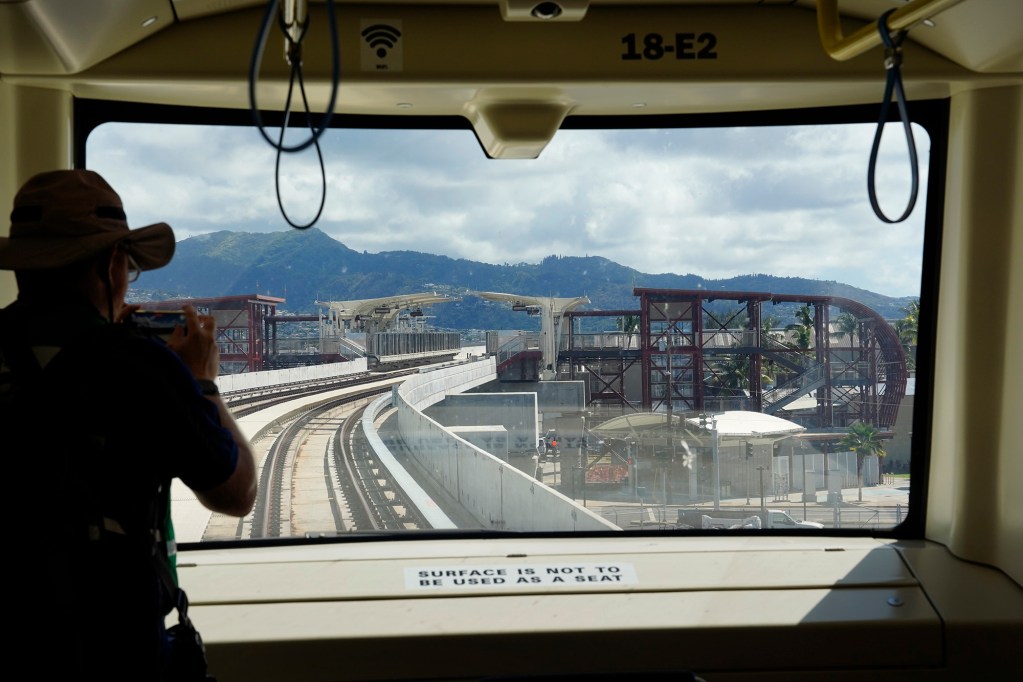
Rail and other forms of transit also offer more efficient use of time. People can read, watch videos on the Wi-Fi network or work on the Skyline trains, he said, things they cannot do if they are stuck behind the wheel in traffic.
He predicted the improved city transit system with Skyline may even allow some families to get rid of a car and save $1,000 a month on gas, insurance and other costs.
“This should be really worth something to people now because we’re finally doing what it was designed to do, and that is take people where they want to go,” Blangiardi said.
Blangiardi acknowledged his projection of 25,000 riders per day by this time next year is not based on any scientific formula, but added: “I actually think I might be lowballing it.”
Transit systems across the country are facing headwinds, with ridership declining nationally since its peak in 2014. Ridership in Honolulu followed a similar pattern, but city Department of Transportation Services spokesman Travis Ota said in a written statement ridership has rebounded since the Covid pandemic, which began in March 2020.
TheBus had an average weekday ridership of about 190,000 in 2019, according to Ota, and last month averaged nearly 135,400 weekday riders.
Fare increases could also work against the city administration’s efforts. The Honolulu City Council is considering a modest transit fare increase that would apply to both the Skyline and the bus system, and critics warns that will further reduce ridership.
Roger Morton, director of the city Department of Transportation Services, told members of the council Tuesday the $3 cash fare charged to Honolulu bus riders is already higher than major cities such as New York and San Francisco, and might be the highest in the nation.
The proposal for the fare increase was deferred by the council’s Budget Committee Tuesday to allow for revisions to the bill.