

City Has Few Options To Address Pockets Of Squalor In Waikīkī
Owners of blighted properties won’t say what they’re planning to do with vacant lots and deteriorating buildings in Waikīkī, and there’s little that public officials can do about it.
Kālaimoku Street at Kūhiō Avenue is one of Hawaiʻi’s swankiest addresses: home of the Ritz-Carlton Residences, the Dean & Deluca food emporium and second-floor Artisan Loft selling oatmeal for $25 a bowl. Next door is the Luxury Row retail space housing brands like Chanel, Gucci and Saint Laurent.
But step across Kūhiō, and Kālaimoku is far from posh. The street is lined with vacant lots and buildings, their windows blinded by plywood. One ramshackle structure at the end of the block has been a blight for neighbors and city officials for more than a decade.
The scene strikes neighborhood residents like Indra Erne as bizarre.
“It’s strange,” said Erne, a 58-year-old retired media executive who was at Dean & Deluca on a recent morning buying coffee and croissants for his wife’s birthday breakfast. “You’ve got this one luxury block, and the rest is crap.”
The crappy side of Kālaimoku Street underscores a reality of Hawaiʻi’s tourism center: For all of its luxury boutiques and resorts with infinity swimming pools and spas catering to monied visitors, Waikīkī still has its share of squalor.

Some vacant parcels are part of the natural ebb and flow of commerce. Retailers in Hawaiʻi’s thriving tourist mecca leave, and others, eventually, take their place. But other properties, like East Oʻahu resident Nicolas Lynn’s shambling building at the corner of Kālaimoku and Ala Wai Boulevard, have been that way for years.
And there’s not much government officials can do about it. Lynn didn’t respond to requests for comment.
“You’ve really got two separate questions here,” says David Callies, a retired property law professor and author of a treatise on Hawaiʻi land-use law. “What they can do about it, versus what, from a public policy standpoint, should be done.”
If the landowners are in compliance with building codes and zoning laws, Callies said, “there’s really not a whole lot the city can do.”
Honolulu Rarely Uses Eminent Domain Power In Waikīkī
The properties on Kālaimoku Street are hardly the only ones to raise eyebrows in Hawaiʻi’s prime tourist district.
A vacant property in the heart of Waikīkī on Kūhiō and Seaside Avenue, owned by ABC Stores chief executive Paul Kosasa, has drawn the ire of neighboring businesses. Plywood planks covering windows of a nearby building on Kūhiō and Lewers Street, formerly home to a Foodland Inc. Whaler’s Village convenience store, have become canvases for graffiti artists, despite a fence surrounding the property.
For years, officials have eyeballed a large vacant property encompassing 19 separate parcels on Cleghorn Street near Liliʻuokalani Avenue. Waikīkī’s state representative, Adrian Tam, went so far as to sponsor a resolution calling for the City and County of Honolulu to buy the property from its current owner, Okada Trucking Co. Ltd. But city officials have demurred. Okada Trucking declined to comment.
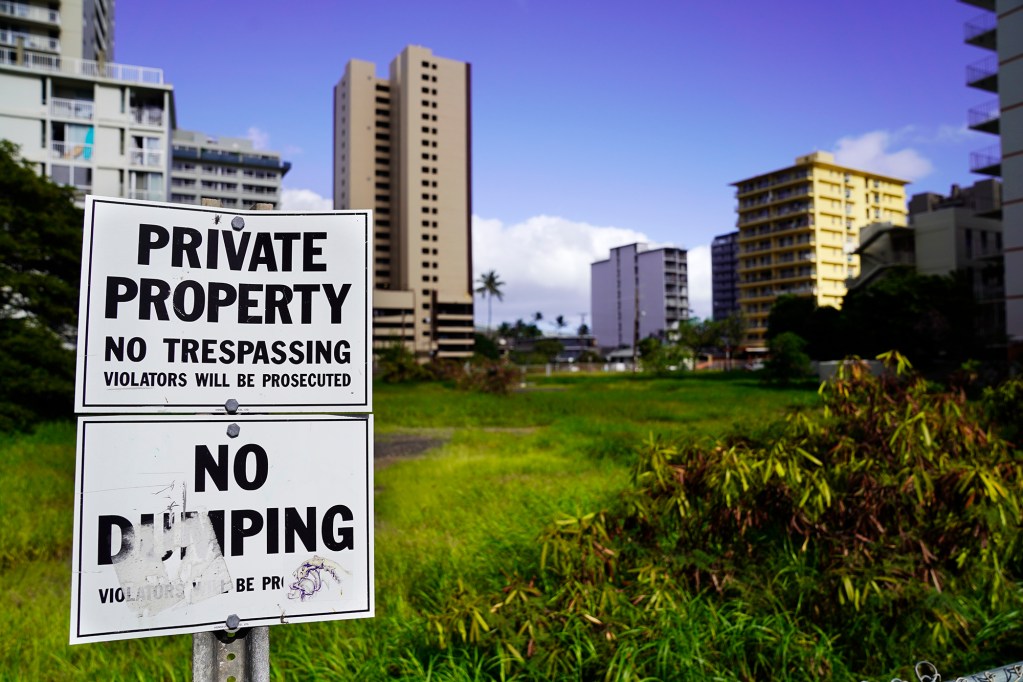
In some cases, the city has taken steps to acquire blighted or underused properties, but — as with all development in Hawaiʻi — the process of building can be slow, and slower still when factoring in the process of the city using its eminent domain powers to force owners to sell.
State and local governments generally have broad power to buy property through eminent domain as long as the taking serves a public purpose, Callies said. That typically means taking steps to fulfill a broader development plan. The U.S. Supreme Court has ruled it’s even OK for a government to force a private landowner to sell their property to another private party to further economic development goals.
In some cases, Honolulu has exercised that power to take over blighted properties in Waikīkī.
In 2023, for instance, the City and County of Honolulu used its eminent domain power to acquire a long-vacant and rundown building at 1615 Ala Wai Blvd. as part of a strategic housing plan. According to Kevin Auger, Honolulu’s Director of the Department of Housing and Land Management, the city is now working on a pre-development agreement and a ground lease with Centre Urban Real Estate and making presentations to the community about the project. The city hopes to complete the project in late 2027.
Near 1615 Ala Wai, at 436 Ena Road, the city is working to redevelop a property acquired by former Mayor Kirk Caldwell’s administration in 2018 to provide housing for low-income and homeless people. The building became the focus of controversy in 2023 when tenants who had moved in less than five years before under Caldwell were forced to move out because the building needed extensive repairs.
Current Mayor Rick Blandgiardi’s administration is now working with EAH Hawaiʻi, a developer of affordable housing, to redevelop the property, Auger said in a statement. Demolition is expected to start in 2026, Auger said.
Owners Won’t Discuss Plans For Kālaimoku Properties
The fate of Kālaimoku’s derelict properties is less clear. In 2018 and 2019, Sanko Soflan Hawaiʻi LLC, a subsidiary of Japan-based Sanko Soflan Holdings Ltd., began buying properties along Kālaimoku, including vacant parcels and single-family homes built in the 1940s on the Diamond Head side of Kālaimoku Street. Nicolas Lynn owns the rest of the block.
Sanko Soflan also bought two houses on neighboring Launiu Street.
Altogether, the company spent $14.5 million to acquire much of the property on Kālaimoku, including now-vacant, boarded-up houses. A notice of a water shut-off from the Honolulu Board of Water Supply, dated late December, is taped to the wall of one of the houses. The Go Law Group, which is listed as Sanko Soflan’s agent on business registrations, didn’t respond to an interview request about the company’s plans for its property, which includes a parcel across Kūhiō from the Ritz-Carlton.
City and County of Honolulu bond documents indicate the firm is planning a 130-unit residential project at the site.
In the meantime, Dean & Deluca customers sipping lattes on the café’s lanai get a view of the company’s empty lot and one of its derelict houses.
And there’s not much to be done about the scenery. Callies, the property law expert, said that whatever expansive power governments have to acquire property through eminent domain, such power typically doesn’t apply to deal with merely aesthetic issues.
“The owners of these properties should be very transparent.”
State Rep. Adrian Tam
“You’ve got to have an ordinance, statutory or charter provision that would give you standing to do it,” Callies said. “You can’t just go and say it’s unaesthetic so we’re going to take it.”
The situation frustrates elected officials like Melissa Filek, a real estate broker who also serves on the Waikīkī Neighborhood Board. Sanko Soflan’s property is in one of Waikīkī’s best locations, and the company has never reached out to share its plans with the board — a common step for developers wanting to engage stakeholders and get community feedback for proposed projects.
“It’s prime real estate,” she said. “I just don’t know what they’re waiting for. It’s something. I just don’t know what it is.”
Tam agreed. The lawmaker said he has no inherent problem with a property owner like Nicolas Lynn using a parcel for a parking lot, which Tam said is needed in Waikīkī, as long as the lot doesn’t pose a public safety problem. And Tam said he understands redevelopment projects can take a long time to realize.
But he said owners of vacant and blighted properties like Sanko Soflan owe their neighbors the courtesy of sharing plans for the parcels and the reasons the parcels are in bad shape.
“The owners of these properties should be very transparent,” Tam said. “I’m sure the community would understand.”

