Honolulu’s Mayor Has Ideas To Improve Everyday Life On The Island
Mayor Rick Blangiardi pledged Wednesday night to make city services work faster for Oʻahu’s residents.
Quickly building more housing of all kinds, extending the city’s Skyline rail system into and beyond the city’s core, embracing new technology like artificial intelligence — all will make everyday life better for Honolulu’s million or so residents, Mayor Rick Blangiardi promised in his sixth State of the City address Wednesday evening.
But the area’s high cost of living, he said, undermines everything and reducing it will be a major focus of his second term, which ends in 2029.
Honolulu County has experienced the largest decline in population across the state during Blangiardi’s tenure, with about 13,600 residents leaving Oʻahu between 2020 and 2024, according to the U.S. Census Bureau. The mayor couched that population decline in terms of both living cost and unnecessary bureaucratic delays, saying the “scarcity of affordable housing” is driving people away but “everything we do in city government has a nexus to affordability.”
“When we eliminate waste, when we cut red tape, when we move faster, your families pay less,” he said. “This is what our team is focused on: driving change in city government that makes Honolulu more affordable — change that survives long after our time in office.”

The mayor then spoke directly to city employees, asking them to embrace change but reassuring them that technological advances should not scare them because “there will be no AI-related job cuts while I am mayor.”
He also commended them for stepping up during the recent ravaging storms, saying that city departments “answered the call: clearing streams, removing trees, and keeping our island running — great work” and singling out emergency management and first responder agencies.
Blangiardi has had to brace for natural disaster several times this past year, including during a tsunami scare in July and severe rainstorms the past couple months that brought heavy wind and flooding. During last week’s Kona low, one North Shore neighborhood had to be evacuated and thousands more found themselves on evacuation watch as rain threated to overflow a reservoir in Wahiawā.
At a press conference just before last week’s storm, Blangiardi said being mayor of Honolulu has taught him to “expect the unimaginable.”
During his 2025 State of the City speech, the mayor said that he hoped to purchase land in Pūpūkea for a First Responders Center to provide more rapid emergency services to the North Shore. The land across the street from the popular Sharks Cove beach destination currently hosts food trucks and jewelry shops. A year later, he had news on that front: “Tonight, I’m pleased to report that all parties have signed the purchase and sale agreement for that property, effective today.”
How Far Can The Skyline Go?
While the current plan is to build a Skyline rail system that stretches from East Kapolei to Kakaʻako – and eventually Ala Moana, if funding allows – Blangiardi recently signed a bill that authorizes planning for the system to potentially reach deeper into Kapolei and to the University of Hawaiʻi Mānoa.
On Wednesday, he thanked the City Council for support in considering these extensions, saying it would save future generations hundreds of millions of dollars in construction costs. That, too, he tied back to his central theme.
“When we concentrate housing near transit, we reduce traffic,” he said. “We reduce commute times, we give families back hours of their lives every week, and we lower the cost of living.”
The city’s much-delayed and vastly over budget rail system opened its second segment in October, linking riders — who had previously been limited to stations next to empty fields, residential neighborhoods and a defunct stadium — to major hubs such as Pearl Harbor, the airport and Kalihi Transit Center.

That expansion more than doubled ridership to about 10,000 people a day, and Blangiardi hopes a $1 million public relations campaign can help catapult that number to 25,000 by the end of the year.
Proposals also call for sprucing up rail stations and the areas around them so people have more reasons to use the system. Ideas have been floated to plant fruit trees and install vending machines that dispense library books, and the governor is talking with a Japanese rail conglomerate for advice on how to spur commercial and other development around the stations.
Where To Stash Oʻahu’s Trash?
West Side residents have long resented playing host to Oʻahu’s only municipal dump at Nānākuli’s Waimānalo Gulch Sanitary Landfill. Past administrations passed the buck by not opening a new site elsewhere on the island, Blangiardi has said for years, but he has promised to identify a new site not on the Waiʻanae Coast.
On Wednesday, he pleaded for help from state lawmakers to change laws to allow him to place a landfill elsewhere, since new state restrictions essentially prohibit waste facilities on porous land to protect the island’s underground natural water supply.
“To our legislative partners,” he said, “even if it’s a bitter pill – we need you to share in this responsibility with us.”
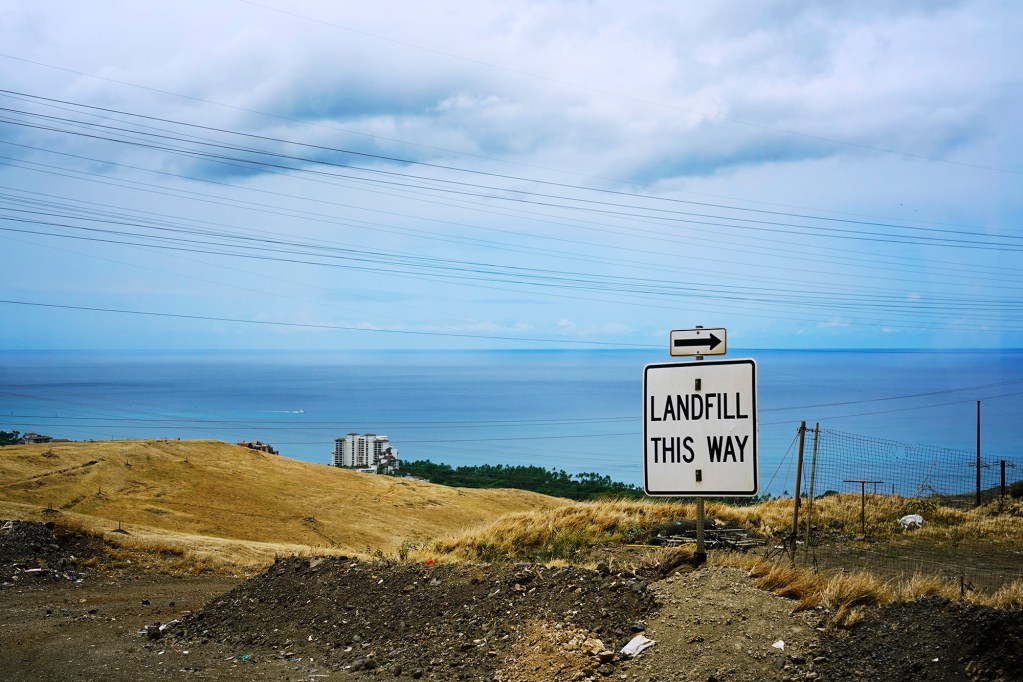
Previously, Blangiardi tried but failed to negotiate a location on military land. Then he tried but failed to secure a spot in Central Oʻahu on pineapple land about 800 feet above an aquifer, prompting a backlash from state legislators who then moved to effectively block all sites in the middle of the island.
Faced with little other choice, the administration is now setting aside money to expand the current site. But in his speech, Blangiardi said expanding Waimānalo Gulch is not acceptable to him.
“The city’s hand is being forced by rules and laws that ignore our capacity to build a safe, state-of-the-art landfill,” he said.
How To Speed Up Building Permits?
To address a permitting backlog that’s stifled economic development and new housing construction, the Department of Planning and Permitting launched new software in August called HNL Build to replace permitting software from 1998.
The rollout has been bumpy. Developers and department employees complained it wasn’t efficient and that they had problems transferring data from the old system. Fewer than half as many permits were issued during its first month compared to the prior August.
Still, officials like Blangiardi and DPP director Dawn Takeuchi Apuna attributed that to growing pains and a workforce struggling with change, a theme Blangiardi carried forward in his speech.
“Even if we install the most advanced software available on the best machines we can buy,” he said Wednesday, “we accomplish nothing if our employees don’t know how to use it. Or worse — if they resist using it.”

More permits were issued in the months following the software’s launch, Takeuchi Apuna said at a council meeting earlier this month, and the city is also rolling out an artificial intelligence software called CivCheck that it says is already reducing the number of errors on new permit applications and cutting city review time.
“HNL Build took more than 60 different permitting or licensing functions away from paper copies, away from trips to the Fasi Building, and into the digital age,” Blangiardi said Wednesday.
This matters, the mayor said, because every new housing unit makes the housing more affordable overall.
“When developers build more market-rate units, people move up,” he said. “When we add supply at the top, families can move into bigger or newer homes, creating availability all the way down the housing market.”
Along with checking building permit applications, Blangiardi said AI is taking on simple and repetitive tasks. The Honolulu Police Department is exploring using AI to help write police reports, and the Department of Customer Services started using AI a few months ago to answer phone calls about routine city services.
“That AI system is already handling 40% of those calls,” he said, “and our employees now spend their time helping residents with complex issues instead of answering simple questions over and over again.”
What To Do About The Homeless?
Homelessness remains, as Blangiardi has described it, a “wicked problem.” Two summers ago, after a landmark U.S. Supreme Court case empowered local governments to more strongly enforce anti-camping laws that typically target homeless people, the mayor vowed to get 1,000 people off the street within a year.
On Wednesday, Blangiardi said his administration eclipsed that goal by removing 2,000 people from the street in 2025, which he said is another essential part of “building a city that works for our residents.”
“The results are visible across our community,” he said. “Our streets look different. They feel different.”
The administration has previously struggled to produce data on how many people it has moved off the streets, into what services and for how long. After the speech, Department of Community Services Director Anton Krucky clarified that the 2,000 were taken to shelters and medical respite areas and he added a caveat: the city doesn’t know how many of them have since returned to the streets.

Regardless, Krucky said, he considers this progress since it means the city is reaching these people and starting conversations with them.
“That’s 2,000 people that you get there that you get to work with,” he said, “and before you weren’t working with.”
A Civil Beat investigation published late last year found law enforcement citations of Honolulu’s homeless for such violations as sitting or lying on a public sidewalk did significantly rise in the year after Blangiardi made his pledge — with 11,000 being issued — but the number of people being cited did not. Police were mostly citing the same people over and over in a revolving door of enforcement. And citations alone, which lead to court dates and sometimes jail time, have not been proven to get people permanently off the street.
Officials quoted in that investigation also provided numbers for the Homeless Outreach and Navigation for Unsheltered program, or HONU, a popup offering short-term beds, washrooms and access to medical treatment and housing referrals. They said that in the 13 months leading up to November 2025, just under 170 people who entered that program entered medical or treatment programs; transitional housing permanent housing or boarding houses; or were reunited with their families.
At that time, Krucky said that people in the program moved 419 times into shelters from HONU, although he said he couldn’t say how long those people stayed sheltered.

Blangiardi’s budget proposal for the coming year aims to expand HONU, which currently operates out of one city park at a time and gives people short-term support as it directs them to long-term housing and support services.
In his speech, he touched on another city homelessness outreach program — Crisis Outreach Response and Engagement, or CORE — which sends EMS workers around the island in refurbished ambulances to treat homeless people on the streets. CORE started in 2021 as an offshoot of EMS, and an audit of its performance is expected to be complete by September after Council Vice Chair Andria Tupola, whose district includes the island’s largest homeless population, said it was unclear that the program was meeting its goals of addressing mental health crises and steering people into services.
During the recent Kona low storm, CORE fanned out to offer transportation to shelter beds, but got few takers.
Contributing: Civil Beat reporters Caitlin Thompson and Jeremy Hay