Budget Committee Makes A Deal To Save State Tax Cuts
Lawmakers urgently needed to reach an agreement on the tax issue before they could move on to the state budget.
House and Senate negotiators finally struck a deal Tuesday night to ensure lower- and middle-income Hawaiʻi residents will benefit from the full package of state income tax cuts that the Legislature approved two years ago.
The political logjam that threatened those tax breaks finally began to break Tuesday afternoon as the House and Senate swapped a series of complex proposals that involved additional tax cuts for some, income tax increases for others, and the elimination of some popular state tax credits.
The current controversy grew out of a huge package of state income tax reductions lawmakers approved in 2024 that included a series of increases in the standard deductions as well as adjustments in the income tax brackets. The plan was to provide relief to Hawaiʻi’s hard-pressed working families.
Those 2024 tax cuts will cost the state an estimated $740 million in lost revenue next fiscal year, and billions of dollars more in lost tax collections in years to come. Gov. Josh Green proposed that the state pause any additional tax breaks indefinitely to help balance the state budget in the face of federal funding cuts.
That plan generated a surge of criticism from both inside and outside the State Capitol, and lawmakers clearly didn’t want to halt the tax cuts entirely. But with less than two weeks left in this legislative session negotiators for the House and Senate were under pressure to find a workable alternative.
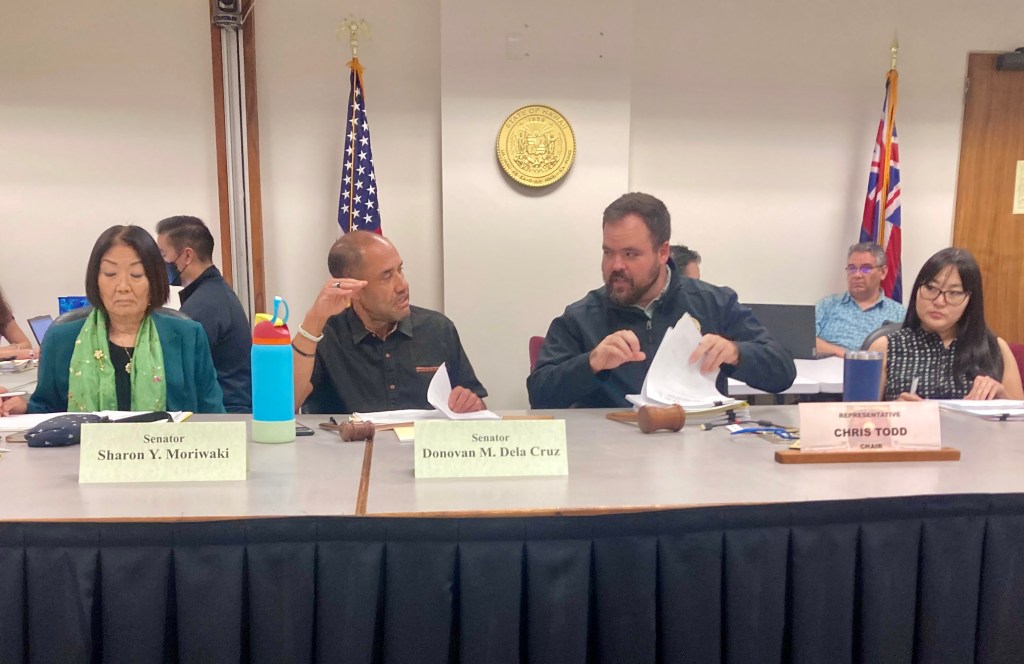
House Finance Committee Chair Chris Todd offered a compromise proposal Tuesday afternoon he said would help to balance the state budget by saving some $680 million over the next five years, most of which would come from phasing out two major tax credits.
Todd had proposed leaving the entire 2024 package of tax cuts intact for Hawaiʻi families who earn less than $350,000 a year while increasing the state’s top marginal income tax brackets by one percentage point for the highest-earning Hawaiʻi taxpayers in the top three tax brackets.
That proposed tax increase would have applied to joint filers who earn $450,000 or more per year, Todd said, and the extra revenue from the tax increase on high earners would be used to deliver $400 million in new tax relief over the next six years to lower-income taxpayers.
However, the state Senate rejected that proposal. In a press release issued early Wednesday morning, the Senate said the proposed increase in the highest state income tax brackets was removed from the bill, and did not make it into the final draft.
Instead, Dela Cruz agreed to a proposal Todd made later in the negotiations to create a new income tax bracket for households earning $1 million or more and single filers earning $500,000 or more. That new bracket would have a marginal tax rate of 13%.
“I don’t think this is very far apart,” Todd said of the House and Senate proposals. “I’d really like this just to be a positive, kumbaya-type of moment and we just move on and get into the budget.”
Sacrificing Tax Credits
To increase revenue for the state, Todd essentially agreed to Senate proposals from earlier in the session to phase out the popular renewable energy tax credit that subsidizes many rooftop solar energy systems, and to end the capital goods tax credit that provides tax incentives for businesses to make capital investments.
The Hawaiʻi Solar Energy Association has urged lawmakers to retain the solar credit, describing it as “one of the State’s most effective policies enabling households and businesses to invest in rooftop solar and energy storage — technologies that reduce electricity bills, protect customers from fuel price volatility, and improve resilience during grid outages.”
The Chamber of Commerce Hawaiʻi, meanwhile, objected to the plan to eliminate the capital goods tax credit, arguing that wiping it out “will raise costs for equipment and infrastructure across sectors, with those increases likely passed through to consumers.”
According to the chamber, “In an already high-cost environment, this creates additional upward pressure on prices and cost of living.”
During the negotiations Dela Cruz reiterated the Senate’s support for scaling down the renewable energy technologies tax credit in the years ahead, saying the tax credit mostly benefits wealthier residents who are able to afford the up-front costs of rooftop solar systems.
But he said the Senate would agree to a plan to cap the solar tax credit at $40 million per year, with the cap ending at the end of 2030.
Todd said the package of tax changes backed by the House on Tuesday would save the state $680 million over five years, with most of the savings coming from ending the tax credits.
Dela Cruz agreed with Todd’s plan to leave intact all of the 2024 tax breaks for joint filers earning less than $350,000 and single filers making less than $175,000, which was apparently identical to a Senate proposal made earlier in the session.
Dela Cruz also proposed Tuesday that lawmakers allow the state earned income tax credit, the food excise tax credit and the child and dependent care tax credit be reduced as scheduled in 2027, which would also save the state money. Dela Cruz cited data showing tens of thousands of low-income households that qualify for those credits never actually claim them.
He also restated the Senate’s support for ending the High Technology Business Investment Tax Credit, the Renewable Fuels Production Tax Credit and the Research Activities Tax Credit, saying they should all be terminated at the end of 2028.
Ending or modifying those state tax credits would save the state $971 million in the years ahead, Dela Cruz said.
“This draft represents a real path forward to tax relief for Hawaiʻi’s working families,” he said.
On To The Budget
Once lawmakers finally resolve the issue of the tax cuts, Dela Cruz and Todd will need to dive deeply into the details of the state budget to hash out an agreement on that complex document by Friday.
Todd said Tuesday the Senate has proposed cuts to the state Department of Human Services and Department of Health that are “off limits” for the House.
“We’ve been very flexible on trying to come to an agreement on this tax plan, even in areas where I’m personally uncomfortable,” he said, but some budget cuts proposed by the Senate are non-starters.
Despite those difficulties, “I’d rather today just to say it’s not about how we got here, it’s how we’re going to move forward,” he said.
This story was updated to add new information about the House-Senate agreement based on information released by the state Senate early Wednesday.