Disaster Debris: Coming Soon To A Park Near You?
Some park users are getting in the faces of city crews and leaving ugly voicemails, demanding the debris be taken elsewhere.
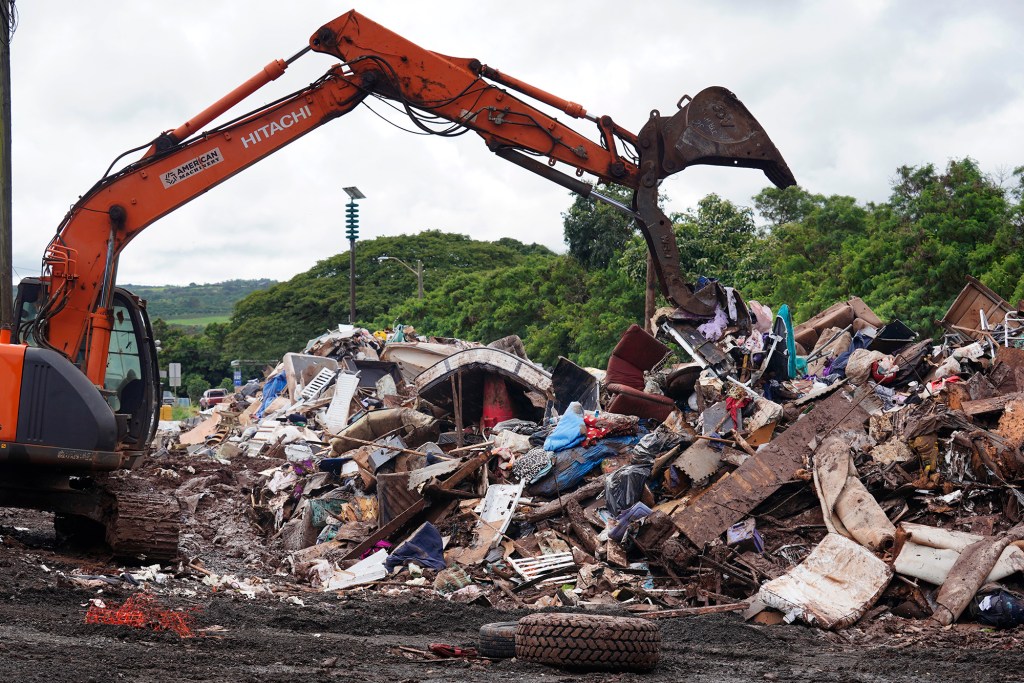
Neighbors were taken by surprise last month when more than 5,000 tons of Kona low storm debris — from wet, rotting furniture to carpets and wood — landed on a grassy field above the baseball diamonds at Patsy T. Mink Central Oʻahu Regional Park.
City officials said they had little choice; they had to move fast. Waialua flood debris was quickly piling up at two makeshift dump sites after a historic storm dumped more than 2 trillion gallons of water across the state. They needed to get all that wreckage to the best available site as soon as possible.
The Waipahu park, known as Corp, for short, fit the bill. It had been designated for alternate temporary storage of debris after a disaster such as a hurricane or major storm, along with 19 other parks across the island. That list includes prominent locations such as the Ala Wai Golf Course, Ala Moana Beach Park and Kapiʻolani Regional Park.

Those 20 parks are not widely known and there is a reason for that: they were just added to the city’s debris management plan last year, without public input or City Council approvals. Previously, the city had considered using industrial yards, agricultural lands and military training sites instead.
The city’s Environmental Services Department told Civil Beat it recently posted the debris plan to its website. A review of that city site using the Wayback Machine, an internet archive tool, shows it had not been posted as of March 12, around when the Kona low storms struck.
The debris plan, city officials say, is updated every 10 years or so.
“I don’t believe the City and County, or the state, has ever come to neighborhood boards to just kind of message this,” Danielle Bass, who chairs the Mililani-Waipiʻo-Melemanu Neighborhood Board, said of using parks to manage disaster debris. “So I very much understand where the community is coming from where that was a surprise,” she said, when the debris first started appearing at Corp.
Still, using public park lands to collect and sort debris after an extreme disaster on an island with limited space makes a lot of sense, Bass added, and it’s a way for communities to help neighboring ones nearby.
“One of the benefits of a park,” she said, “is to help sort the damage and collect it so that the impacted communities can move on.”
The public parks in the city’s debris plan are now listed as potential alternates to six primary sites that are either privately owned or controlled by the military. The plan envisions a Category Four hurricane hitting Oʻahu, with damage far more catastrophic and widespread than the Kona low storms, which flooded isolated areas.
State and county officials started creating these advance plans on how to handle debris after the Category Four Hurricane ʻIniki pummeled Kauaʻi in 1992.
Dole Field in Wahiawā, owned by Dole Food Co., is the nearest of the city’s primary sites to Waialua, where the debris now at Corp originated. However, city officials were so surprised by the extent of the flooding, Environmental Services Director Roger Babcock said, that his department didn’t have time to arrange access with Dole to its property.
“I basically looked at it and said, ‘OK, what properties do we have — that are city properties — that we can quickly activate,” Babcock said, “that would be of adequate size and close to this event?” Corp, he said, made the most sense. City-hired contractors could drive their trucks right off Kamehameha Highway onto an 8-acre grass field there.
In the future, he said, the city could look into whether there’s a way to more quickly gain access to the primary debris sites in an emergency before resorting to taking rubbish to a park.
“I think if there was a really big event,” he added, “we would be activating these bigger sites for example, Dole and Campbell Industrial Park.”
The city expects to use Corp for debris storage, sorting and hauling for another couple of weeks, Babcock said.
Its contractors, DRC Emergency Services and Tetra Tech, will have to leave the site the way they found it, he added. They took soil samples from the field when they started depositing debris there, he said, and the state health department will have to certify that their soil tests come back free of toxins when they’re done.
The contract crews have hauled all the debris from Waialua to Corp to be sorted, separating out any remaining hazardous waste, Babcock said, which are brought to a city facility for proper disposal. Crews have also laid barriers on the ground around the debris pile to help contain any runoff.
‘Ugly’ Confrontations
Despite assurances that the debris is temporary and the park grounds will be restored, not all local residents have been as understanding as Bass.
Honolulu Parks and Recreation Director Laura Thielen said Corp staff received nearly four dozen angry voicemails at their on-site office the day after debris started appearing there. Some messages, Thielen said, called on the staff to die.
Other park users have angrily confronted park staff in person, she added, demanding that the debris be removed.
“They’ve had threats, they’ve had all kinds of things. And that, to me, is the thing that’s so disheartening because it’s not like when you have a disaster anybody wants any of this to happen,” Thielen said.
“The folks that are yelling and leaving the ugly messages, it’s like, ‘Where is the aloha and compassion for your neighbors?'” she added. “Because if the next disaster were to strike your home, you would want a similar help and assistance.”
Thielen said her department had been included in city emergency planners’ talks when the decision was made to add the various park sites to the updated debris management plan.
“Information is passed around and discussions had, but there’s a limited number of open sites,” she said. “When you have a disaster of the size that they are planning for which, God forbid it ever does happen, they’re going to have to have multiple sites to be able to stage debris while people recover.”
Added Bass, who also works as the state’s Sustainability Coordinator, “We have to be creative. We’re an island, right? So we have to have dual uses for things.”
Civil Beat’s coverage of climate change and the environment is supported by The Healy Foundation, the Marisla Fund of the Hawai‘i Community Foundation and the Frost Family Foundation.