

North Shore Flood Will Add A Month’s Worth Of Debris To Landfill
The city has limited options when it comes to disposing tons of refuse from the flash floods that roared through the North Shore last month.
A mountain of debris from recent storms on Oʻahu’s North Shore – large enough to blanket a football field in garbage 9 feet high – is likely headed to the island’s near-capacity landfill.
Honolulu officials are hoping to divert as much of the estimated 6,000 tons of debris as they can away from the Waimanalo Gulch landfill. That facility is nearly maxed out and scheduled to close by 2028, and multiple city administrations have struggled to find a suitable replacement.
The main alternative to the landfill is burning the debris at H-Power, the city incinerator that breaks down waste and produces less than 10% of Oahu’s electricity. The resulting ash is still sent to the landfill, but takes up less space and weighs less. When trash is too dirty or wet, however, it isn’t flammable.
“That introduces a component that doesn’t burn and ends up in the ash and messes up the H-Power boilers when we’re trying to burn it,” Roger Babcock, director of environmental services, said.
Now Patsy T. Mink Central Oahu Regional Park in Waipahu is acting as an enormous outdoor drying table to enable the flood water to evaporate.
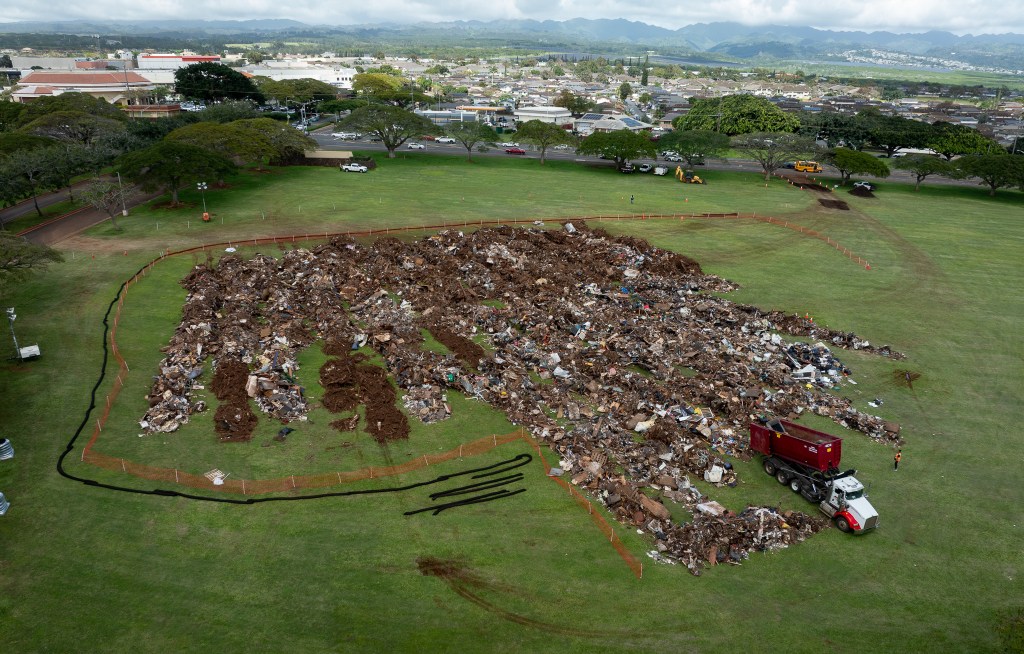
In the end, Babcock said, an estimated 80% of the flood debris or 20,000 cubic yards – the equivalent of an extra month’s worth of Honolulu’s municipal waste – will likely end up at the landfill.
While the disaster load is definitely a hit on the facility, he said it won’t have a major impact on its operations or its projected lifespan. Around 225,000 tons of waste are landfilled there every year.
“The amount continues to climb each day, but it’s manageable. We’re trying to reduce what we send to the landfill, and we’re trying to take out all the metal. We don’t want to bury that,” Babcock said. “But you need to spread it out and have a contractor go through it.”
One of the only relief valves is a landfill operated by PVT Land Company, which has a county contract to take commercial building and demolition waste. Those materials will be directed there once people start rebuilding, Babcock said, a process that will take months.
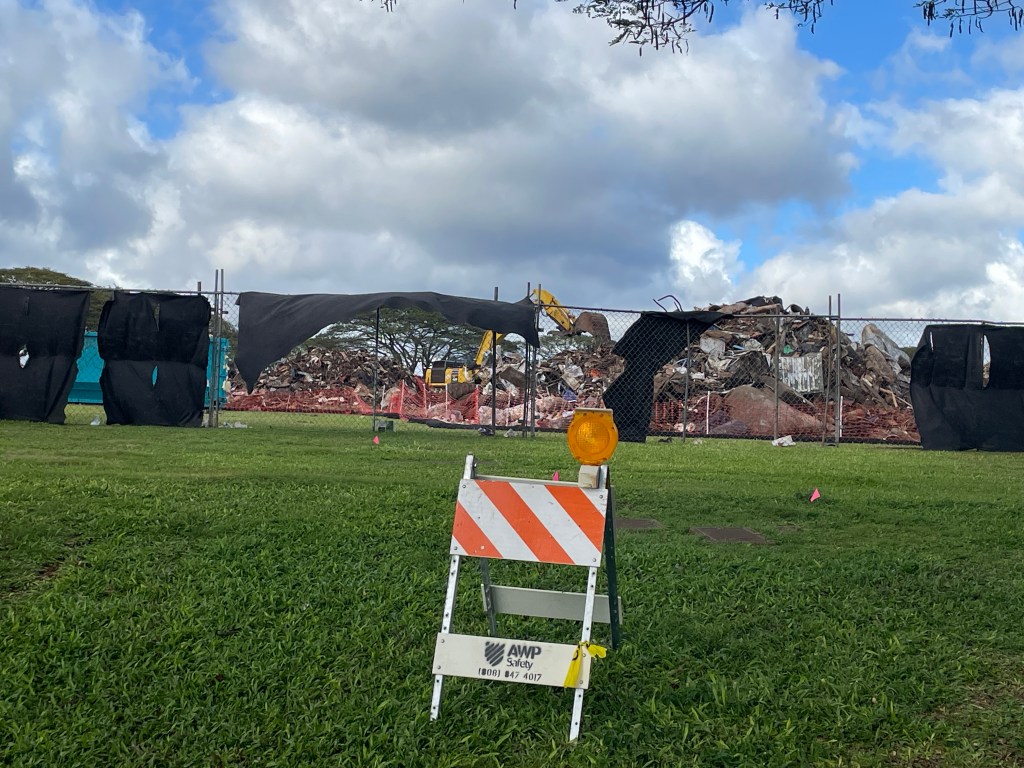
On Monday, the roar of heavy machinery enveloped a fenced section of the the regional park as contractors sorted and consolidated mounds of saturated bedding, window frames, twisted metal, stud timber, vegetation and appliances.
Black construction cloth flapped in the wind against a temporary barrier fence, offering glimpses even from the ground of backhoe loaders picking over the remains of people’s farms and homes severely damaged during flash flooding in Waialua on March 19 and 20.
“I mean stuff was wrinkled against houses, against fences,” said Brandon Rice, a Waialua resident who used his own heavy equipment to help clear the resulting debris. “There were Tupperware containers, plastic totes, sheet metal from roofs or fencing, and washers and dryers that washed down the road.”
The staging area in Waipahu is effectively a super-sized outdoor recycling center where city contractors sort the wreckage. While the city’s Department of Facilities Maintenance temporary collection sites at Otake Camp and Long Bridge were closed earlier this week, residents could still take debris to regular collection centers.
City crews will be back in Waialua on Monday for curbside refuse collection and residents have been asked to separate damaged appliances from other debris, and schedule the pickup of hazardous items by calling (808) 768-3201.
Residents Had Little Time To Sort
A lot of the clearing has already been carried out by locals who worked to move the soggy debris during the weekend after the storm. They piled debris into a temporary dump site in Waialua before city crews arrived in force.
It was hard to tell objects apart from one another, Rice said. Residents’ best option was to “just grab everything and dump it into trailers.”
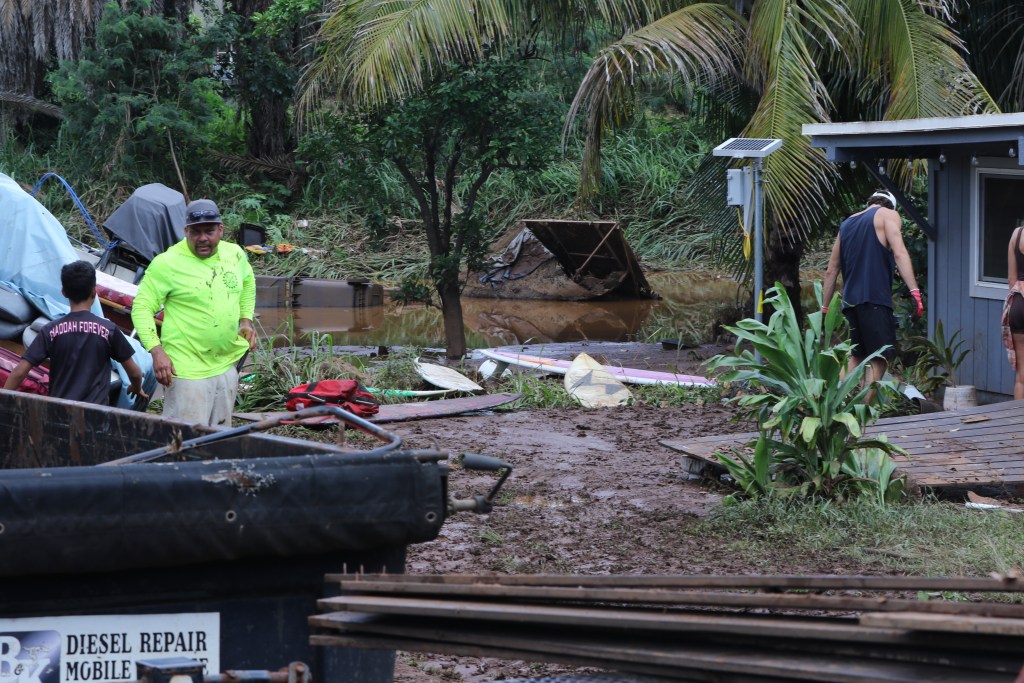
“Everything was muddy, smashed and wrinkled,” he said.
That helped clear kitchens, garages and driveways faster but is complicating the processing of the tons of detritus at the temporary staging area.
In many cases, the truckloads arriving at Patsy Mink park have been screened for flammable and hazardous materials by contract crews at the temporary dump sites.
“The contractors were pretty decent at using machines to identify propane tanks and electronic parts. I saw them pulling batteries, propane and gas tanks out,” Rice said.
The amount of flood debris being trucked to the staging area should level off soon, Babcock said.
“We actually expect the piles to start shrinking,” he said, as materials are diverted.

Nearly 100 truckloads had been delivered as of Saturday, a county press release said. Now the two county contractors, DRC Emergency Services and Tetra Tech, have to determine where it all goes.
“Some of it can be recycled, some is going to the landfill and some might be able to go to H-Power,” Babcock said.
The county’s municipal incinerator, H-Power, turns an average of 2,000 tons of waste a day into ash that takes up 90% less physical volume and 75% less weight at the landfill, and “that space is precious,” Babcock said.
H-Power Struggles With Muddy, Damp Waste
The county’s ability to turn the sodden debris into ash is limited by the mass burn technology of the H-Power incinerator, which doesn’t effectively burn material that is wet or contaminated by soil.
Diesel fuel can be added to help material burn but that’s much less efficient, Babcock said.
That means more of the flood debris will have to be landfilled than might normally be the case.
Some products recovered from the trash can be recycled, including steel and household appliances.
Those will be processed by county contractors and ultimately shipped in containers to the mainland, Babcock said. With large appliances, he said, “the contractors are taking out the chemicals and then they’re shredding it. And then they’re compressing it –– just like junk cars.”
That’s no different from the current recycling workflow for recycling.

It is too early to estimate the final cost of the debris clean up, Babcock said, but it will certainly be “several millions.” The county is hoping to recoup most of that through insurance and from the Federal Emergency Management Agency, he said, although the timing of a potential federal reimbursement is hard to predict.
Babcock said that Honolulu retains one of the two companies, Louisiana-based DRC Emergency Services , to provide emergency services and debris removal on short notice.
While the North Shore floods were devastating and will require years of recovery, Babcock said the removal operation is on the smaller end of what the county has planned for. In the event of a large catastrophe, like a Category 4 hurricane, the company has the capacity to do debris removal work worth hundreds of millions of dollars.
Meanwhile, Rice said that he’s anticipating that another phase of debris removal will be required as home repairs unearth tons of vinyl flooring, wood planks, sheet rock, insulation and fixtures.
“It’s all underneath in the mud,” he said, “and as people go through the mud, there’s going to be more rubbish and debris for sure.”
Civil Beat reporter Caitlin Thompson contributed to this story and its coverage of climate change and the environment is supported by The Healy Foundation, the Marisla Fund of the Hawai‘i Community Foundation and the Frost Family Foundation.

