Hawaiʻi Storms: Otake Camp Evacuation Ordered Again
Honolulu officials had planned to hold a press conference to provide updates on the storm Friday afternoon, but canceled it shortly after the evacuation order went out.
Emergency officials ordered the evacuation of Otake Camp on Friday afternoon, making it the fourth time so far this year that residents of the North Shore neighborhood were told to flee because of flash flooding.
The order was lifted at around 7:30 p.m. but officials said high water vehicles would be stationed on the North Shore in case the situation changed overnight.
Although the amount of rainfall on Oʻahu Thursday night and early Friday was less than seen during the Kona low storms in March, it had pounded ground still saturated from a historically wet winter, quickly filling the nearby stream already brown with sediment deposited by recent storms.
Kaukonahua Stream, which runs along a row of homes in the small neighborhood, had risen about 8 inches in less than two hours on Friday, according to the U.S. Geological Survey stream gauge. The stream flowed forcefully but easily, with water levels remaining several feet below the banks as of 5 p.m.
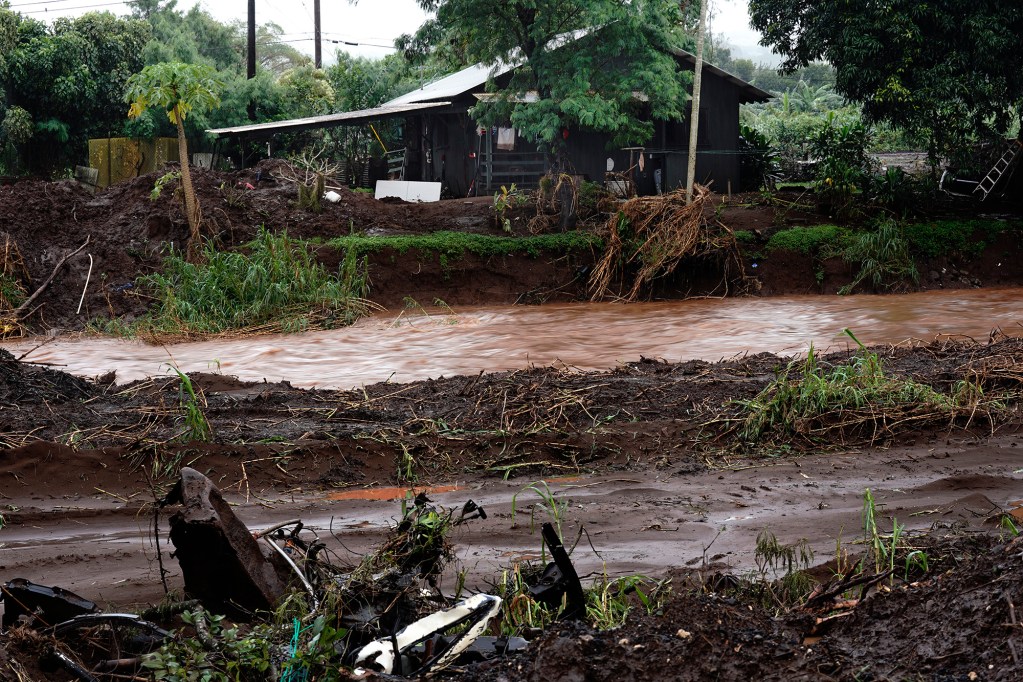
Throughout history, Otake Camp residents have been no strangers to Kaukonahua’s rising waters. This season, they evacuated for the first time on February 21, only to be forced to flee a few weeks later during the first Kona low on March 13 when the USGS stream gauge reached more than 13 feet. The second Kona low on March 20 sent people swimming to reach safe ground and crashed a house into the Otake Bridge.
Half an hour after the fourth evacuation order went out on Friday afternoon, the Kaukonahua Stream gauge had risen but remained lower than it during the previous evacuations, at 7.70 feet. That level had already dropped by 4 p.m.
Honolulu officials had scheduled a press conference to provide updates on the storm at 3 p.m. Friday, but canceled it about 20 minutes ahead of time, shortly after issuing the evacuation order.

The city is providing free bus services for people trying to evacuate on the North Shore and in Waiʻanae.
The neighborhood of plantation-era houses behind the grocery store T. Otake and Sons has faced some of the worst flooding anywhere in the state this year. The community is still cleaning up from the last Kona low, which forced people to flee fast-moving and rapidly rising waters in the middle of the night on March 20. By that morning, the USGS gauge at Kaukonahua Stream reached more than 20 feet — nearly triple its normal height this time of year — as residents across the North Shore of Oʻahu got a warning that the Wahiawā Dam was at risk of failing.
In the days and weeks since, members of the local community and government crews have been clearing sediment and debris. Excavators perched on the banks of the river have been dredging the channel to allow more water to flow through.
Otake Camp was eerily quiet Friday afternoon. Ponds were collecting on roads across the North Shore, but cars were able to cross over Otake Bridge like normal, even after the evacuation was ordered.
On Wednesday, Gov. Josh Green announced that the federal government has agreed to provide funding to support the recovery efforts across the state. On Thursday, he closed government offices in anticipation of another major storm although as of midday Friday, predictions were that the storm would be less intense than expected on most of Oʻahu and the rest of the islands.