New $2M Fund Covers Neighbor Island Medical Flights
State-funded flights to Honolulu medical appointments aim to stop rural residents on Molokaʻi and beyond from putting off routine health care.
Molokaʻi resident Lonnie Kaʻai says taking his kids to doctor and dentist appointments feels like a logistics nightmare. It’s not hyperbole: Getting medical help, even for routine needs, often requires a Cessna.
There are no pediatricians on Molokaʻi, an island of 7,400 residents where Kaʻai, a police officer, lives with his family. So several times a year he or his wife, an elementary school principal, fly to Honolulu with their children for routine doctor check-ups, vaccinations and sports physicals. After their Kaunakakai dentist stopped billing insurance a couple years ago, the family started boarding a nine-seat airplane for teeth cleanings, too.
The 37-minute airplane ride isn’t the problem. It’s the shortage of flight opportunities coupled with frequent flight delays that all too often lead residents to miss their Honolulu medical appointments — sometimes repeatedly. And when travel costs to access an off-island procedure aren’t covered by health insurers, a trip to the doctor can feel out of reach.
“It’s the cost that we pay to live on this island that’s home, where we’re from,” Kaʻai, 45, said. “The people here, we feel the struggle, we grumble about it, but at the same time we just accept it.”

One new solution now covers airfare costs for Molokaʻi and Lānaʻi patients struggling to access medical care. The taxpayer-funded flights are part of a growing effort to increase access to comprehensive and timely medical care for residents of isolated parts of the state.
In April, Kaʻai said everyone in his family was about six months overdue for dental cleanings but a trip to the dentist would have cost the family of four about $1,100 in roundtrip airfare, plus Uber rides and on-the-go meals. He was inclined to push off the appointments further — but then he learned about the Essential Rural Medical Air Transport pilot program, or ERMAT, which covered the costs.
Since ERMAT launched in January, nearly 70 Moloka‘i residents and about 40 Lānaʻi residents have used it to reach off-island medical services, including sleep apnea treatments, dermatology appointments and heart exams. The $2 million initiative is funded by the state through June 2027.
For patients, all that is needed is a doctor’s referral. A project coordinator books the patient a seat on a commuter flight operated by Mokulele Airlines, the only commercial air carrier that serves Moloka‘i and Lānaʻi.
For project organizers, it’s a bit more complicated. It’s sometimes difficult to find an open seat on a flight that will get a patient to Daniel K. Inouye International Airport in time for an appointment.
Morning flights to Honolulu’s main airport are in high demand among Moloka‘i residents who must travel by airplane to earn an income or see a doctor. It’s not uncommon for seats on early flights to sell out days or weeks in advance.
ERMAT project coordinators sometimes work directly with airline executives to open up seats for patients with urgent medical needs, said Lani Ozaki, executive director of Pulama Ka Heke, a Molokaʻi health care nonprofit hui that’s running the project with Lānaʻi Kinaole, a home health care agency.
“It gets a little crazy but we find ways to get patients out,” Ozaki said. “What’s important is people no longer have to delay care.”
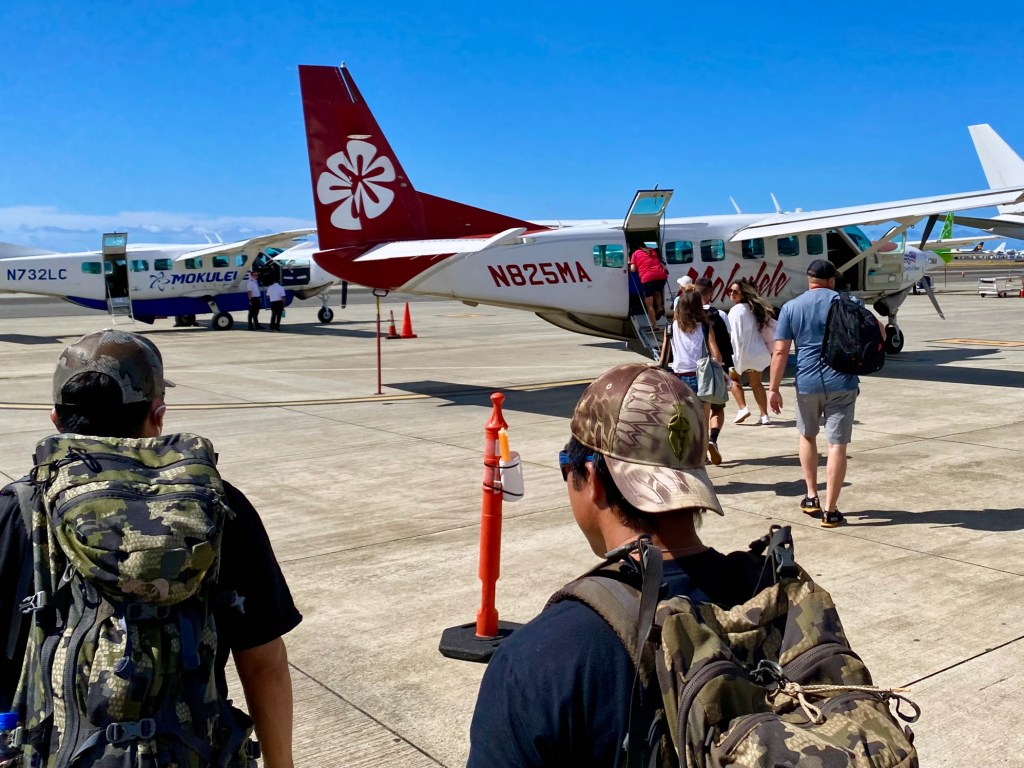
Although the project can’t prevent flight delays, it stops people from having to shell out money they can’t afford for flights.
Molokaʻi resident Lesley Sambajon, 71, said she recently put an $853 roundtrip flight for an oncology appointment on her credit card without knowing how she would pay it off. She had to resort to flying first from Molokaʻi to Maui and then Maui to Oʻahu.
“I have been traumatized,” the retired district court clerk said. “Many times I had anxiety like, ‘How am I going to deal with my health when I’m so overwhelmed with the amount I have to pay to get over there to see the doctor?’ That’s why it’s such a blessing to have this program. It feels like there’s a light at the end of the road. Like, ‘OK, I can do this.’”
The program is now working to boost capacity.
In mid-May, Pacific Air Charters will build on the effort by providing medical charter flights dedicated to the program, President Marshall Ashley said. The flight schedule is to be based on patient needs. Ozaki, of Pulama Ka Heke, said she’s also in talks with representatives from Lānaʻi Air, a luxury airline owned by tech billionaire Larry Ellison, that plans to expand to Moloka‘i.
When things go smoothly, an off-island medical trip can easily stretch into a 12-hour endeavor, one that forces kids to skip a day of school and parents to miss a work day. When there’s a hitch, that missed day of school or work could have been for nothing. Missed medical appointments, even pressing ones, can take months to reschedule — a bane for patients and physicians in the state’s stressed-thin medical system.
Hawai‘i needs to grow its supply of doctors by about 23% to meet patient demand, according to a 2025 report that tracks the state’s medical professional needs. On Moloka‘i, the physician workforce needs to grow by 83%, said Dr. Kelley Withy, a physician at the University of Hawaiʻi’s John A. Burns School of Medicine, who oversees the ongoing study and is its primary researcher.
A small number of medical professionals opt to travel to Moloka‘i and Lānaʻi to provide residents with routine care, but the same flight disruptions that vex patients have led some time-pressed doctors to stop flying to see neighbor island patients.
Molokai resident Catherine Aki, a 74-year-old substitute teacher, said she used to be able to avoid air travel for colonoscopies, but the procedure is no longer available on Moloka‘i.
“Something’s broken, something needs to be fixed when you can almost count on delays and it’s really, really complicated to get yourself there,” Aki said. “I’m grateful for the free plane flights but the plane flights are a Band-Aid.”
Civil Beat’s health access reporting is supported in part by the Atherton Family Foundation; reporting on healthcare access issues in Maui County is supported in part by the Fred Baldwin Memorial Foundation; reporting on economic inequality is supported by the Hawaiʻi Community Foundation as part of its work to build equity for all through the CHANGE Framework; and by the Cooke Foundation.