‘Dangerously Close To Capacity’: Maui Weighs $53M Kīhei Desalination Plant
Community members gave the idea a lukewarm reception when the Maui Department of Water Supply shared details.
The sunny leeward side of Maui is close to running out of water. During the dry months, the system pumps out nearly as much water as it produces. Or, as Eva Blumenstein with the Maui Department of Water Supply put it recently, “it’s getting dangerously close to capacity.”
As the county plans for more development, the demand for water in the region will grow by an estimated 6 million to 10 million gallons a day by 2040.
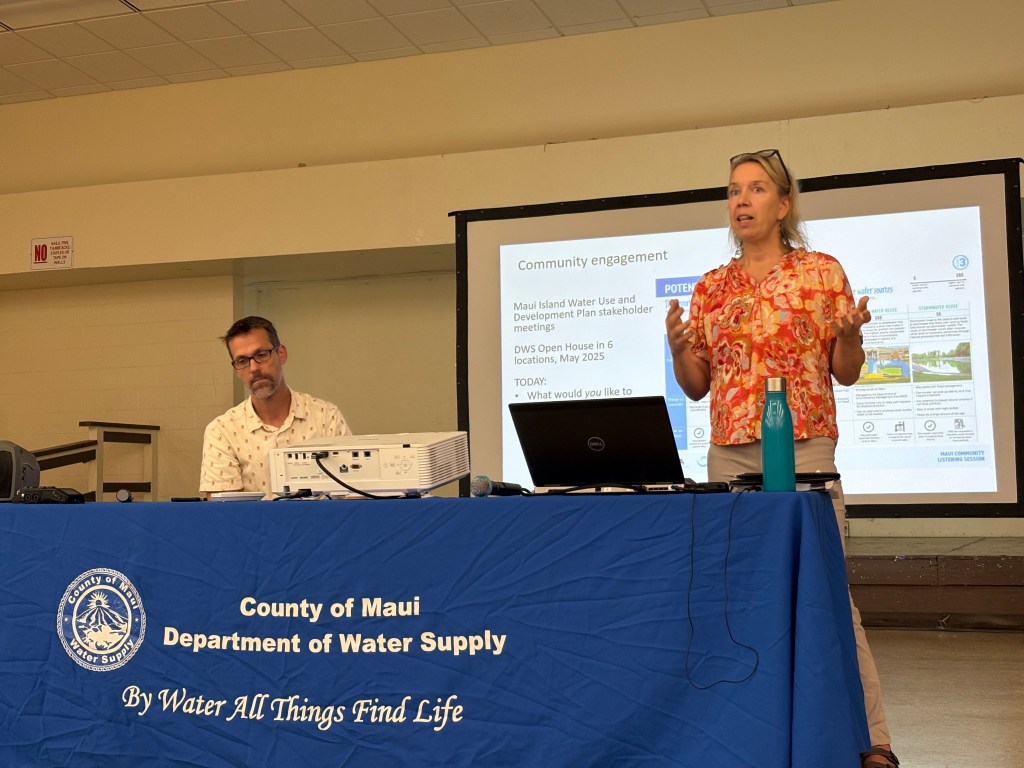
Can desalination help fill some of that demand? That’s the question posed by Blumenstein, the department’s planning program manager, and other county officials who invited the South Maui community to weigh in last week.
The gathering at the Kīhei Community Center focused specifically on the idea of a $53 million desalination plant in Kīhei. And while most of the community members who attended didn’t shut the idea down entirely, many shared skepticism about the cost and the disposal for the brine that would be a byproduct of the process.
Community members said they wanted the department to prioritize other strategies first, such as conservation and water reuse, and to look to desalination only if those approaches fail.

Blumenstein shared the desalination feasibility study conducted by the engineering consultant Brown and Caldwell for the county in 2024. She said the department is considering applying for funding from the U.S. Bureau of Reclamation to embark on a planning and design process based on recommendations of that study. But she and the department’s director, John Stufflebean, stressed that the county is still early in the process — and developing a plan for desalination doesn’t necessarily mean it will be implemented.
The Central-South Maui water system has a capacity of 26,810 million gallons a day. During the dry months, when it is at peak production, the system delivers 26,795 million gallons a day to people who live and work in the area.
“Most of the urban growth areas on the island are in drier watersheds,” Blumenstein said. Typically, there’s not enough groundwater to supply the region, she said, so water has been imported from wetter areas.
That option is making less and less sense as rainfall becomes less predictable, Maui’s aquifers are pushed to the limit, and a variety of policies are making Upcountry water less accessible to South Maui communities. For all those reasons, the department sees desalination as a viable backup.
“We have to make sure that we have a sufficient, reliable source to get us through drought, and to have some backup contingency source as well,” Blumenstein said.
The desalination plant Brown and Caldwell recommended in South Maui would use reverse osmosis, run on solar energy and use brackish groundwater from the nearby Kamaʻole aquifer system. Desalinating brackish water is less energy intensive and requires less upfront investment than saltwater desalination. However, it would produce less overall freshwater than desalinating saltwater straight from the ocean because it is limited by the availability of groundwater. It would also produce less brine.
The consultants recommended that the Kīhei plant start out producing a half-million gallons a day and scale up to produce 2 million gallons per day.
Brown and Caldwell identified three other sites for potential desalination plants on Maui ranging in cost from $37 million to $80 million: another brackish plant in Wailea, a saltwater plant in Lahaina and either a brackish or saltwater plant in Kapalua.
In West Maui, desalination has been positioned as key to future affordable housing developments, such as the 500-home Pulelehua project, which stalled last year due to lack of available water.
Maui isn’t the first county to consider adding desalination as a way to produce more potable water. On Oʻahu, one desalination plant is already moving forward. The Kalaeloa Seawater Desalination Facility will provide an initial 1.7 million gallons per day to the ʻEwa area.
Conservation Or Desalination?
When asked whether desalination would be prioritized over the restoration of the existing watersheds on Maui, Stufflebean and Blumenstein made a point of clarifying that it would not.
“There are multiple landowners who are really trying to preserve the native forest. In other areas, they are trying to restore disturbed landscapes. That’s our first priority, and that’s why we have tied that effort to our operations budget,” Blumenstein said. “We cannot develop any water resources anywhere without making sure we have a fairly intact watershed where most of the recharge is coming from.”
Other community members raised the fact that infrastructure to put the highest-grade recycled water being produced in Kīhei is lagging behind, and could be put to better use to reduce the need for potable water. The Kīhei plant can produce up to 8 million gallons of this so-called R-1 water every day, but an extension planned to transport it to Wailea has never been built.
“We have 3 million gallons of available wastewater that could be generated in South Maui, and used in South Maui to free up irrigation water that could be used for potable water,” said County Council member Tom Cook, who represents South Maui and is chair of the Water and Infrastructure Committee.
“The challenge is we don’t have the tanks and all the pipes to utilize all the waters, but that’s in progress,” he said. “It is actively, aggressively being implemented.”
James Jensen spoke to another key efficiency measure, infrastructure upgrades — specifically, maintaining 2,000 miles of leaky main water lines. “In some areas, we have a very low count of services per mile, and those areas are difficult to maintain. It’s an ongoing struggle, but efficiency is important,” he said.
He pointed to the water conservation ordinance that Mayor Richard Bissen signed in March as a big step forward for the department’s efforts.
“We’re hoping that the conservation bill leads us all to tighten our belts with how we use water,” Jensen said. He noted that populations have doubled in some cities on the mainland while water usage has remained flat, and mentioned a policy in Bermuda — an island nation — that required everyone who builds a new house to have a cistern and to design a roof that optimizes water catchment.
“I could see in the future a water-efficient landscape ordinance … that would limit turf because that’s part of what it takes to live here.”
Blumenstein added that while the new ordinance might temper demand to the point of not needing more source water, she pointed to the lawns outside the Kīhei Community Center.
“We’re far from there,” she said. “There are lawns right outside.”
What To Do With The Brine?
As the feasibility report spells out, the brine leftover in the desalination process is a concentrated waste product. The consultants assessed the potential for beneficial uses but found none. That’s in part because, in addition to salt, it would contain a concentrated form of the chemicals that are used to treat the water from the aquifer.
At Wednesday’s meeting in Kīhei, community members raised questions and concerns about the brine — and whether it was truly possible to dispose of it.

The feasibility study recommends sending the brine deep underground using injection wells — technology that concerns some Maui residents. The county was hit by a lawsuit in 2024 over its use of injection wells to send wastewater into the so-called transition zone between the salt and fresh water lenses without the necessary permit from the Environmental Protection Agency.
The Department of Health maintains an underground injection control line that separates drinking water aquifers from non-drinking water aquifers. All drinking water must be sourced from above, or mauka of that line. The brine from desalination would have to be injected below that line, but not too close to the ocean.
Anita Selinger, an engineer and senior manager at Brown and Caldwell, said the salty brine would be “injected below the saltwater lens, so very very deep. And then we have to make sure there’s at least a 50-year path for it to get to the ocean.”
That wasn’t enough to reassure some community members. As one participant responded, “You talk about a 50-year path to the ocean. That’s not even one generation. I mean, then what?”
On Friday, James “Kimo” Landgraf, deputy director of the Department of Water Supply, said Wednesday’s meeting was an opportunity to talk broadly about water availability and the long-term reliability of Maui’s water supply.
“There isn’t a specific percentage or level of community support that DWS would need to see before considering an application for federal funding for planning and design,” he said. “At this stage, pursuing funding would be another step in exploring the option and developing a better understanding of its feasibility, potential benefits and impacts. It would not represent a decision to move forward with construction.”
Or as Jensen put it, “If the path to desalination is a road trip, at this stage I would say we’re kind of still loading up the car.”
Maui County will host a second community feedback session on Thursday, Aug. 13, from 5:30 to 7:30 p.m. at the Lahaina Civic Center Social Hall.