Developers Want City’s OK To Build Big. Here’s How They Sweeten The Deal
When developers propose big new projects, Honolulu asks them for community benefits in return. Some residents think the city could ask for more.
On a recent Sunday afternoon, dozens of people stopped by a craft fair hosted by Ala Moana’s newest residential high rise project, the Park on Keʻeaumoku. Kids played with balloon animals. A man gave away free plants. People meandered through the booths and enjoyed the vibes as a man performed mellow songs on the guitar.
Mānoa resident Pam Kuwamura was enjoying visiting the building’s indoor food court, which hosts mostly local restaurants, alongside family visiting from Kauaʻi. While she’s skeptical that locals could afford to live in many of Honolulu’s sleek new condominium buildings — the Park’s listings started around $350,000 for a studio — she said she likes the addition to the neighborhood.
“At least they have some green space,” she said.
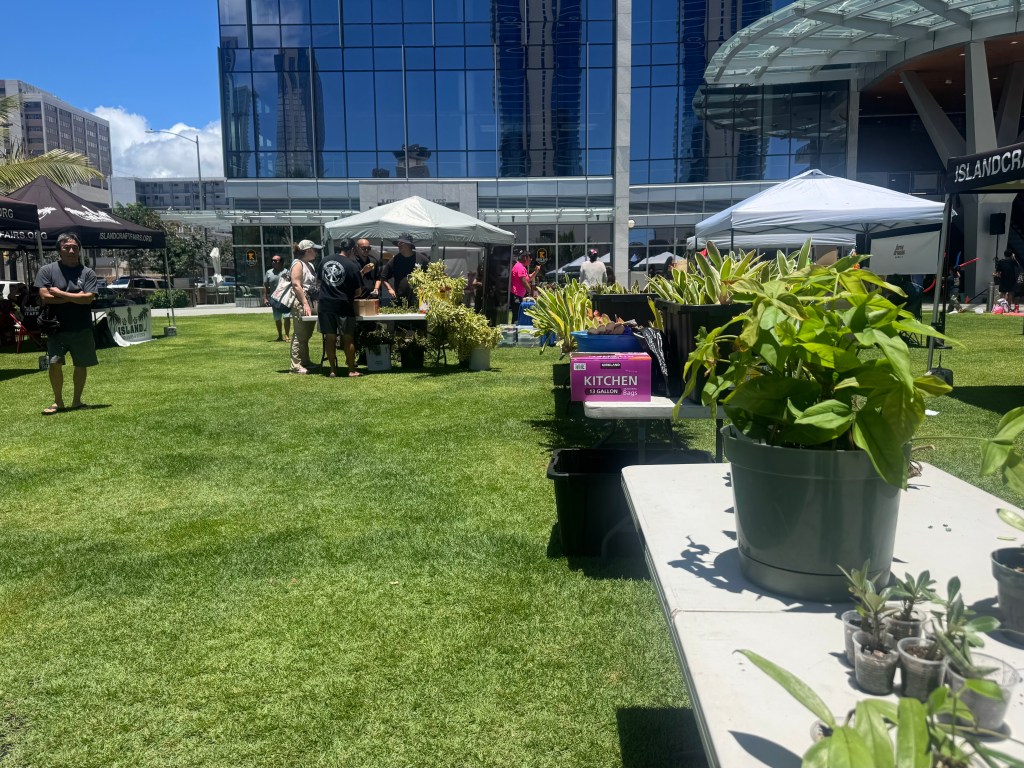
That green space was the outcome of a trade between developers and the city. The developer got to build almost 1,000 new apartment units between two towers, each 400 feet tall. That’s higher and denser than what the city’s zoning would normally allow. In exchange for the allowances, the Park provided community benefits: more units deemed affordable than the city already requires, money for street safety improvements and a big grassy park along Keʻeaumoku Street with a minimum of six annual events hosted onsite for the public.
These kinds of trades — bending zoning rules in exchange for community perks — happen on the mainland too, and are becoming more common locally as developers plan for increased housing along Honolulu’s planned rail line. Agreements can vary widely depending on the project, causing some residents to scratch their heads over how the benefits are chosen and whether they represent a fair trade between big-money developers and the communities where they seek to build.
On an island that desperately needs more affordable housing for locals, some are wondering whether the county is using its power to the fullest and getting the most community benefit out of these developers.
“It seems very arbitrary to us,” said Dale Vanderbrink, an Ala Moana resident who serves on the neighborhood board.
More projects are on the way. Under a city program that allows developers to build higher and denser in anticipation of Skyline reaching urban Honolulu, the city – which has the leverage of the permitting system – has an opportunity at each location to extract promises of community benefits such as more units of affordable housing and additional public spaces for the neighborhood. The council has so far approved eight projects in Ala Moana and one in Chinatown.
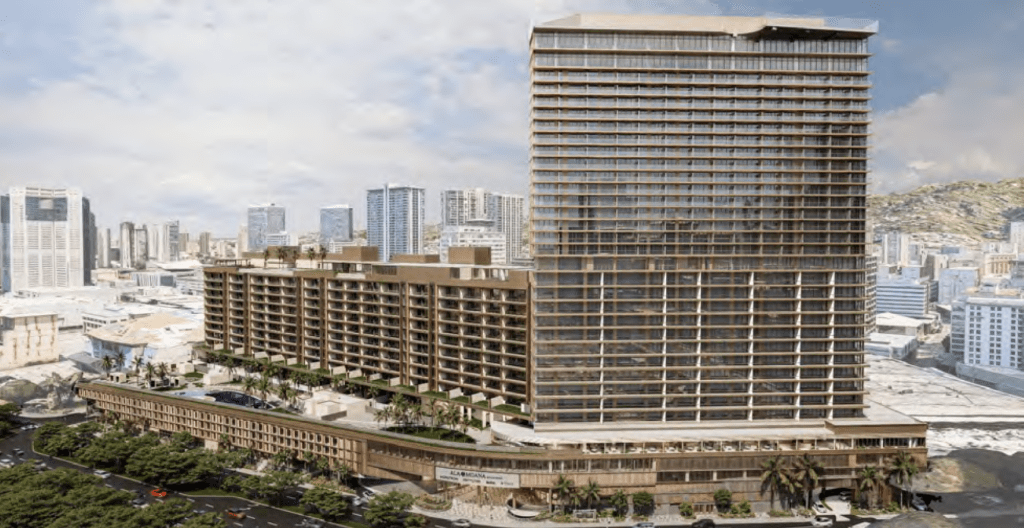
Last month, the Department of Planning and Permitting recommended the City Council approve another deal, this time for a hotel and condominium development known as 1588 Ala Moana that would rise out of the Macy’s parking lot at Ala Moana Center. The city permitting office is proposing that Developer BSC Acquisitions II, an affiliate of Blacksand Capital and the Kobayashi Group, provide millions of dollars in community benefits to improve the streetscape. Blacksand Capital and the Kobayashi Group did not provide responses when asked for comment.
For it to proceed to the next step, the project will need to have a hearing at the City Council, and members of the public will have the opportunity to weigh in at a future council meeting. That could come in September, according to the zoning committee chair council member Esther Kiaʻāina.
Desire For More Affordable Housing
As proposed, 1588 Ala Moana’s construction would flout current zoning standards.
Despite being built on land zoned for a maximum height of 100 feet, one of its towers would be 200 feet tall and the other would be 400 feet. It would have more than twice the maximum density allowed by city law. And rather than gradually leaning away from the street the higher it gets, a requirement intended to let natural light reach the street and prevent an urban canyon effect, it would rise relatively straight up.
The rules are negotiable though. City officials’ long term vision is for Ala Moana to be a dense urban neighborhood with a Skyline rail station, and the plan is to rezone the area accordingly.
But completing the required meetings, plans and ordinance changes for rezoning can take years. In the meantime, the city allows developers to apply for permits that mimic the denser standards they envision for the area, and the deal is that developers repay the public by providing community benefits.
Honolulu Complete Streets Coordinator Renee Espiau, who helped design the program, said community benefits generally fall into one of three categories: affordable housing; public park or plaza space; and Complete Streets improvements, which reconfigure roads to accommodate users beyond drivers of cars and trucks. The terms are different for each development.
“We talked about adding specific formulas that would be kind of cookie cutter across the board,” Espiau said, “and quickly realized that didn’t really make sense.”
Some developers may have expertise in making more units affordable, she said, reducing their need to provide other benefits.
In addition to 1588 Ala Moana excess height and density, it would also block a protected view of the mountains from Magic Island. In exchange, the developer would provide 69 housing units deemed affordable as well as chip in $1.5 million for street trees and $5 million for Complete Streets improvements at a hectic adjacent intersection.
But those benefits don’t go far enough, some community members have said.
“When we think of these community benefits, could the money be better utilized in the housing itself?”
Dale Vanderbrink, Ala Moana resident
Roughly 200 members of Unite Here Local 5, a union representing more than 10,000 workers in food service, hospitality and healthcare, stood along Ala Moana Boulevard in late July to protest the project, saying in a press release that “with the housing crisis and the cost of living going up, the developer should give more back in return for what it would be getting.”
The group’s primary ask is for the developer to provide more units of affordable housing, spokesperson Ben Sadoski said in an interview. He said roughly 57% of their members spend more than half their income on housing, according to an internal survey the group conducted in 2024.
“It’s definitely a huge crisis for them,” he said.
Vanderbrink, the Ala Moana resident, said he also weighs extra housing as a top priority when it comes to community benefits. Extra cash for projects spearheaded by bureaucrats at the Department of Planning and Permitting may be nice, he said, but he thinks residents would be better served by pushing for more units at lower prices.

“When we think of these community benefits, could the money be better utilized in the housing itself?” Vanderbrink said. “To make it cheaper, to have more affordability, to build more housing.”
That goal may be easier said than done, however.
“Providing affordable housing is extremely expensive,” said Minjee Kim, an urban planning professor at the University of California Los Angeles. “So I think you get more bang for your buck if you’re asking for other benefits.”
This especially goes for transportation projects. Local governments often pay for transportation projects using federal grant money, and to get that money, they often need to contribute 20% of the total cost.
“I think anyone should be focused on not just the building itself, but how people are going to live when that building gets built.”
Kathleen Lee, chair of the Ala Moana Neighborhood Board
If 1588 Ala Moana gives the city $5 million in cash for intersection improvements, DPP says in its report to the council, that money can serve as the local contribution for a $25 million project. That was the approximate cost of a new pedestrian bridge down the street.
Kathleen Lee, chair of the Ala Moana Neighborhood Board, agrees with Kim that developers shouldn’t put all of their eggs into the affordable housing basket. Community benefits should extend to the surrounding area, she said.
“I think anyone should be focused on not just the building itself,” she said, “but how people are going to live when that building gets built.”
Lee said she liked that the proposed project at 1588 Ala Moana would have affordable units. The plan is currently to provide 69, higher than the 52 affordable units they proposed during a fall presentation to the City Council. A different city law mandates that a minimum of 10% of units be affordable, and only the extra units above that threshold count as community benefits.
Still, she and Vanderbrink said, the process for determining which community benefits to ask for feels arbitrary, and they wondered how city bureaucrats come up with these numbers.
‘The Leverage Is With The City’
The first step of deciding which community benefits to ask for is to look at current city plans, according to Elizabeth Krueger, chief planner of DPP’s Land Use Permits Division.
The permit agency’s report says 1588 Ala Moana would block a cherished view of the mountains from an important beach park. But Krueger said that beach park isn’t important just because she thinks so.
“No,” she said, “it’s an important beach park because the plan says so, and the general plan talks about the importance of regional parks.”
Plans and current zoning can serve as a yardstick for measuring how much leeway the city is giving a developer. The more leeway the city gives, Krueger said, the more it can ask for in return. This is especially the case in highly desirable real estate markets like Honolulu where everyone wants to build, said Kim, the UCLA professor.
“Then,” she said, “the leverage is with the city.”

Other cities also wrestle with how to extract community benefits from developers who want to stretch zoning limits, and some require community benefits even when no stretches are requested. Boston used to favor a flexible negotiation policy, but a few years ago it switched to a formula using square footage to calculate how much money large commercial developments owe the city for affordable housing and jobs training initiatives.
New commercial developments mean new jobs, the thinking goes, and workers in those jobs need housing. Job training is meant to ensure Boston residents have a shot at those jobs.
Honolulu’s calculations are more flexible than those in Boston, and the city sometimes pushes back on what developers offer. In response to the proposed benefits from 1588 Ala Moana, the permit office shared its displeasure.
“The proposed community benefits are not commensurate with the magnitude of the requested flexibilities,” DPP’s report from July says, “nor do they sufficiently mitigate the impacts resulting from the requested flexibility.”
How to mitigate the loss of a cherished park view, for example – one that’s included in the city’s Coastal View Study from 1987 – is a question Krueger’s office attempted to answer.
“Well,” she said, “you can help by creating a park-like sense or a park-like atmosphere throughout the entire district.”
The developer proposed paying the city $50,000 to help fund street trees in the area, but the city said that’s not enough. A more appropriate dollar amount for the number of trees needed, the report says, would instead be $1.5 million.
Still, even if the city does have the leverage, it doesn’t always get the benefits it says it wants. A central goal officials have for Ala Moana is making it safer and easier for people to get around without a car, and part of the vision is to have protected bike lanes along Kapiʻolani Boulevard and Keʻeaumoku Street. Despite collecting community benefit money from developers ostensibly for this purpose, however, the roads remain without bike lanes.
Along with relying on other departments’ road repaving schedules, part of this is because the amounts collected don’t come close to paying for improvements.
Another hotel condominium project around the corner approved by the council in 2018 called Sky Ala Moana, for example, contributed money to construct a bike lane on Kapiʻolani Boulevard or to fund other similar infrastructure projects in the area.
Eight years later, there is no bike lane there.

Sky paid $103,000 to the city to fulfill this community benefit, an amount derived by multiplying the length of the proposed building by the cost per foot of a recent bike project. But it would have cost about $1 million to change the traffic signal at the intersection of Keʻeaumoku Street and Kapiʻolani Boulevard to incorporate bicyclists, according to Espiau, the city’s Complete Streets coordinator who oversees new bike lanes.
“No one project is going to provide that much money,” Espiau said, “so we’re sort of storing up the money and then we’ll contribute it to the roadway rehab project when it happens.”
Essentially, Espiau said, some community benefits this project contributed towards are still years or even a decade away from becoming reality.
Worth It?
Negotiating community benefits from developers is somewhat of an art since there’s not a precise 1:1 rubric for what the city receives in exchange for allowing developers to maximize their potential profit.
Sadoski, from the union Local 5, said he’s not sure what amount of affordable housing he would be satisfied with as a community benefit.
“I feel like we’re always kind of fighting an uphill battle,” he said, “so we’ve never really gotten to a point where we felt like it was good enough.”
The permits granted to developments like Sky Ala Moana and the Park on Keʻeaumoku came with the idea that the city’s rail system Skyline would eventually reach the neighborhood. But to save money after years of financial woes, Skyline’s Ala Moana station was cut from the plan in 2022. Developers are still reaping the benefits. But is the community too?
That’s a complicated question, Lee, the neighborhood board chair said during an interview at Midtown Eats, a popular food court at the Park.
“It has provided housing, obviously, along with spaces like where we are right now for people from the neighborhood,” Lee said. “You don’t have to live in the building to gather around here.”
Still, she said, affordable housing is desperately needed in Ala Moana and on Oʻahu in general.
In the case of 1588 Ala Moana, DPP’s report suggested making the rents affordable for a wealthier income bracket of people than previously proposed. It would translate in a shift from being geared toward individuals making $86,000 to those making $129,000, and the units would remain affordable for a longer time, doubling the period from 30 years to 60.

Some researchers argue that adding any units of housing at all counts as a community benefit.
“The broad policy goal is supposed to be to have more housing supply,” University of Hawaiʻi Economic Research Organization professor Justin Tyndall said.
Tyndall said cities used to raise property taxes to pay for new infrastructure, but now it’s more common – and more politically appealing – to extract these funds from developers.
“Which means we build less housing because it becomes very expensive to build housing,” he said. “And when we do build housing, the developers have to recoup that infrastructure cost by increasing the prices on the units they sell.”
This makes cities more reliant on the boom-bust cycle of development, UCLA professor Paavo Monkkonen said.
“If there’s a recession and nobody’s building,” he said, “then no community benefits are being generated, right?”
Krueger, the DPP planner, said that’s an overly simplified narrative, and that governments have always relied on developers to help provide basic infrastructure in some form. Lee – Monkkonen’s UCLA colleague – also pushed back, saying local governments aren’t as flush with federal funding as they were decades ago.
Whatever the case, Tyndall said the community benefits in Ala Moana “are pretty apparent.”
“There’s a playground there with dozens of kids and their parents utilizing that area,” he said, referring to the Park.
Andres Hernandez, a father who visited the Park’s craft fair with his family, said he and his kids enjoy visiting the development’s green space from their home a few blocks away to play on the playground or kick around a soccer ball.
“We can just walk or bike,” he said. “It’s great to have another playground in the area. Nice green space. The other walking distance park that we had is the one in Makiki.”
That other park, he said – Cartwright Neighborhood Park – often doesn’t feel safe to visit with the kids. Despite being mere blocks away, it feels like another world: rundown and populated by homeless people who can’t afford to live anywhere else.
Reporter Matthew Leonard contributed to this story.