Big Island Wants To Ban Big Data Centers, Once They Agree On What They Are
Giant data centers have become the latest bogeyman for residents across the nation wary of industrial development. So far, none are based in Hawaiʻi.
Hawaiʻi County is discussing a bill that would restrict large-scale data centers on the island. But the public, officials and state representatives can’t agree on how to define one — or whether they are even a threat.
Under Big Island zoning rules, residents and businesses can only use their land in the ways outlined by the county’s code. If it’s not listed as a permitted use, then it’s not allowed.
Currently, the code allows for data processing centers in an area with a mouthful of modifiers: industrial-commercial-mixed-use-zoned.
Translated, that means if a data center developer wants to build in an industrial area, they would just need to apply.
There aren’t any so-called “hyperscale” data centers in Hawaiʻi yet. Zoning codes for Maui, Kauaʻi and Honolulu counties also have a not-listed-not-allowed rule for land use. Some of their codes currently permit data storage and processing facilities. But no other county has put forward regulations and the state is only just beginning to study the issue.
Bill 170, introduced by Councilwoman Heather Kimball, seeks to make sure data centers like the ones ruffling feathers across the continent are not permitted anywhere on the Big Island. If it passes, construction of large data centers would be banned with one caveat: they can apply for a special use permit.
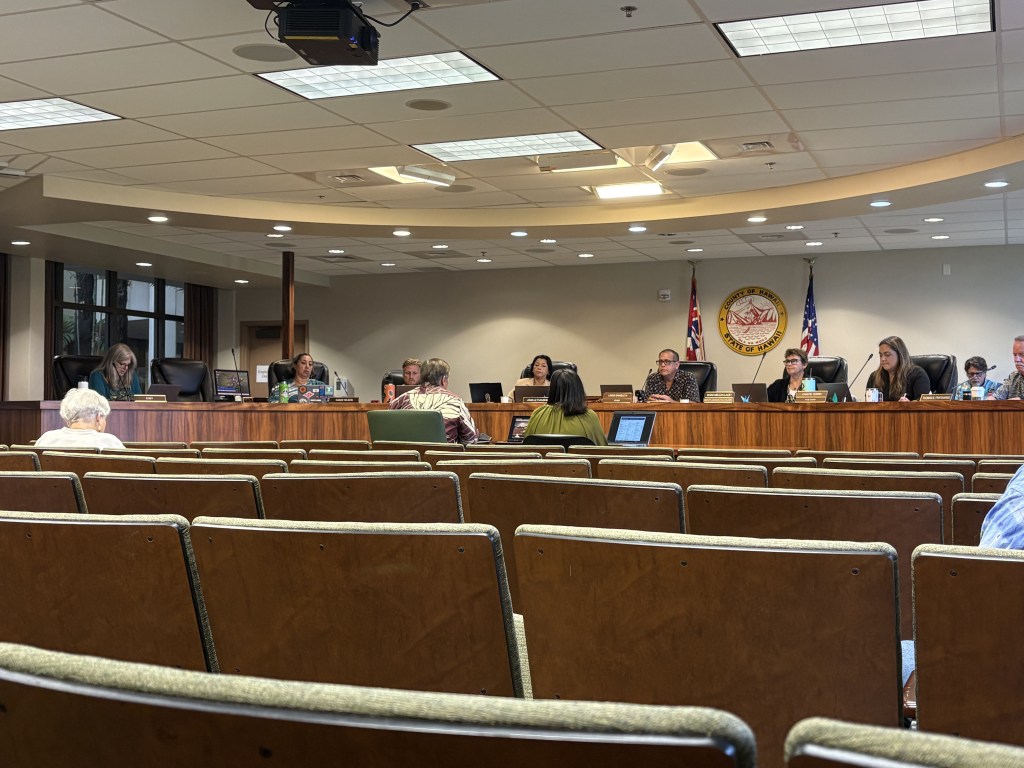
The bill was heard for a second time by the Windward Planning Commission on Thursday. The Leeward Planning Commission will take up the issue on Oct. 15.
So far, however, the biggest hurdle is figuring out how to define what would qualify as a data center under the proposed new rules.
“If we get a really good definition, I think that could solve a lot of things,” said Louis Daniele, chair of the Windward Commission. “We keep calling things data centers, data processing facilities – That’s kind of confusing for the layperson.”
‘We Don’t Want It’
Powerful technology corporations are rapidly putting up data centers across the country to power the artificial intelligence boom. The rush has sparked significant backlash from communities over concerns about the impact on the environment, the power grid and their neighborhoods.
Hundreds of counties from California to Maine have already introduced regulations or instituted moratoriums on data center construction. The centers, which can cover thousands of acres and consume entire city blocks, are the latest target for those wary about new industrial development, such as Amazon megawarehouses and microwave cellphone towers.
“I wanted to make sure we got ahead of the issue,” Kimball said. “I think it’s better to do it now,” she added, before developers start knocking on the door.
Her primary concern is the effect a data center could have on the island’s already strained grid and aquifers. The massive centers being built across the country require equally massive amounts of energy and water. A typical hyperscale data center can use up to 100 megawatts of electricity annually, for instance. That could power 100,000 households, according to The International Energy Agency.

The increased demand on the grid and the added infrastructure required to support it are raising utilities’ costs to produce electricity elsewhere, and those costs are being passed on to residents. In Maryland, customers pay $168 to $216 more per year on their electricity bills primarily due to the data center boom, according to estimates.
Across Hawaiʻi and the country, residents are not only concerned about higher bills. They’re also worried that the energy demand increases the use of fossil fuels and thus pollution, which drives climate change and threatens health.
Christina Holt, a Hilo resident who recently ran unsuccessfully for state representative, is leading the local charge against the centers. She’s hosted community Zoom meetings and posts regularly on social media to inform residents and urge them to speak out.
Dozens of Big Island residents have shown up at planning commissions meetings. In hours and pages of testimony, residents have made clear that they support an outright ban.
“We don’t want it,” Holt said, “and we, as a community, have every right to say no.”
Defining ‘Data Center’ No Easy Feat
For Bill 170 to be effective, advocates say, it needs to clearly define data centers and distinguish them from a data processing center.
Data processing center use was added to the county code in 1996 when the council undertook numerous amendments to the zoning rules. The addition reflected emerging technologies and business activities at the time.
It generally referred to office-oriented businesses that used computers to process information, maintain electronic records, or provide administrative and technical services. These types of centers don’t require much electricity and are vital to business and research operations.
Today, the state has more than 20 data processing centers, two of them on the Big Island.
A Hawaiian Telecom facility in Kawaihae is one of them. Jeannine Souki, manager of government and regulatory affairs for Hawaiian Telecom, testified in front of the Windward Commission, one of two planning commissions on the island, in September.
Advocates have two related worries. A definition that’s too broad could exclude necessary infrastructure. Being too specific could create loopholes developers can exploit.
Souki urged commissioners to consider whether the way Bill 170 defines data centers could unintentionally ban these essential telecommunication facilities
Lawsuits by developers against towns elsewhere in the country that have attempted to prevent construction are adding further pressure to get the definition right.
“They’re going to lie, cheat and steal to get what they want,” Chuck Flaherty, secretary of the Hawaiʻi island Sierra Club, said about developers.
Kimball said she’s open to changing the definition to address these concerns.
“It’s OK to be more specific, but you don’t want to get so specific to the point that there are ways to work around your definition,” she said.

Holt and the Sierra Club have offered their own definition that would explicitly allow telecommunication centers and place specific parameters around maximum energy use to block hyperscale centers.
The planning department director has submitted his own recommendations, including defining a data center as a facility that is over 10,000 square feet.
The Windward planning commissioners are mostly in agreement that data centers don’t belong on the island. But at the recent meeting held Hilo, some had a difficult time wrapping their heads around the definition issue and what parameters to add to it.
At one point during Thursday’s meeting, commissioner Thomas Fratinardo requested that the planning director bring in an expert on the issue.
The Windward Commission ultimately submitted an unfavorable recommendation for the bill, despite agreement that data centers don’t belong on the Big Island. In the end, commissioners just didn’t think the bill’s definition of a data center was clear enough.
Their vote, though, is not binding. The Leeward Commission will have a say and then it will be up to the County Council to decide.
The planning director, Jeff Darrow, also wants the county to create a permitting pathway for the large data centers. A complete exclusion of them as a permitted use, his recommendation said, may have the unintended consequence of driving development toward the State Land Use Agricultural district, where they could apply for a special permit.
Advocates and Kimball disagree with Darrow’s worries.
“We can’t not protect ourselves on a county level because we’re worried the state will allow something,” Holt said.
Hawaiʻi ‘Not A Candidate’ For Data Centers?
As the Hawaiʻi island ban moves through regulatory channels, the state isn’t fully convinced data centers are even a threat.
Kona state Rep. Nicole Lowen passed a resolution this past session requesting that the State Energy Office study potential impacts on the state from large data centers.
“I feel like there’s a bit of a social media-driven panic around something that’s not really happening,” Lowen said.

But she thought it would be good to at least look into the issue. The working group had its first meeting in September. Mark Glick, the chief officer of the energy office, said from what he’s learned so far, he doesn’t believe data center developers will be knocking on Hawaiʻi’s door anytime soon.
Data centers need enough bandwidth to transmit information and cheap energy, Glick said.
“Frankly, we have neither of those, so we’re not a candidate,” he added.
He does think it’s important to study the risks so the state is prepared and well informed. The working group will share its findings with the Legislature in 2027.
“Without having a clear definition of what you’re trying to control and understanding the full implications of the meaning, it makes it very difficult to create bans,” Glick said.
Still, other counties are interested in bringing forward bans or regulations for data centers. Even though Kauaʻi Councilwoman Felicia Cowden is skeptical about whether developers would want to build centers on the island, she wants to be preemptive.
“I think it’s good to have the policy in place,” Cowden said. “I have never heard from a single soul who does want it.”