

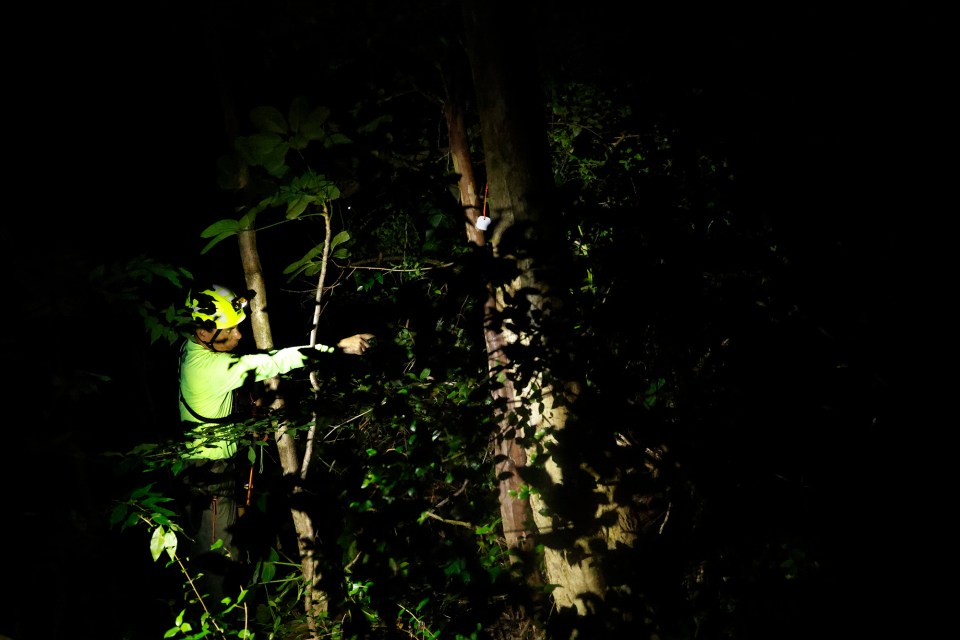
Michael Shiroma can be found scaling the steep forested valley around his Pālolo Valley neighborhood any given night of the week, his headlamp and UV flashlight strobing the understory in search of tiny coqui frogs the size of his thumb.
Shiroma has removed thousands of them from the wet and muddy landscape, including hundreds of recent kills liquefying in jars of acid lining his driveway. He wants them all dead — a goal that officials and invasive species experts are now saying is verging on impossible.
The frog population in Pālolo — one of three ongoing large infestations on Oʻahu — has gotten so big that the target is no longer to eliminate the frogs, but to contain them to the valley, a state official recently acknowledged at a public meeting.
Even that will be a stretch.
If nothing changes, the frogs will not only become permanent residents in Pālolo, invasive species experts say, they’ll start spreading across the island.
A lack of state action and resources has fueled the problem, community members involved in the fight against invasives contend, and the situation is at a crisis point as the entire island provides ideal habitat for the frogs. The animals have already been discovered on other parts of the island, including recently on the North Shore. Last week, a biologist out on an evening walk captured one in Waikīkī.
“If we are even able to eradicate the coqui frog, which is a massive if, it’s going to be a decades-long effort,” Nate Dube, manager of the Oʻahu Invasive Species Committee, told Civil Beat. “We’re looking at at least 10 years per site right now, for Pālolo and Waimānalo, and that’s not considering the frogs that are up on the headwall in Waimānalo and up at the summit in Kuliʻouʻou.”
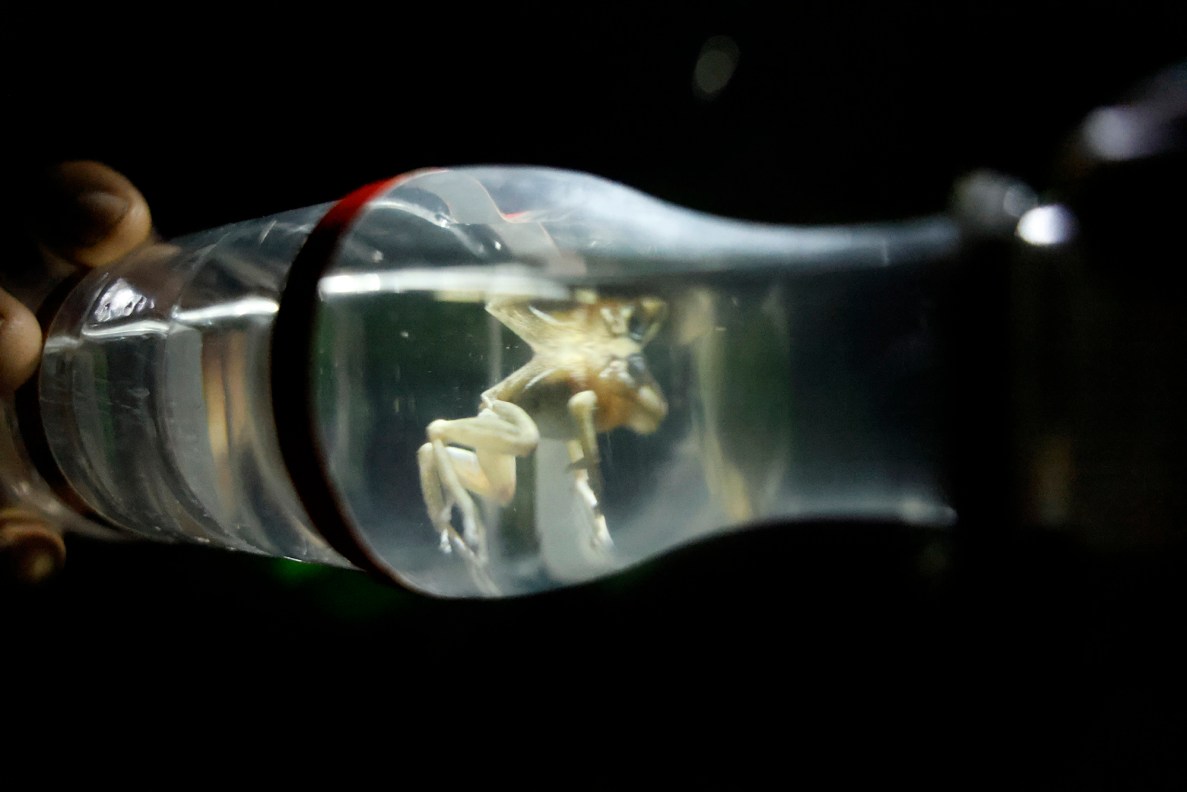
Oʻahu has successfully fended off coqui infestations in the past, but the current populations represent the greatest strongholds the island has ever faced, striking fear into residents that the island may soon face the same fate as the fully infested Big Island and struggling Maui.
Eradication is especially unlikely given the state’s historically limited investment in the problem, and the ongoing reluctance of the Department of Agriculture and Biosecurity to impose greater restrictions on the plant nursery industry — a key transmitter of invasive species such as the coqui and the palm tree-killing coconut rhinoceros beetle. Invasive species experts now believe it would cost north of $5 million over the next five years just to address Pālolo, but there are still doubts that even that would make much of a dent in their spread.
For now, the daily battles against coqui are being led primarily by volunteers, with some limited assistance from the invasive species committee, Division of Forestry and Wildlife and the state agriculture and biosecurity agency.
Shiroma, born and raised in Pālolo, has spent almost every night this year in the hills hunting frogs, dealing with what he refers to as the state’s “self-created problem.” He first called the state Department of Agriculture and Biosecurity in 2021 to ask them for help. At the time, he was being kept awake by a group of coqui frogs at the orchid nursery next door. They initially would not let him onto the property to treat it himself and the agency, he said, did virtually nothing to address the thumb-sized animals.
It wasn’t the first time the frogs appeared in the area, fellow community member Sidney Lynch said. But today, even with the nursery now taking part in eradication efforts, the frogs have taken hold.
Lynch is one of at least 60 community members who have joined Shiroma since March, when they formally organized, collectively volunteering over 2,000 hours of their time. Together, they have killed almost 11,000 frogs around the neighborhood. But the frogs continue to spread.
Shiroma refuses to accept the recent alarming prognosis. Eradication is still possible, he said, but only if the state ponies up funding and clamps down on nurseries. He is continuing to fill his jars.
“This is basically Hilo, 1988,” Shiroma said, referring to the early stages of the Big Island’s frog invasion. He believes Oʻahu’s fate can be different. “I’m still here because I know that it can be.”
Multiple Fronts
The pivot from trying to eradicate the animals marks a significant turning point in the fight against the invasive Puerto Rican amphibians.
Coqui frogs have been making sporadic appearances on Oʻahu since at least the late 1990s, about a decade after first arriving on the Big Island and Maui in 1988.
The state’s response to the frog — which is known for having a call that can reach the volume of a leaf blower, but also threatens the island’s ecological balance — was sluggish. It took almost a decade for state officials to raise concerns about their presence, at which point they had spread throughout the Big Island and parts of Maui.
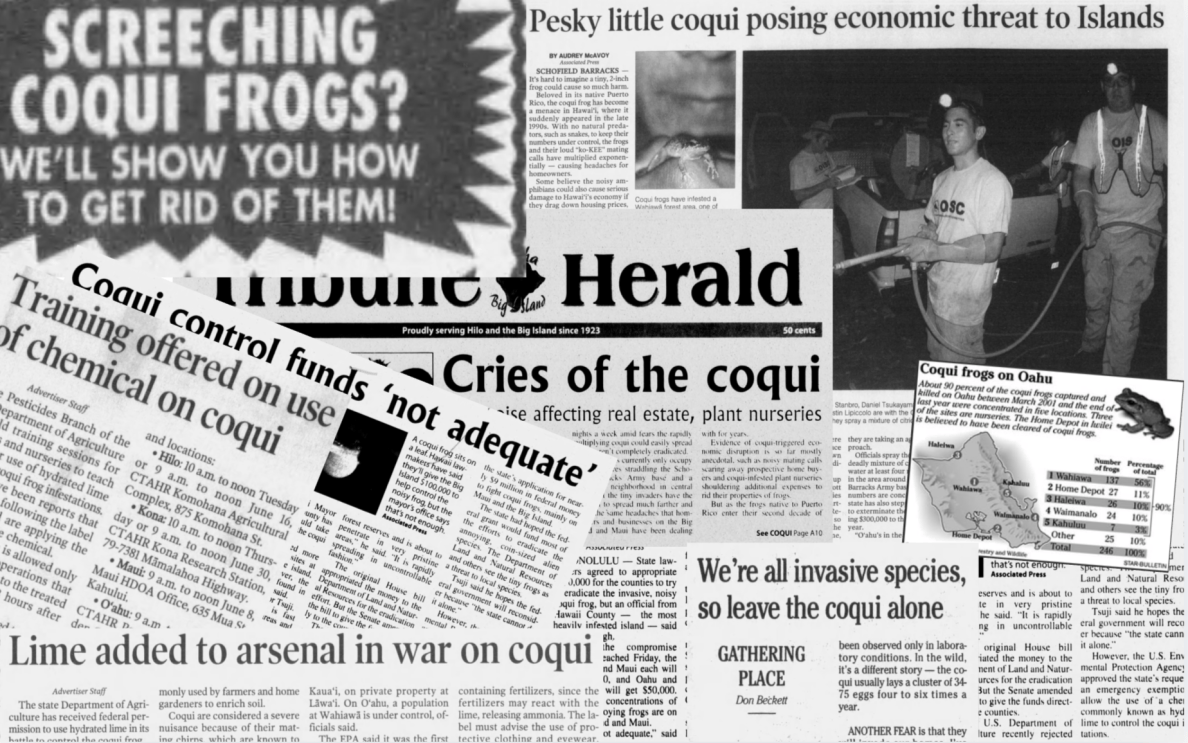
It wasn’t until 2009 that the state agriculture department designated the frog as a pest, an important step toward stopping its continuing spread. It was too late, however, as the frog had already been found on all islands but Kahoʻolawe and Niʻihau, with state and county officials, nonprofit groups and community members all playing an ongoing game of whack-a-mole.
Before the arrival of the frogs in Pālolo over five years ago, Oʻahu’s best-known infestation had been in Wahiawā. The state won that battle, but it took years and seven agencies — including the military — cooperating to get rid of the population around Schofield Barracks.
The agencies were also aided by the flat terrain at Schofield, which allowed for systematic spraying operations, akin to putting out a wildfire, said Christy Martin of the Coordinating Group on Alien Pest Species, a project of the Pacific Cooperative Studies Unit at the University of Hawaiʻi Mānoa.
The mountainous conditions in Waimānalo, Kuliʻouʻou and Pālolo Valley — home to the largest Oʻahu infestations today — are far less favorable for pest control efforts. And none of today’s infestations have had the same level of sustained attention or resources as the Wahiawā outbreak.
Pay Now, Or More Later
The frogs’ march across the islands has been fueled by plant nurseries, which the Star-Advertiser noted in 2009 were “both victim and perpetrator in the spread of coquis,” even with the threat of up to $25,000 fines for spreading the pests.
Despite increased attention and funding from lawmakers to halt the spread of invasive species, the state biosecurity and agriculture agency still faces criticism for failing to hold nurseries accountable.
The state agency’s conflicting priorities — promoting agriculture and regulating it — are a key sticking point. When new nurseries become infested, the department is often reluctant to name the businesses or stop them from selling infested products.
On Oahu’s North Shore, between Haleʻiwa and Waimea, the state has spent about 15 months contending with the frogs, said Jonathan Ho, state Plant Quarantine Branch manager. That included treatments at a large nursery in the area, which is now free of them, Ho said.
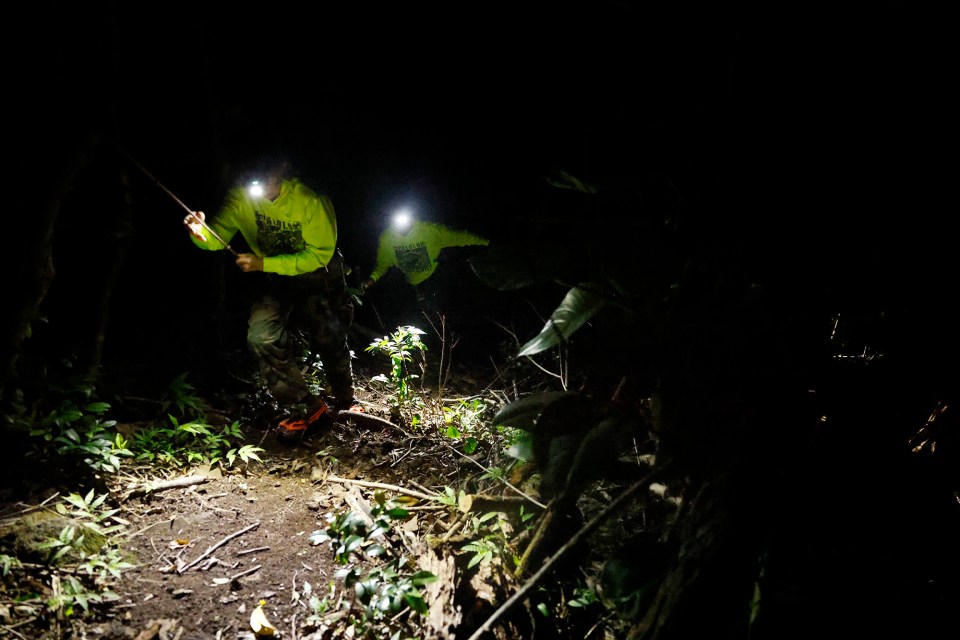
Shiroma and other community advocates believe the department should treat nurseries as the state Department of Health treats restaurants and food safety standards: If in breach of regulations, they’re shut down until they come into good standing.
“If DAB ran DOH, we’d all be sick or dead,” Shiroma said.
Legislation to better regulate nurseries has failed several times in recent years, leaving the state falling short of standards set by national organizations and other states.
When lawmakers ponied up more than $10 million in 2024 and attempted to overhaul the department, just $74,355 was allocated to coqui frog management. The department has typically funded community efforts by providing citric acid, plus approximately $350,000 in coqui management contracts over the past 19 years.
Additional support comes from the Department of Land and Natural Resources, which spent more than $1 million on frog control contracts statewide over the same period. The Hawaiʻi Invasive Species Council distributes around $3 million annually to the four islands’ invasive species committees for their work with all pests, including the frogs.
The natural resources and biosecurity departments are working together, with a lot of help from the Oʻahu Invasive Species Committee, to conduct eradication efforts in Pālolo. Together, they make about half a dozen site visits each month. They also work in Waimānalo — the island’s other most problematic zone — coordinating volunteer days alongside the O‘ahu Invasive Species Committee, which has been burdened with much of the responsibility for controlling every invasive species on the island.
“We have so many invasion fronts that we’re fighting on,” committee manager Nate Dube said, “and so little given to us to fight.”
The state biosecurity and environmental agencies estimate it would cost $900,000 per year for a dedicated 10-person coqui response team to start making headway in Pālolo. At a recent meeting, Ryan Chang of the state Division of Forestry and Wildlife said five years of that funding, and more than $240,000 for citric acid, would also be needed for the valley.
Money is not a silver bullet, said Ho, the state’s plant quarantine branch manager, citing his department’s chronic personnel shortages and lack of adequate options to control the spread of the animals.
It would take more people and resources to address the problem in the valley and islandwide, Martin of the Coordinating Group on Alien Pest Species said. The state’s estimate doesn’t account for the infestation in Waimānalo, where coqui frogs have marched across the Koʻolau Range and into Kuliʻouʻou.
“I’m not saying it isn’t worth doing but it’s really hard for agencies to justify or prioritize one community over another,” Martin said, “especially when our control tools are imperfect.”
The community agrees. Lynch co-chairs the neighborhood coqui group, which is working alongside the nursery to control the frogs. She says if the community were able to receive state funding for tools and acid, it could provide a model for others to respond to their own infestations.
“Part of our problem in Palolo is that we thought we’re supposed to pick up the phone and you know the Menehune from the government come and grab all the frogs,” Lynch said. “There’s just simply not enough staff.”
‘No Less Motivated, No Less Compelled’
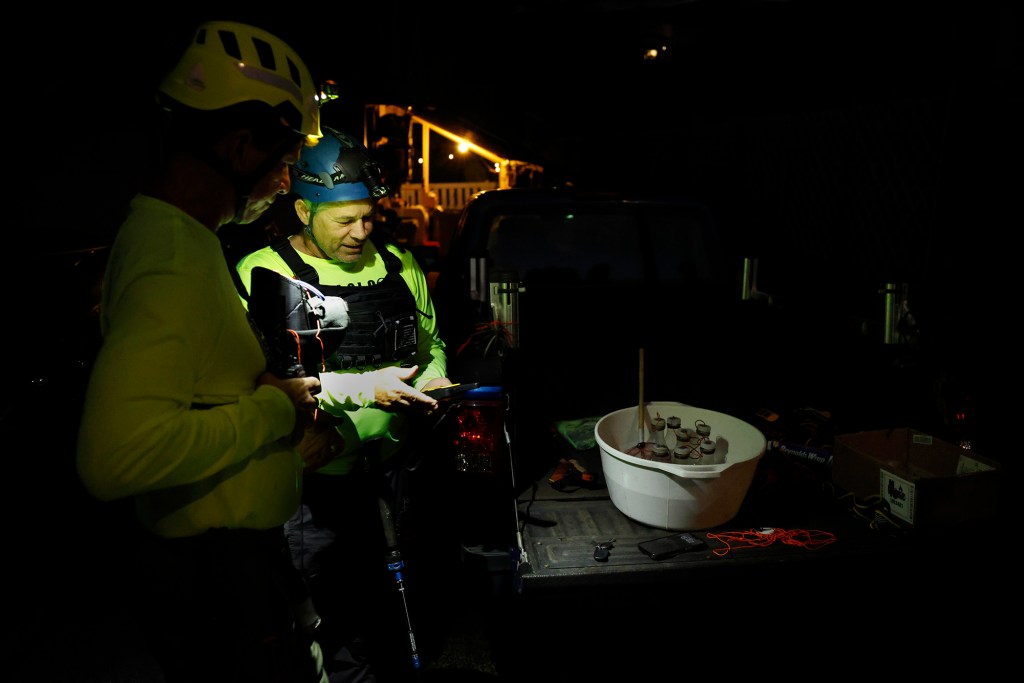
Michael Shiroma’s home has become a base camp for Pālolo Valley’s nightly community coqui frog hunts and his own personal laboratory for experimenting on coqui control methods.
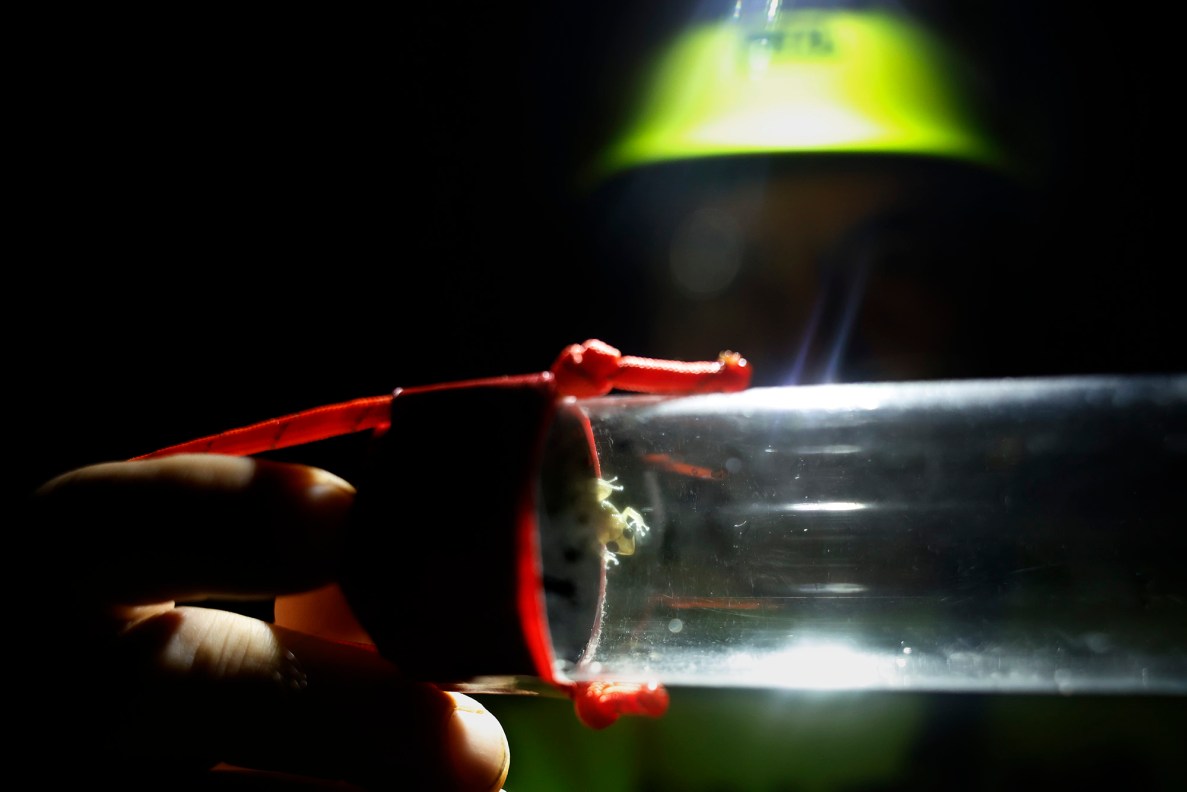
Inside his garage are machetes for bushwhacking, walkie-talkies for communications, high-vis vests and trail markers, hiking poles and distress whistles. He also has a handful of UV-light torches, piles of custom-built tubes to hand-capture the elusive amphibians and bottles of acid to drown them. It’s an operation built with over $100,000 of the TV producer’s own money.
Shiroma uses citric acid to asphyxiate the frogs, who breathe through their skin, a substance that has been deployed around the state for more than a decade, including on the Big Island.
North Kohala resident and nursery owner Kim Takata organized the community from 2003 to 2018. But even then, their efforts were considered insufficient and Big Islanders are unsure Oʻahu will be better off.
“The Big Island people weren’t less motivated. They weren’t less compelled. They weren’t less active. They weren’t less engaged. They had all that,” said Franny Brewer, Big Island Invasive Species Council Program manager. “They only had a limited number of tools, and so this community is stuck with the same limited number of tools that my communities on the Big Island had.”
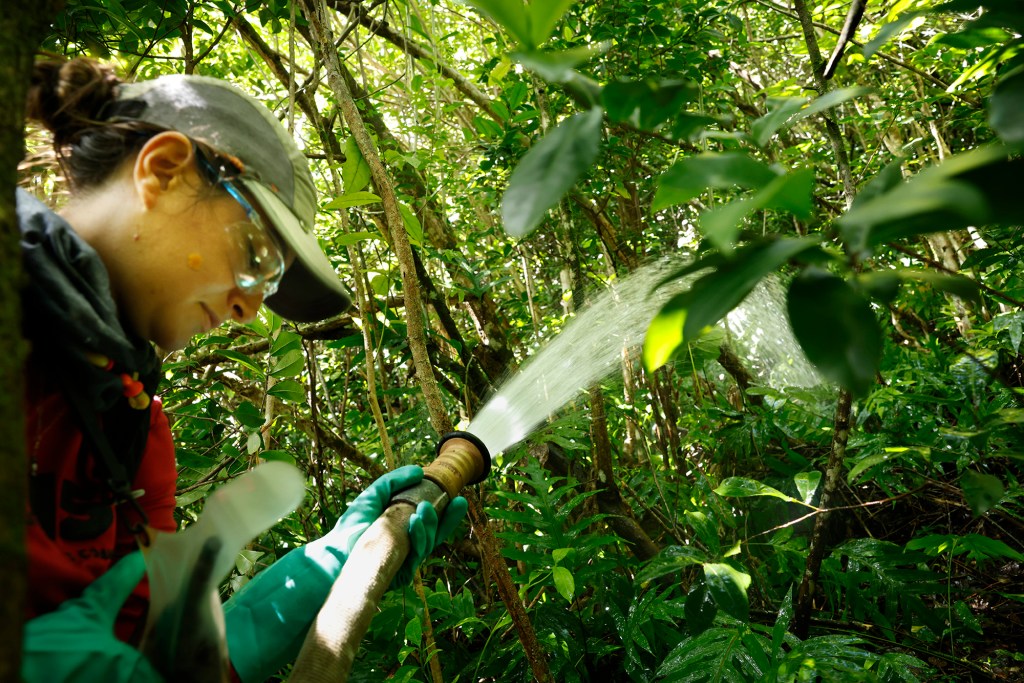
Citric acid mixed into water has become the default option for eradicating coqui, despite Takata and others finding the application of ground limestone was more efficient. The acidic ground limestone is often used by farmers to benefit soils but, despite short-lived exceptions for its use, employing it for pest control is against environmental regulations. Takata said it is far easier to distribute and apply, not requiring cumbersome tankers and hoses.
Shiroma, for one, believes hand-capturing is more efficient. But authorities and the island’s invasive species committee say that while citric acid is imperfect, it’s the best weapon against the frogs.
Takata spent years coordinating weekly groups of six to spray down private properties and worrisome infestations in gulches. The year following state recognition as an invasive species hero, in 2020, she sold her nursery and gave up. There was no successor.
“The state could have done a whole lot more as we went forward,” Takata said. “Let’s let this next generation step up, take care of their home.”
Maui has faced a similar struggle, although it has thus far managed to stop the frogs from spreading outside of dense pockets, mirroring Oʻahu’s current containment strategy. The Valley Isle’s infestations are currently centered on Haʻikū and Upcountry, and the Maui Invasive Species Committee is focused on keeping the frogs from spreading east to prime habitat in Hana.
Research, Findings
Research into new, more effective management methods never progressed past citric acid, though Shiroma has been experimenting, having discovered that blacklights help highlight the amphibians’ eyes in the dark.
More official research, underway at Hawaiʻi Pacific University, aims to help rid the islands of coqui — and potentially every other frog in the islands — by employing a new form of the chytrid fungus, which has been blamed for decimating global frog populations.
In Hawaiʻi, that would be a good thing, Associate Biology Professor Brenden Holland said, especially given how negatively amphibians affect the landscape. But it’s a lengthy process mired in bureaucratic red tape to ensure collateral damage is kept to a minimum. If a suitable strain of the fungus is found, it would “clean the slate” for Hawaiʻi’s frog problem, he said. In the meantime, Holland will also research the frog’s spread in the wild with radio trackers to help inform future mitigation measures.
Holland, who lives near Shiroma in Pālolo, has become attuned to the sound of the frogs. In fact, he snagged one in the heart of Waikīkī last week, at the corner of Kālia Road and Beach Walk. It could have come in landscaping materials or hitched a ride on a car, though he cannot be certain.
For the Pālolo community, if things don’t change, coqui could easily become a problem for the entire tourism industry. If it’s not resolved, they believe it’s a foregone conclusion.
“They don’t have to go far,” Shiroma said. “They’re gonna go straight down the stream … and that’s gonna be really bad for everybody.”
