

OHA Maui Candidates Want More Funds, Educational Opportunities For Native Hawaiians
Keʻeaumoku Kapu and Carmen Hulu Lindsey both highlight their experience helping Maui in the aftermath of the 2023 wildfires.
A community leader from Lahaina who figured prominently in the town’s recovery is looking to unseat a veteran of the Office of Hawaiian Affairs, who formerly chaired the board.
OHA Trustee Carmen Hulu Lindsey and Keʻeaumoku Kapu are facing off in the race to represent Maui on the nine-member Board of Trustees.
Although OHA trustees represent geographic areas, they are elected statewide. And all voters in Hawaiʻi have been allowed to vote for OHA since the U.S. Supreme Court’s 2001 decision in Rice v. Cayetano struck down a state law limiting those races to only voters of Native Hawaiian ancestry.
Kapu, whose family was affected by the 2023 wildfires, is a cultural practitioner and advocate from West Maui. His nonprofit oversaw cultural monitoring work and aid distribution sites in Lahaina after the fires.
Lindsey’s accomplishments include securing more money for OHA from the Legislature and directing emergency aid to Maui fire victims. She was the board’s chairperson for four years, from 2020 to 2024, replaced by Kai Kahele.
This is only Lindsey’s third contested race since being appointed OHA’s Maui trustee in 2013 — she did not have an opponent in 2022 — and is a rematch of her 2018 race against Kapu, which she won in that year’s general election by 11 percentage points.
OHA is faced with a few pressing issues in the coming years. Renegotiating annual payments to the office from the state’s use of former Hawaiian Kingdom lands was top of mind for both candidates. The office is also weighing the acquisition or purchase of culturally important sites, which both candidates support.
If reelected, Lindsey says she wants to focus on securing more money for OHA’s beneficiaries from the state, an effort she began as chairwoman of the board.
Kapu has ideas for a variety of educational programs, and wants OHA to be more involved in hyperlocal issues, such as the management of watersheds on Maui that have historically been a source of conflict between Native Hawaiian farmers and large landowners that sought to divert water.
Keʻeaumoku Kapu
Kapu grew up on Oʻahu, but moved to Maui in the 1990s to help his father restore his family’s ancestral land, which launched the Kapus into a decades-long legal battle with some of West Maui’s largest landowners. They’ve recouped some of those lands, and those cases have served as a roadmap for other Hawaiian families who were dispossessed of their lands following the Great Mahele under King Kamehameha III.
Through the nonprofit Na Aikane O Maui, Kapu has also spearheaded efforts to restore a royal complex in Lahaina, once the seat of the Hawaiian Kingdom’s government. The nonprofit had typically reported less than $50,000 in annual revenue since it formed in 2011, but that rose dramatically following the wildfires. It reported more than $1 million in revenue in 2023, and $11.1 million the year after.
Much of the new funding came through grants and contracts, largely to perform cultural monitoring work – watching cleanup and rebuilding sites to ensure contractors don’t disturb ancient burials or artifacts.
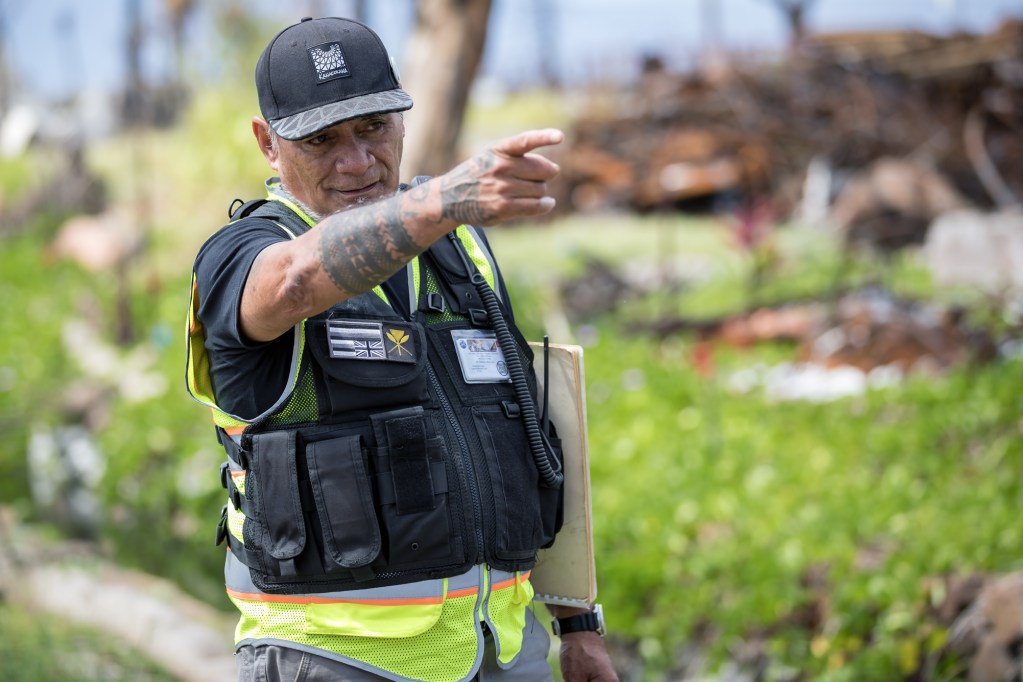
Kapu says they were “voluntold” by state and county leaders to bid for that work after proposals came in from off-island archeologists.
Scaling up operations to perform the work was a significant undertaking; the nonprofit went from supporting five employees to having to pay for training, wages and medical benefits for 82 cultural monitors, some of whom had lost their homes in Lahaina.
Kapu says he is much more experienced compared to when he last ran eight years ago. He points to the management of those multimillion-dollar contracts as valuable background for serving OHA since they required him to work with state and federal officials.
He also wants to ensure that community voices are heard.

Kapu chairs the Native Hawaiian Preservation Commission, which advises OHA, and has sat on other county boards, and he said recommendations are often ignored by higher-ups in government.
“Often, we don’t have a voice advocating for us, but us,” he said.
Kapu thinks OHA needs to be on-the-ground more at community meetings and county commissions to keep up with local issues and advance community recommendations by throwing the office’s weight behind them. If he is elected, he said he would continue to attend such community meetings and other county-level commission hearings, and he intends to focus on education and land use.
He wants OHA to push for more place-based educational opportunities for children, such as working in a loʻi patch or learning about the ocean while at a beach. He also thinks OHA should champion or even help fund school lunch for all children, a proposal that has repeatedly failed at the Legislature.
As part of negotiations with the military over land leases, Kapu thinks OHA should suggest that unused military housing units be set aside for locals.
Carmen Hulu Lindsey
Lindsey was appointed to the Maui seat in 2013 by then-Gov. Neil Abercrombie after the Board of Trustees failed to agree on a replacement for Boyd Mossman.
A former staffer to Gov. John Burns, Lindsey moved to Maui in 1970. She worked for Maui Land & Pineapple and for the administration of Maui Mayor Elmer Carvalho as head of the county land use division.
Those jobs were instructive in the intricacies of land use and development, Lindsey said. After getting her real estate license, she later worked as a salesperson at Valley Isle Realty while moonlighting as a singer in hotels and resorts.
The dual jobs were a “wonderful balance between pressure and fun,” she said.
She later chaired a committee that oversees OHA’s finances and instituted policies that sought to rein in agency spending, requiring changes to the budget and expenditures over $100,000 to come to the board for approval.
Lindsey took over as chair in 2020 after former Chairperson Collette Machado lost reelection. Among her accomplishments, she said, is advocating for $10 million worth of direct emergency assistance to Lahaina fire victims. It didn’t come out to “big money” for individuals, but helped people cover costs for food, rent or clothes and furniture they lost in the fires.
Her top accomplishment involved getting more money to OHA. In 2022, when she led the board, lawmakers upped payments to OHA from the state’s use of public lands from about $15 million annually to $21.5 million. Reports commissioned by OHA indicated the state could be underpaying the office by tens of millions of dollars annually. In 2022, Lawmakers also gave OHA $64 million in back pay for years of shorting the office.
That process also formed a Public Lands Trust working group to settle on a new annual figure due to OHA. Lindsey is a member of that group and wants to see its work completed.
Another priority would also be to push for development of a Hawaiian cultural center in Kakaʻako Makai, a direction she said the board began moving several years ago.
In her four years leading the board, OHA failed to persuade the Legislature to lift a ban on residential development in Kakaʻako Makai, part of a years-long effort by the agency to build high-rises in the area.
While Lindsey supports efforts by the Department of Hawaiian Home Lands to possibly build residential towers on OHA land in Kakaʻako, she said that building a cultural center, which OHA could do under the current zoning regulations, could show the Legislature that “OHA can do a good job” with development in the area.
A Quiet Campaign
Neither candidate has raised much in campaign funds this election season.
Lindsey hasn’t raised any money since 2023 — aside from getting $500 from the campaign account of former Maui Sen. Gil Keith-Agaran — and has not spent any money during the four-year election cycle. Her campaign had $4,987 on hand as of Aug. 8. She said she hates asking for money.
Her biggest donor over the years has been the ironworkers union, which has contributed $17,000 to her campaign since 2012. Lindsey says she has known its leader, George Parish, for many years. In 2018, she also was among politicians who received a donation from lobbyist Tobi Solidum ($500), who is now accused of bribing Lt. Gov. Sylvia Luke and others.
Lindsey said she cannot recall meeting him and did not know what he may have been interested in regarding OHA.
Kapu similarly appears to not have raised or spent anything during the election period, according to campaign finance reports. His last donation came in 2018.
He knows he has ground to make up; he trailed Lindsey by more than 23,000 votes in 2018, with about half of those coming from Oʻahu.
Kapu has been traveling across the state and plans to go door-knocking, but is running into a common refrain among voters: many don’t want to vote in the Maui trustee race either — despite the 2001 Supreme Court ruling allowing it — because they are not Hawaiian or feel that seat should be determined only by Maui voters.

