

State Errors Led To $13M+ In Improper Homeless Spending, Audit Says
The audit followed Civil Beat reporting that found irregularities in the state’s kauhale initiative.
In a rush to stem an accelerating homelessness crisis, Gov. Josh Green’s administration put its signature program to address the issue in the hands of a small nonprofit ill-equipped to properly account for tens of millions of dollars in taxpayer money it was spending, overseen by a state agency equally incapable of controlling expenditures.
The result was that the state Office of Housing and Homelessness Solutions made at least $13.7 million in unauthorized or questionable expenditures to its handpicked contractor, the nonprofit HomeAid Hawaiʻi, State Auditor Les Kondo found in a 58-page report on the governor’s kauhale initiative released Wednesday.
The audit findings about the tiny home initiative are consistent with past Civil Beat reporting, which documented excessive costs, HomeAid’s failure to submit receipts justifying payments and payments made to insiders, including the nonprofit CEO’s spouse.
But the audit goes even further in scope, the amount of money in question, and the sheer volume and variety of questionable transactions by the state homelessness office.

The office, Kondo found, took on the responsibility of planning and administering the multimillion-dollar public works project without the institutional capacity and technical expertise needed to do so. Without the capability to properly oversee contracts, the audit says, the office instead “relied on HomeAid itself to review and control the costs submitted for reimbursement,” which HomeAid failed to do.
That led to myriad unauthorized or questionable expenditures: payments for housing units that weren’t built at all or modular units that the auditor could not confirm were ever delivered to Hawaiʻi; nearly $1 million in taxpayer money to fund HomeAid’s own business operating costs; and more than $600,000 for marketing, communications and community relations, including HomeAid branded T-shirts and advertising in a local newspaper and magazine.
The state also paid HomeAid thousands of dollars for unauthorized travel, including first-class airfare; reimbursed payments to HomeAid employees without required timesheets showing what work they actually performed, and spent nearly $80,000 to rent an ocean view condominium on Maui. The state also reimbursed HomeAid $108.38 for two “Intimacy Kits” containing condoms, lubricant and sex toys at a Las Vegas hotel.
“We found no evidence that SOHHS rejected – or even questioned – any HomeAid request submitted for reimbursement,” Kondo said in a media statement accompanying the audit.
“The State wanted to move fast. But when speed outruns accountability, public money is put at risk.”
Hawaiʻi State Auditor Les Kondo
Kondo attributed the lax oversight to a desire to build villages quickly to address the state’s homelessness crisis, which Green has officially declared an emergency.
“The State wanted to move fast,” Kondo said in the media statement. “But when speed outruns accountability, public money is put at risk.”
The audit also vindicates Jeffery Ben, a construction manager who was placed on leave after seeking to bring concerns about mismanagement to Green in 2025.
In its response to the audit, the homelessness office said it has taken steps to control HomeAid and claw back some of the money paid to the organization – although nothing close to the $13.7 million in unauthorized and questionable payments the audit identified. The office’s crackdown on HomeAid also came more than a year after Civil Beat began raising questions in early 2025, prompting denials of wrongdoing by the homelessness office and HomeAid.
In August, the state homelessness coordinator sent a formal notice to HomeAid Hawaiʻi’s chief executive, Kimo Carvalho, citing recurring, systemic billing deficiencies—including missing original receipts, duplicate line items, unallowable expenses, and unapproved third-party vendor charges. The office placed HomeAid under heightened administrative oversight, ordered the immediate rejection of non-compliant invoices, and mandated that HomeAid submit a written corrective action plan.
The office also has sought to recover about $486,000 in expenditures from HomeAid, including $16,000 in unauthorized travel expenses and first-class air tickets, $300,000 in office and administrative expenses and $170,000 paid to HomeAid contractors that wasn’t related to the kauhale initiative.
“We welcome accountability and will continue strengthening the program.”
Gov. Josh Green
In a statement, Green pointed to these efforts to recover the money and said the office had accepted all 11 of the auditor’s recommendations at the governor’s direction.
Green also said the report mischaracterizes a significant portion of payments as “unauthorized,” including $2.5 million paid to HomeAid for the Alana Ola Pono project near downtown Honolulu and $2.4 million in payments to HomeAid for a predevelopment agreement.
Homelessness office “documentation shows these payments were, in fact, authorized,” Green said.
Green also pointed to the program’s results: “900 beds so far, providing stable housing and human services to more than 2,900 of our formerly houseless neighbors, including medically fragile and older adults, families with children, people with behavioral health needs and survivors of domestic violence.”
“We welcome accountability and will continue strengthening the program,” the governor added, “but we will not lose sight of what matters most: kauhale are working, they are changing lives — and we are going to keep building on that progress because the people of our state deserve a real solution to this generational problem.”
HomeAid declined to comment on the audit. However, Carvalho, the organization’s chief executive officer, addressed the audit in an Instagram post in which he took responsibility for the errors and also echoed Green’s comments about the program’s accomplishments and one of the auditor’s overarching findings.
“We were creating systems while we were delivering projects, and while I’m incredibly proud of what our team accomplished, I also do recognize that our internal systems did not always grow as quickly as the work itself,” he said.
He also appeared to address the issue of charging taxpayers for the intimacy kits, saying that “personal and business expenses were just not properly separated.”
“That should never have happened, and as CEO, I take responsibility for that,” he said. “Those expenses should have been clearly identified, documented, and kept separate from the beginning.”
The statement indicates he later paid the state back.
Kondo said accountability problems will likely persist without a major change in the entity overseeing the sprawling project.
Until the state “obtains qualified personnel or independent assistance to administer and oversee these public works contracts,” the auditor wrote, “new procedures and additional reviews alone cannot provide reasonable assurance that the deficiencies identified in our report have been or will be corrected.”
Audit Followed Criticism By Former Top Official
The audit follows months of drama surrounding the program, including allegations of excessive costs by its former top official.
The kauhale or tiny homes initiative is Green’s signature program to address homelessness. Having helped open the state’s first kauhale in Kalaeloa while serving as lieutenant governor in 2019, Green expanded it statewide as governor upon taking office in 2022. Since then, the state homelessness office has developed more than two dozen housing projects, many of which consist of simple, one-room shelters with common bathrooms and dining areas and social support services, including in some cases full-time medical staff.
To build the kauhale, the homelessness office hired the nonprofit HomeAid Hawaiʻi via a sole-source, no-bid contract, side-stepping procurement laws as allowed under Green’s emergency proclamation on homelessness.
The auditor said homelessness office records also “do not establish who made one of the initiative’s most consequential decisions: selecting HomeAid for this expanded role.”
Former homelessness coordinators and other state officials provided conflicting accounts of who made or participated in the decision, the audit says. The former coordinators told the auditor that they weren’t involved and identified other officials as having made or participated in it, including the deputy director of the Department of Human Services, Green’s general counsel, the current coordinator and HomeAid’s CEO. But the governor’s chief of staff told the auditor that the former coordinators were responsible for hiring HomeAid, the audit says.
“The conflicting accounts and absence of contemporaneous documentation left us unable to determine who selected or approved HomeAid as the state’s kauhale planner and principal contractor — or why,” the audit says.
Regardless, the contract has led to an explosion of growth for HomeAid, which saw its annual revenue increase from $1.3 million in 2021 to $142.9 million in 2024.
As the state homelessness office and HomeAid began building the tiny home villages at a breakneck pace, questions surfaced about whether the office and HomeAid were prudently managing the work.
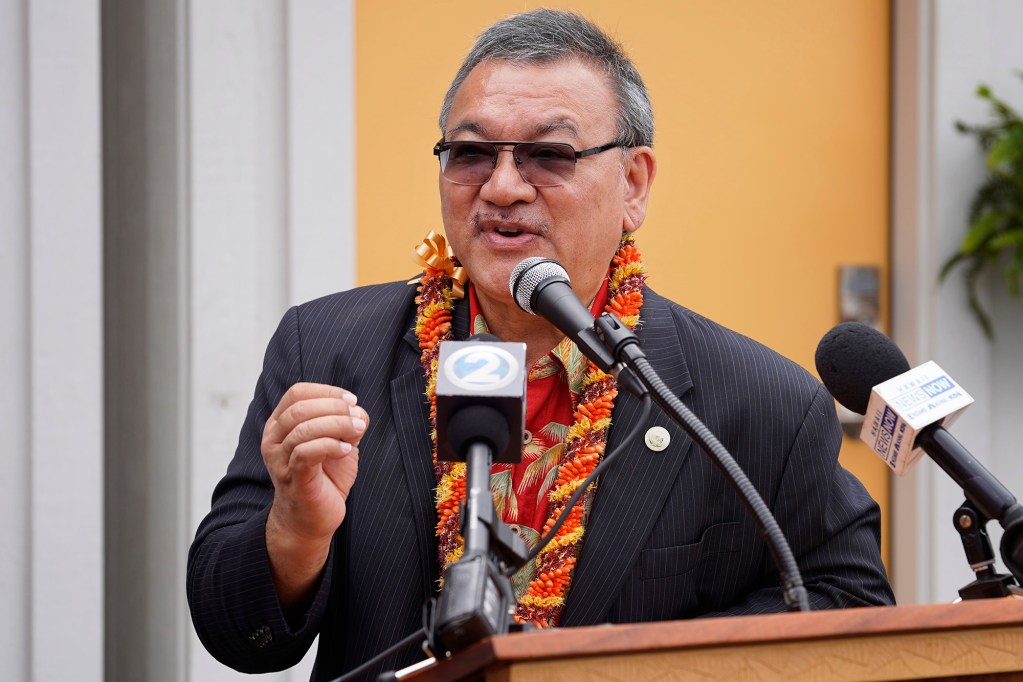
In February 2025, then-state homelessness coordinator John Mizuno publicly criticized the cost of operating a downtown kauhale without connections to the electric grid and municipal water systems and called on lawmakers to open kauhale development to competitive bidding.
Civil Beat at the time reported how the state had spent $21,000 per month to provide electricity to a village of 20 tiny homes. Shortly after, Mizuno stepped down as homelessness coordinator and was replaced by Jun Yang, who had been involved with the kauhale initiative while working on a Hawaiʻi Department of Transportation homelessness program.
In April 2025, Civil Beat reported that the homeless office lacked the records to show how millions of dollars paid to HomeAid was actually spent.
The same month, lawmakers called for an audit of the program as part of a bill to fund the initiative. The bill pledged $42.8 million in the funding bill for 2026 and 2027 and another $37 million in general fund appropriations. At the time, the governor said lawmakers had “appropriately insisted on maximum transparency and collaboration.”
The next month, Civil Beat reported on allegations made by Jeffery Ben, a manager for the firm HomeAid hired to oversee construction, who came forward with allegations of mismanagement and was quickly placed on administrative leave by his firm, CM&D International.
Audit Finds Host Of Payment Irregularities
A root cause of the problems, the audit found, is that the homelessness office simply wasn’t equipped to oversee a complex, statewide construction project. The state Department of Accounting and General Services often handles building projects, while the Department of Education handles a sprawling portfolio of school construction and maintenance projects. But the homelessness office, which is part of the Department of Human Services, simply had no such experience.
Green’s chief of staff, Brooke Wilson, said as much to the auditor, the report says. According to the report, Wilson said the homelessness office took on the work because other departments didn’t want to do it.
The current homelessness coordinator, Yang, told the auditor that “work on the infrastructure assessments, the land, all of that stuff, is not something our office was well situated to do.”
The audit paints a vivid portrait of what ensued: a contractor spending money without controls placed on it by the government agency purportedly in charge.
According to the audit, the office allowed work to begin before contracts were signed and did not consistently enforce contract requirements.
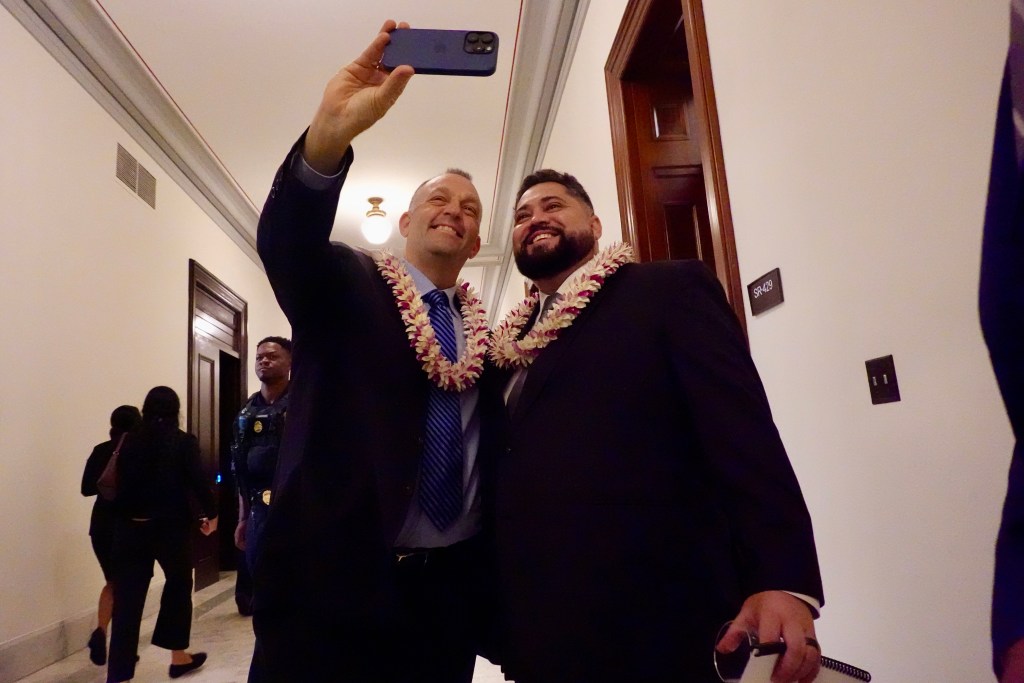
The report is replete with documentation of unauthorized and questionable expenditures paid to HomeAid, like thousands of taxpayer dollars for unauthorized travel, including a $17,500 sponsorship fee for the 2025 Hawai‘i on the Hill conference in Washington, D.C.
In some cases, the auditor found, HomeAid didn’t build the number of tiny homes envisioned for certain projects — and the homelessness office didn’t adjust the amounts paid to HomeAid to reflect that. The $5.2 million Alana Ola Pono project near downtown Honolulu, for instance, called for 75 tiny homes, yet HomeAid built only 45.
“Despite the 40 percent reduction in the project’s primary deliverable,” the auditor found, the homelessness office “did not revise the contract’s scope or reduce its $5.2 million not-to-exceed amount, allowing HomeAid to expend close to the entire contract amount.”
Something similar happened at the Kipuola project on Maui: the contract called for 128 units; HomeAid built 64 but still got paid close to the full contract amount, the auditor said.
In another instance, the state paid HomeAid $5.9 million for 273 tiny homes built for Hawaiʻi in South Korea, but the auditor found some of the units were never delivered to Oʻahu and instead were sent to a storage yard in Korea. The office nonetheless found that met the contract’s requirements. The contract wasn’t amended to account for the cost to ship the units from Korea, import fees and tariffs, and charges to transport the units from the harbor — leaving taxpayers to foot the bill.
As of October 2025, the office confirmed some of the units were still in Korea, the audit said.
The auditor also found peculiar arrangements where taxpayers seemed to be paying for HomeAid office staff, essentially funding a buildout of HomeAid’s administrative capacity, rather than for work on kauhale projects.
In one instance, the audit said, HomeAid’s “Chief Impact Officer submitted ‘contractor’ invoices for monthly fees from February 2025 to August 2025 while she simultaneously served as a HomeAid employee.” The office reimbursed HomeAid $17,129.07 for her charges, even though the invoices didn’t say what work she performed or why a HomeAid employee should be paid as an independent contractor.
The State also reimbursed HomeAid over $150,000 in “Contractor” fees for HANO Marketing, which was founded by HomeAid’s Chief External Affairs Officer, who charged for his work as a “contractor” from April 2024 to May 2025 while simultaneously working as a HomeAid employee.
HANO Marketing’s invoices charged from more that $9,000 to $13,000 monthly, and described the charges as “blended services.” The invoices didn’t include information on hours worked, tasks performed or other details.
The audit also drilled down further into Civil Beat’s previous reporting on insider transactions between HomeAid and relatives of Carvalho.
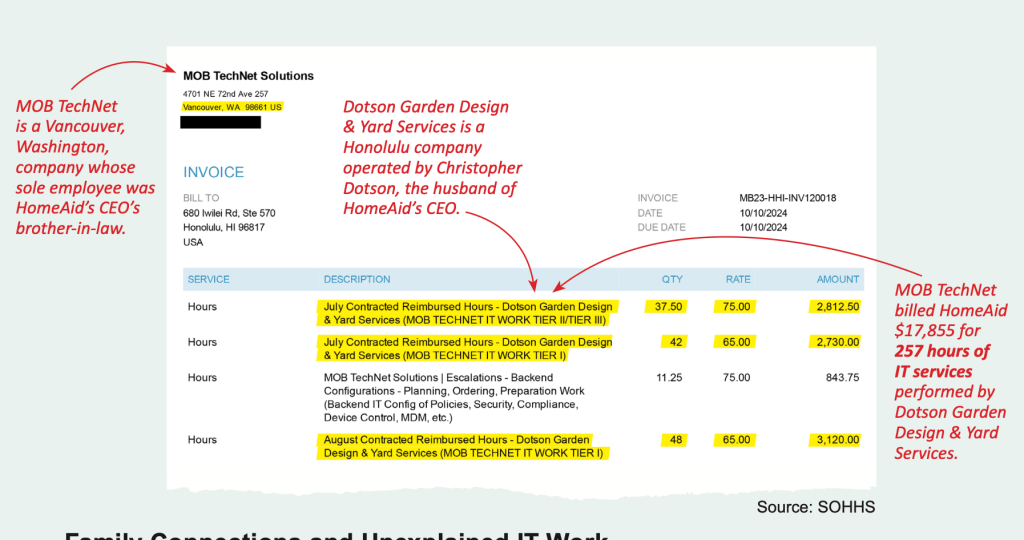
In May, Civil Beat reported that HomeAid had paid $87,379 to his then-spouse, Chris Dotson, for landscaping work between 2023 and 2025 perfrmed by Dotson’s landscaping company, Dotson Garden Design & Yard Services. In the same period, HomeAid paid another $112,780 for IT services to a Vancouver, Washington, company owned by Dotson’s brother, MOB TechNet Solutions. Some of the payments were not reported to the IRS as required by laws governing nonprofits, which HomeAid chalked up to a technical error.
The audit digs deeper into these transactions. It points out that one of the IT invoices submitted by MOB TechNet included charges of $17,855 for 257 hours of IT work done by Dotson’s landscaping company.
The auditor couldn’t determine whether HomeAid submitted that invoice to the state for reimbursement. Still, the auditor said, “the records do not explain why a landscaping company was credited with performing IT work, what work it performed, who performed it, what role MOB TechNet served, or why HomeAid recommended payment.”
In addition, the audit questioned whether it was reasonable for the state’s contractor to use an out-of-state subcontractor, Mob TechNet, to buy commercially available equipment such as laptops, docking stations and cameras, some of which were shipped to Vancouver, racking up over $1,000 in next-day shipping fees.
In an interview, Kondo said the homelessness office is fundamentally a policy office not equipped to run a complex construction project. The administration, he said, should “conduct a comprehensive review, determine which costs were actually reimbursable under the agreements, and recover the amounts that were not.”
But the review, he said, should be done by “an office with public works or construction experience, not a policy office, or by an independent consultant, like a construction auditor.”
“The issue is not whether kauhale should have been built or whether the initiative helped people,” he added. “Our audit was about whether the state protected public money while it was building them. We found that it did not.”

