Honolulu Council Sued Over Secret Zippy’s Meeting
A lawsuit seeks to ban members involved in the meeting from council leadership positions.
Five Honolulu City Council members who allegedly went “rogue” and selected their new leader at a secret meeting at a Zippy’s in Waipahu broke Hawaiʻi’s public meetings law, according to a lawsuit filed on Monday.
On Oct. 5, Honolulu council members Tyler Dos Santos-Tam, Esther Kiaʻāina, Matt Weyer, Radiant Cordero and Augie Tulba met at the eatery to discuss “working relationships.” Soon after, Dos Santos-Tam was selected to succeed Tommy Waters as the council chair.
After someone reported the meeting as a potential violation of the state’s Sunshine Law — which generally requires council meetings to be open to the public — the Hawaiʻi Office of Information Practices said it would investigate.
But that didn’t stop the council from proceeding with its leadership change. Despite public testimony in opposition, Dos Santos-Tam was confirmed via a split vote last week. Kiaʻāina was made vice chair, and Nishimoto was made floor leader. The new leaders are set to begin their duties on Dec. 1.
Members Andria Tupola and Val Okimoto voted against it. Waters abstained.
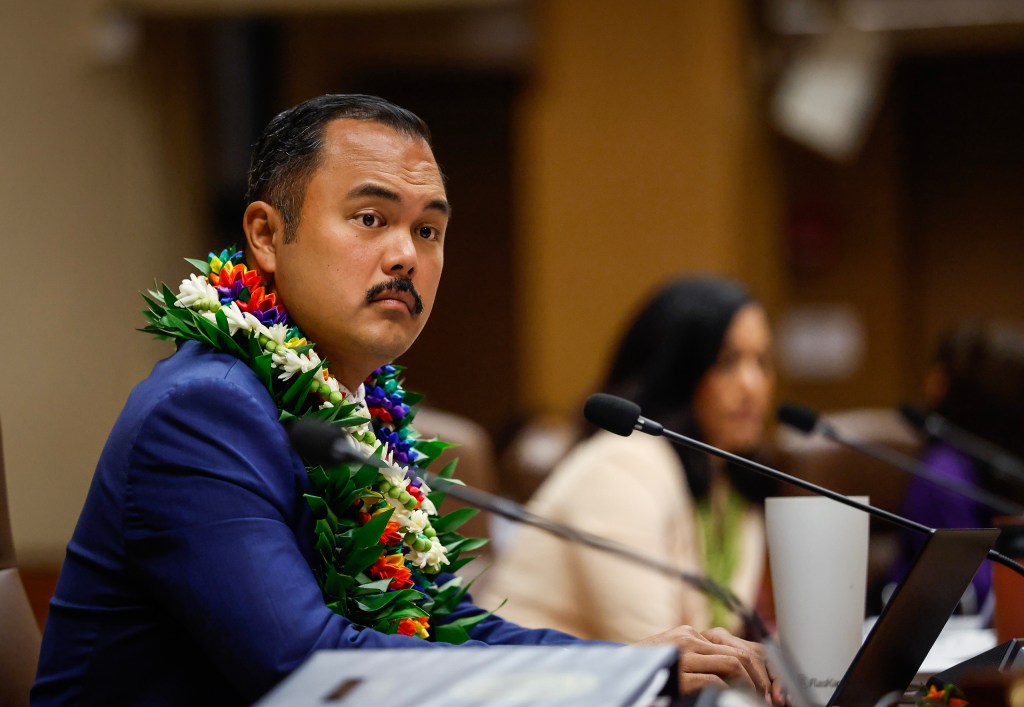
Now, Kaimukī businessman Tim Garry, a frequent council meeting attendee and two-time mayoral candidate, is calling foul and has hired a lawyer. A complaint filed in state court is seeking to void the leadership vote, ban the offending members from leadership positions for four years and force them to undergo training in the public meetings law.
“No one is above the law,” the complaint states. “The public has a right to participate and to hear all of the Council’s discussions, deliberations and actions taken in a properly noticed meeting.”
Dos Santos-Tam and Kiaʻāina declined to comment on the lawsuit, telling Civil Beat on Monday evening they hadn’t yet seen it. Cordero and Tulba did not immediately respond to a request for comment.
The Hawaiʻi Sunshine Law states “every meeting of all boards shall be open to the public and all persons shall be permitted to attend any meeting unless otherwise provided in the state constitution” or elsewhere in the law.
Claire Wong Black, the attorney who filed the lawsuit, said in an interview Monday evening that the Sunshine Law covers discussions and deliberations, not just explicit votes.
“Saying that no one voted is not a ‘get out of jail free’ card,” she said.
In a letter last month, Honolulu’s Corporation Counsel’s office said the council members understand their off-books meeting of five members — a quorum — “may appear to be contrary to the spirit of the Sunshine Law.”
However, the Zippy’s meeting was “an impromptu gathering” that was “not pre-arranged,” the Corporation Counsel’s office said, and members who attended “did not decide” who would fill which leadership positions. Therefore, the city legal department said, the meeting was legal.
Garry disagrees. It is simply not believable that five council members, representing districts as far apart as Windward Oʻahu to Mililani, would each “randomly and spontaneously decide to go to Zippy’s Waipahu at the same time on the same day,” his lawsuit states. And a lack of decision-making does not excuse the council members from the open meetings law, the complaint says.
At last week’s council meeting, Tupola and Okimoto took their colleagues to task.
“I was saddened to see my colleagues justify their actions instead of taking accountability,” Tupola said in an interview on Monday.
At the council meeting, members Kiaʻāina and Cordero defended their participation in the Zippy’s chat by saying they were speaking “bilaterally” — meaning no more than three people were talking to others to “come to the conclusion of who might have the necessary votes to be chair,” as Kiaʻāina put it.
The lawsuit says that kind of “serial communication” is not allowed under the Sunshine Law.
Dos Santos-Tam tried not to get into specifics of the matter.
“I’m not going to get dragged into the mud of engaging with allegations here on the floor,” he said at the meeting, and later told Hawaiʻi News Now the situation was a “distraction.”
The lawsuit notes that Weyer said the Zippy’s meeting “was in a very public restaurant with a lot of other folks around that we talked to” — but the lawsuit says that doesn’t make it better either.
Weyer said in an interview on Monday evening that quote was taken out of context and was specifically in response to a colleague portraying the meeting as a backroom deal. In fact, he said, a lot of people at the restaurant recognized them.
“The idea that we would vote at a restaurant table is kind of outrageous,” Weyer said. “We’re going to be around and having a vote with a bunch of community members sitting there with us? Like, it just doesn’t make sense.”
Because that would violate the Sunshine Law?
“No, I mean just practically speaking,” he said. “That would look weird.”
Weyer said the group enjoyed a meal together and did “relationship repairing,” though he declined to specify further. He said they did their best to comply with the Sunshine Law and are open to following whatever guidance the state Office of Information Practices gives to them.
Garry is seeking a court order declaring the council members’ actions at Zippy’s to be illegal and telling them to avoid conducting official business with each other outside of public meetings.
The allegedly illicit meeting “undermines the essence of open government,” the complaint says.
Claire Wong Black, the attorney representing Tim Garry in this lawsuit against the City Council, is a private attorney occasionally employed by Civil Beat for legal review and contractual matters.