

Hawaiʻi Spent $21,000 A Month To Power A Village Of 20 Tiny Homes
An independent study and a key state official criticize big operating costs when kauhale aren’t connected to utilities.
UPDATE: This story has been updated to include a statement from Gov. Josh Green.
Gov. Josh Green heralded the Alana Ola Pono tiny home village in Honolulu as “a community of hope and support” for formerly homeless people when he held a blessing for the 43-unit development in late December.
Less than two months later, Iwilei neighbors are complaining about noise and fumes from the village’s electricity generator, prompting a community meeting on Thursday and questions from the area’s City Council representative.

And the state’s homelessness coordinator, John Mizuno, has described Alana Ola Pono as an example of what not to do when building the tiny home villages, or kauhale, citing high operating expenses when they are not tied into the municipal electrical, water or sewer systems.
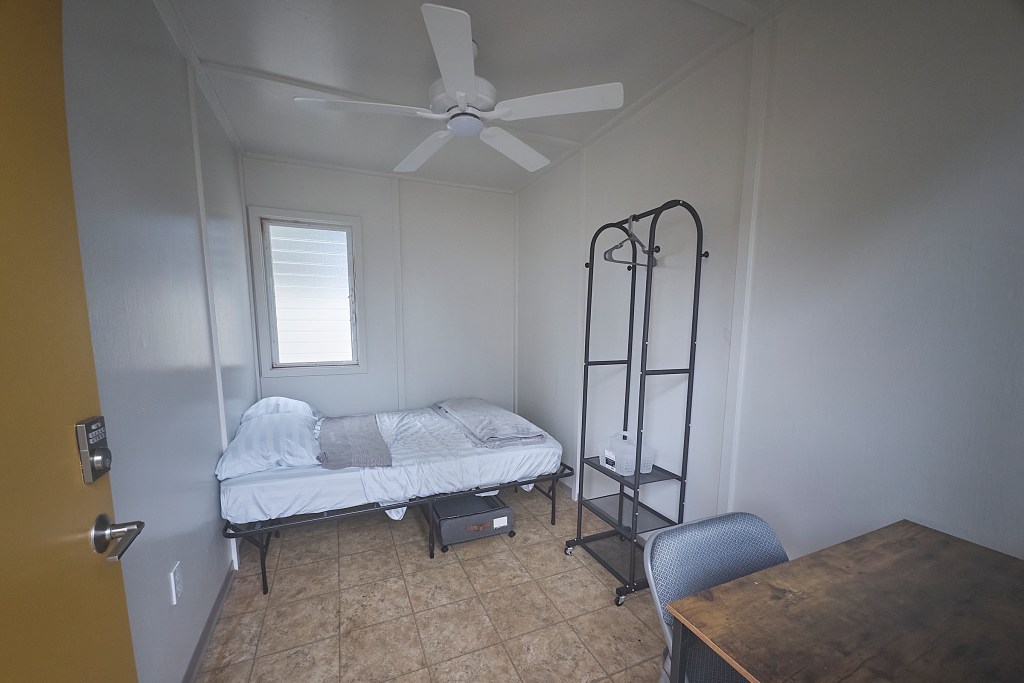
For example, monthly energy bills for one 100-square-foot, off-the-grid home can be four to five times the average cost of powering a full-size house on Oʻahu. The total monthly bill for another 20-home village in Honolulu came out to more than $21,000, and overall monthly costs topped $8,600 per month per person, an independent evaluation found.
A staunch advocate of Green’s push to open kauhale in response to Hawaiʻi’s homelessness problem, Mizuno has repeatedly said it costs less to house people in tiny homes than to keep them on the street. But he questioned the decision to open Alana Ola Pono before the property was connected to utility infrastructure.
“I’m very concerned with off-grid kauhale,” said Mizuno, director of the Statewide Office on Homelessness and Housing Solutions.

In a statement, Green said two of the 18 kauhale currently open are off-grid. Opening villages off-grid is “merely a bridge to the larger goal of providing housing to get our homeless neighbors off the street, into stability and embraced with wrap-around services,” he said.
Green has requested $50 million for kauhale in this year’s budget. House Finance Committee Chair Kyle Yamashita said his office is reviewing the kauhale program as part of the budget process.
Touring the village last week with staff from the Legislature and state Human Services Department, Mizuno said the issue isn’t simply that generators might create a nuisance for neighbors. There’s also the added cost of fuel and generators — the state is paying more than $10 per gallon for diesel fuel at another nearby kauhale — and hauling out wastewater by contractors, he said.
“That’s why it’s going to cost taxpayers a whole lot more money,” he said.
The Price Of Building Fast
After running for governor on a campaign to address Hawaiʻi’s housing crisis, Green declared a state emergency on homelessness in 2023. At the time, Oʻahu’s annual point-in-time count tallied more than 6,223 homeless people, more than half of them living outside. He settled on a strategy to quickly build 12 kauhale villages statewide, with a potential model of about 40 homes sharing a commercial kitchen and other facilities.
Under Green’s emergency proclamation, Hawaiʻi waived competitive bidding and went with a sole-source development contractor, HomeAid Hawaiʻi, to implement Green’s Kauhale Initiative. The endeavor calls for creating “affordable spaces for housing and healing our people, through intentional ‘kauhale’ design and operation.”
Operating costs should be kept as low as possible to keep rents affordable, with a long-term goal of around $500 per month, according to the state housing office’s criteria for kauhale. Green hopes Hawaiʻi can increase the number of kauhale villages statewide to 30 by 2026, he said in his State of the State speech in January.
But building fast can come at a price. Although Green’s emergency proclamation suspends some land use and other regulations, it doesn’t solve the practical challenges of connecting to infrastructure, which can be difficult, even in urban areas.
That challenge is left to the state Department of Human Services, which oversees the program, and HomeAid. Various organizations manage and operate the facilities after they’re built. Setting up shop without connections to infrastructure can dramatically escalate costs.
HomeAid Hawaiʻi’s executive director, Kimo Carvalho, disagreed with Mizuno’s assessment about off-grid kauhale. He said the generators and other systems at the facilities are temporary. Alana Ola Pono, for instance, is working with Hawaiian Electric Co. to connect to the grid as soon as possible, officials say, although the timeline for that connection is uncertain.
And it’s imperative — and less expensive — to get people inside rather than leave them on the street, Carvalho said.
“Our governor has stated many times that the cost to live unsheltered on our streets far outweighs the cost to house them, even with interim infrastructure solutions,” Carvalho said. “That’s a critical fact that anyone in a leadership role addressing homelessness should really understand before criticizing the effectiveness of the work being done to provide real housing solutions.”
High Cost Of Temporary Infrastructure
As the kauhale initiative rolled out, the state hired the nonprofit Institute on Violence, Abuse and Trauma to evaluate the program. The report assessed the operational and financial aspects of about 20% of the kauhale operating as of November 2024.
Among the kauhale examined was another HomeAid village, Hoʻokahi Leo Kauhale on Middle Street, which is also off-grid. The report found the operating cost there per bed was an eye-popping $8,629, according to a confidential draft obtained by Civil Beat.
That’s far more than the $6,165 monthly per-person cost of ʻAʻala Respite, another kauhale examined in the study, which is staffed by a doctor and provides 24-hour patient care and dialysis treatments. Given the high level of services at ʻAʻala, Robert Geffner, lead author of the kauhale program evaluation study, said he was surprised that Middle Street cost so much more.
Overall, he estimated that it would cost the state $250,000 to $300,000 less per year to operate the Middle Street kauhale if it were attached to sewer, water and electric systems.
Invoices from the Middle Street kauhale obtained by Civil Beat show very high costs for diesel fuel and equipment to power the 20 tiny homes, common showers, bathrooms, laundry, and a communal area with tables and a management office.
Diesel fuel and equipment cost $21,032 just for April — which comes out to more than $1,000 a month per tiny home — according to invoices from Sunbelt Rentals. In contrast, the average monthly bill for a full-sized residential home on Oahu is $202, according to Hawaiian Electric Co.
The $10.50-per-gallon cost of delivering fuel to the village is almost twice the retail price in Hawaii, according to the American Automobile Association.
Middle Street also has paid K-Five Pumping Services approximately $275 per week to pump wastewater from 1,000-gallon storage tanks, and another $200 to $300 a week for drinking water from Aloha Water Co. Inc., at $1.80 per gallon, invoices show.
Heather Lusk is the executive director of the Hawaiʻi Health & Harm Reduction Center, which operates the Middle Street kauhale. Geffner said he interviewed her for the study, and Lusk was candid. “She was very forthcoming saying this isn’t working,” he said.
Lusk did not return calls, texts and emails seeking comment.
HomeAid’s Carvalho said sewer and electrical connections for Middle Street could be finished in the next few months.
But Geffner’s recommendation is simple: “Electricity, water, and sewer connections should be required for all kauhale sites” before a village opens.

Cheaper Alternatives
Building kauhale off-grid presents logistical problems on top of financial challenges.
As of last week, Alana Ola Pono had only 18 tenants in the 43-unit property. Moe Atuatasi with the Institute for Human Services, a 40-year-old nonprofit hired by HomeAid to operate the Alana Ola Pono, said the village’s shared bathrooms and showers have limited capacity because the electric system can only pump so much water. The problems have repeatedly triggered alarms, annoying neighbors, she said.
“We had to put a hold on” taking in tenants because of the limited capacity, she said last week.
Even if Alana Ola Pono isn’t full, HomeAid Hawaiʻi’s Carvalho said it represented 18 fewer people sleeping on the street.
“Those people were off the streets during a major rainstorm,” he said. “I’d say thank goodness that we had a kauhale that was able to house them during a critical period.”

Other kauhale, however, are more cost-efficient. Another tiny home village in Geffner's report, Paepae Hou Kauhale, located in a three-story home on Wilson Street in Kalihi, comes out to a monthly cost of about $1,300 per person.
During Green’s first State of the State address in January 2023, the governor praised “Aunty” Blanche McMillan, a leader in the kauhale movement, as he talked about his emergency proclamation on homelessness. Green said his Kauhale Initiative would follow her example, “creating low-footprint, low-cost housing, with a village environment designed for common support, healing, and progress.”
McMillan provides housing for 82 people at her kauhale at the foot of the Koʻolau range in Waimānalo. Like Middle Street, McMillan’s kauhale is off the grid. But McMillan says her village costs far less to operate than Middle Street, in the range of $7,000 to $8,000 per month for all 82 residents, each of whom pays a $200 per month fee.
"That’s a frickin’ ripoff."
"Aunty" Blanche McMillan, on monthly operating costs at Middle Street kauhale
Asked about the $8,600 per month per person costs for Middle Street, McMillan said: “Are you crazy? That’s a frickin’ ripoff. I hate to tell you, but you can put that, what I said — it’s a ripoff.”
Author: Competitive Bidding Needed
The kauhale study's author said he’s interested in Hawaiʻi’s program as a potential national model. For example, Geffner said it’s much farther along than what he’s seen in his hometown of San Diego.
But the retired research professor of psychology said the initiative should try to improve as it matures from crisis mode to a new phase. In addition to eschewing off-grid projects, Geffner recommended seeking bids to build the villages instead of using HomeAid Hawaiʻi as a no-bid contractor.
“As a general rule of thumb, you want at least two bids,” he said. “If you don’t have bids you don’t know what to compare it to.”
As for Alana Ola Pono, local leaders hope the project can solve its generator problem soon.
Ernest Carvalho, who is no relation to Kimo, chairs Honolulu’s Downtown-Chinatown Neighborhood Board and embraces the mission of kauhale. But the generator is a nuisance for people living in an adjacent high-rise apartment complex for low-income seniors, he said.
At ground level, the generator emits a steady hum. But Carvalho said, “the higher you go up, the louder the noise is.”
Dale Krupa, an unofficial community organizer at Senior Residences at Iwilei, blamed the state and HomeAid for poor planning. “We need that thing shut off,” he said of the generator. “They’re endangering our health.”
Honolulu City Councilmember Tyler Dos Santos-Tam said residents of Iwilei have been “kind and patient with all the issues there.”
He said he discussed the problems at Alana Ola Pono on Tuesday with the homelessness coordinator for the Hawaiʻi Department of Transportation and the executive director of the organization that runs Alana Ola Pono. They told him they’re making progress connecting to the grid, he said.
Meanwhile, a community meeting is scheduled for Thursday at 215 North King Street, to discuss the problems, he said.
“These are all things we can figure out,” Dos Santos-Tam said, “and hopefully will.”

