

Hawaiʻi Residents Could Face Electric Rate Hike In 2026
Energy advocates say HECO’s effort to increase rates sidesteps ratepayer protection law.
Utility regulators have given Hawaiian Electric Co. the green light to pursue its first major rate increase in more than five years. The result could mean higher electric bills for residents and businesses by the end of 2026.
The utility says it has gone years without hiking its base rate despite skyrocketing costs of materials. Renewable energy advocates say the Hawaiʻi Public Utilities Commission’s order steers the state in the wrong direction and could mean significant cost increases for Hawaiʻi ratepayers, who already pay the nation’s highest rates for electricity.
HECO residential customers on Oʻahu pay approximately 43 cents per kilowatt hour, more than twice the national average of 16 cents reported by the U.S. Energy Information Administration. The second most expensive state is California, where residents pay 32 cents.

The envisioned rate increase would be in addition to a new fee on rate payers, approved by the Legislature on Wednesday, to help HECO finance a $500 million loan for infrastructure and capital improvements to lower wildfire risks. HECO had previously estimated the fee would amount to about $4 per month for an average Oʻahu residence when the goal was to raise $1 billion.
Renewable energy advocates, including the Ulupono Initiative, Blue Planet Foundation and Earthjustice, say the PUC’s order opening a new rate-setting case marks a reversal from a policy set in place in 2020 and codified in Hawaiʻi statutes. That policy calls for setting rates based on HECO’s performance in achieving milestones, such as adopting renewables and cutting costs, with the goal of lowering costs to consumers.
A rate case is a formal process in which utilities ask regulators to approve a rate increase. Other parties can testify in written documents. Rate cases generally take months to complete and include thousands of pages of documents.
HECO has argued that a traditional rate-making method, based on setting rates to cover costs, is consistent with— and even envisioned by — Hawaiʻi’s policy, which requires rates to be set based on the utility’s performance. The Hawaiʻi Consumer Advocate and Hawaiʻi County have concurred with HECO’s position. And the PUC has agreed.
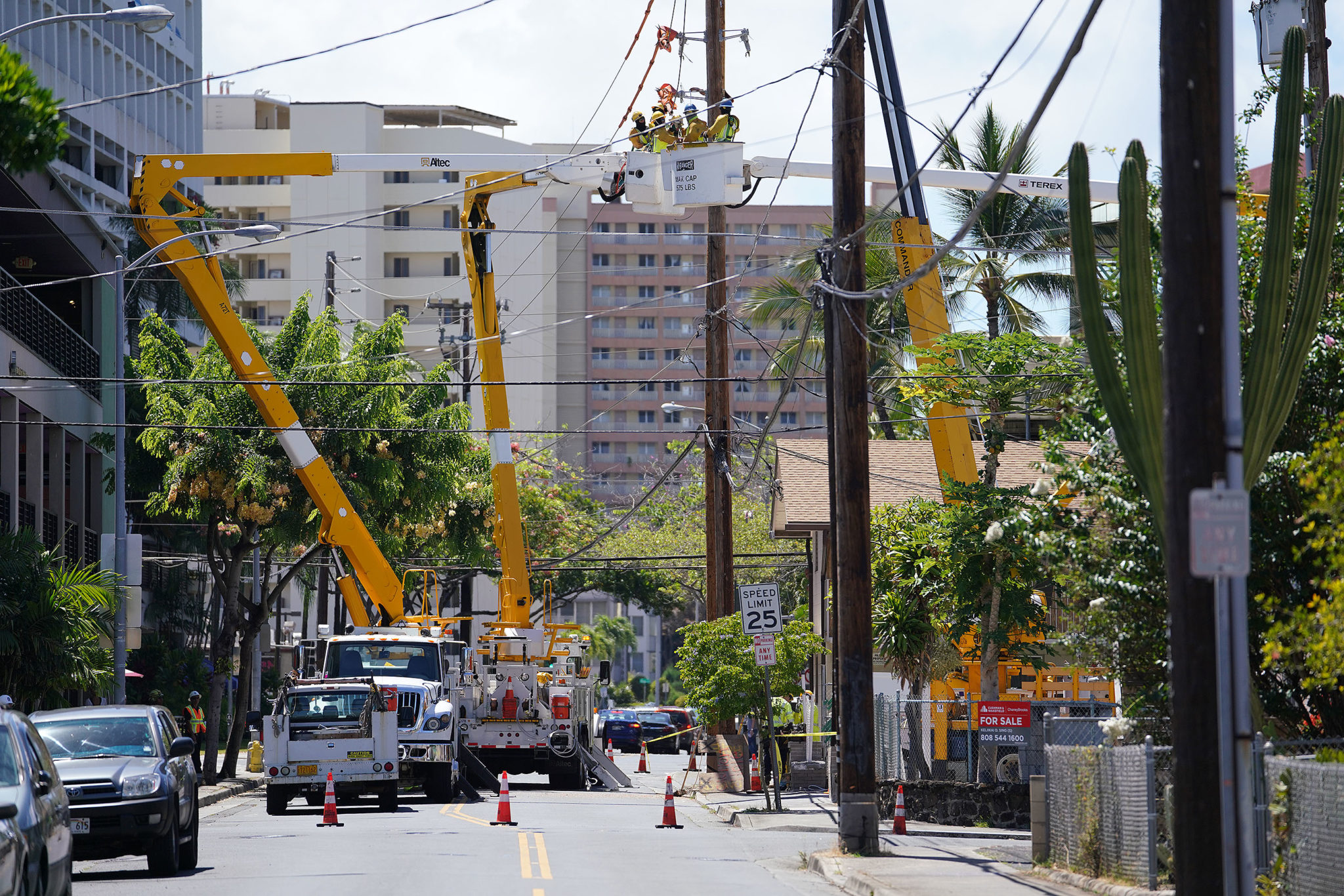
The commission’s order, issued in late February, cites unanticipated costs “such as investments needed to address the risk of wildfires and increased insurance premiums.” HECO says the cost of everything, from trucks and transformers to wooden utility poles, has skyrocketed in the past five years.
The bottom line for residents of Oʻahu, the Big Island and Maui is potentially higher electricity costs, subject to commission approval, to go into effect before Jan. 1, 2027.
Performance-Based Rate-Making
The crux of the controversy is Hawaiʻi’s performance-based rate-making policy, or PBR. In 2018, the Legislature passed the Hawaii Ratepayer Protection Act. It required the PUC to “establish performance incentives and penalty mechanisms that directly tie an electric utility revenues to that utility’s achievement on performance metrics and break the direct link between allowed revenues and investment levels.”
The PUC implemented the law in a 2020 order, after hashing out details with HECO and parties like Ulupono and Blue Planet.
The framework was meant to replace a cost-of-service framework in which utilities were essentially rewarded for spending money. Under that framework, capital investments could be paid for by customers in the form of higher rates if approved by the commission.
“The current rate environment … is unsustainable.”
Public Utilities Commission in 2020
The PUC acknowledged in 2020 that the old model wasn’t working.
“The current rate environment, where customers are burdened by persistently high electricity costs, is unsustainable and, ultimately, unacceptable in the long run,” the PUC said.
Under the new framework, a utility would be rewarded for things like investments to reduce operating costs and to move Hawaiʻi toward producing all of the electricity sold in the state by 2045.
“Under the PBR Framework, customers will benefit from lower utility costs and see greater integration of renewable energy resources, while the Companies will have the opportunity to improve their Financial position through improved efficiencies and by earning rewards for exemplary and high-quality service in targeted areas,” the order said.
The plan was to set rates for a five-year period with potential incremental increases pegged to a formula, including things like inflation adjustments. The order required the commission to conduct a comprehensive review of the program in the fourth year and make necessary changes, such as tweaking the rate-setting formula.
“Although anticipating some modifications to the PBR framework may be appropriate,” the order said, the commission specifically said it did not envision returning to cost-of-service rate-making after the initial five-year period.
Ulupono: PUC ‘Sidesteps Legislative Mandate’
But that’s exactly what the commission has done, Isaac Moriwake, managing attorney for Earthjustice’s Pacific Region, said in an interview.
“They’re taking us back,” said Moriwake, who filed a brief opposing HECO’s request for a cost-of-service rate case on behalf of the Blue Planet Foundation, which supports the use of renewables.
Ulupono agrees. It published a statement in March saying the commission’s decision “sidesteps legislative mandate.”
“Instead of following the Performance-Based Regulation (PBR) law that the Legislature put in place to protect customers and push Hawaiian Electric to improve, the PUC is reverting to an old-school rate case that rewards spending over performance,” Ulupono said.
“A full rate case may lead to significant cost increases for customers, without sufficient guarantees of improved service, efficiency, or cost containment,” the statement says.
In an interview, Ulupono’s energy sector director, Michael Colon, likened performance-based ratemaking to an annual job review in which pay raises are pegged to achieving job performance milestones. By contrast, he said, the cost of service model involves something more like the employee saying, “These will be my household expenses next year, and I would like a raise to pay for it.”
There could be performance-based incentives, but those incentives would be on top of an increased base rate, he said.
HECO: Commission ‘Got It Right’
Joe Viola, HECO’s senior vice president for customer, legal and regulatory affairs, said the PBR statute and framework envision exactly what the utility company is doing. The framework calls for the utility to stay out of rate-making cases for five years after which an assessment is made whether to continue with performance-based rates or not.
“All of us in Hawaiʻi think we should continue with PBR,” Viola said. But he said, “You have to look at your current rates and decide whether they’re reasonable, appropriate, sufficient.”
He added that HECO couldn’t think of another process to do that. HECO’s not aware of any other U.S. jurisdiction that uses performance-based rate-making without a procedure to reset rates, he said.
“We think the PUC got it right,” Viola said.
Jim Kelly, HECO’s vice president for government and community relations and corporate communications, added that costs in the past five years have gone up dramatically. He stressed that it’s the company’s goal is to keep rates as low as possible.
How much this will cost ratepayers remains to be seen. HECO must submit its requested increase with documentation justifying the request, and other parties will be able to weigh in. Viola declined to say what if any increase customers can expect.
“I’m not going to say that yet,” he said. “The commission has to make that determination.”
CORRECTION: The story has been update to clarify the estimated fee on users to finance infrastructure improvements and lower wildfire risks.
Hawaiʻi’s Changing Economy” is supported by a grant from the Hawaiʻi Community Foundation as part of its work to build equity for all through the CHANGE Framework.

