Progress Report: A Series Of Child Abuse Deaths Failed To Spur Major Reform
The legislative session was punctuated by an arrest in yet another child death, but lawmakers did not act on recommendations of a child welfare task force .
The year leading up to the 2025 legislative session saw a series of tragedies that seemed certain to force lawmakers to pay close attention to Hawaiʻi’s troubled child welfare system.
Two children died in alleged abuse cases on Oʻahu in the year before session began, and an adoptive mother was arrested in March in mid-session in a third child death in 2023.
The state auditor issued an alarming report in the spring of 2024 criticizing placements of foster children in unlicensed homes, and an organization called the Mālama ʻOhana Working Group produced a separate report describing deep flaws and suffering in the child welfare system.
Yet in the final days of the session that ended last week, the last two major bills designed to address some of the problems in the state’s Child Welfare Services failed to pass. Both bills were introduced by Gov. Josh Green’s Office of Wellness and Resilience as part of the governor’s package, but even that was not enough to get them through.

Lawmakers did put up $6 million for pay incentives for high-performing staff who manage difficult cases and large caseloads, seek out extra training and meet other goals. They also provided $7 million to upgrade the aging CWS computer system to make office operations more efficient.
House Human Services and Homelessness Committee Chair Lisa Marten said another $500,000 was earmarked to step up security for CWS workers, who have been the target of threats.
And Department of Human Services Director Ryan Yamane is moving ahead with two other initiatives to better oversee some foster and adoptive families and support and protect children in the child welfare system.
- Environment: Bolder Action Needed To Protect Hawaiʻi’s Environment
- Native Hawaiians: Help With Housing Continues To Elude The Hawaiian Community
- Invasive Species: Hawaiʻi Primes Itself To Battle Biosecurity Threats
- Education: Hawaiʻi’s Working Families Need More Support
- Fireworks: Hawaiʻi Fireworks Reforms Put Enforcement Onus On Police
- Insurance: Will Reforms Stabilize Hawaiʻi Condo Insurance Costs?
- Housing: Lawmakers Fund More Housing, Not Special Treatment for Locals
- Progress Report: Neighbor Islands Need More State Support On The Job Front
But an array of potentially far-reaching reform bills died, making this a discouraging year for those who had hoped for more sweeping reform.
“I think the system is really broken, and we’ve got to do something. That’s why I keep using ‘urgent’ as a word,” said Laurie Tochiki, a co-chair of the Mālama ʻOhana initiative. Tochiki compared the reaction to recent child deaths in Hawaiʻi to the public response to mass shootings.
“It’s kind of like every time there’s a mass shooting, and especially when there’s a school shooting, we’re like, ‘Oh, this is terrible. Gotta do something,’ ” she said.
And yet it keeps happening.
Pulled In Two Directions
Senate Health and Human Services Chair Joy San Buenaventura describes two distinct schools of thought about how to fix CWS, and no clear consensus yet among lawmakers.
One camp advocates for deep state involvement in the troubled lives of families deemed at risk of child abuse or neglect. That may involve more staff and training to strengthen the system to keep kids safe by promptly removing those who may be in jeopardy.
An opposing view is that the state often makes things worse by removing children from their families rather than providing support such as housing, drug treatment and cash. The Mālama ʻOhana report underscored the anguish of some children who suddenly land in foster care.
Yamane, who was confirmed this spring as DHS director, has begun to make changes. After a string of child deaths in recent years in foster, adoptive and guardianship homes, he initiated a push to supervise those homes more intensively.
Based on a review of recent cases and input from staff and others, Yamane decided “to put more eyes on our foster kids, and also support our resource caregivers,” as foster parents are officially known.
He launched a new “Kāko’o Program” in early April to make unannounced visits to foster homes after working hours and on weekends.
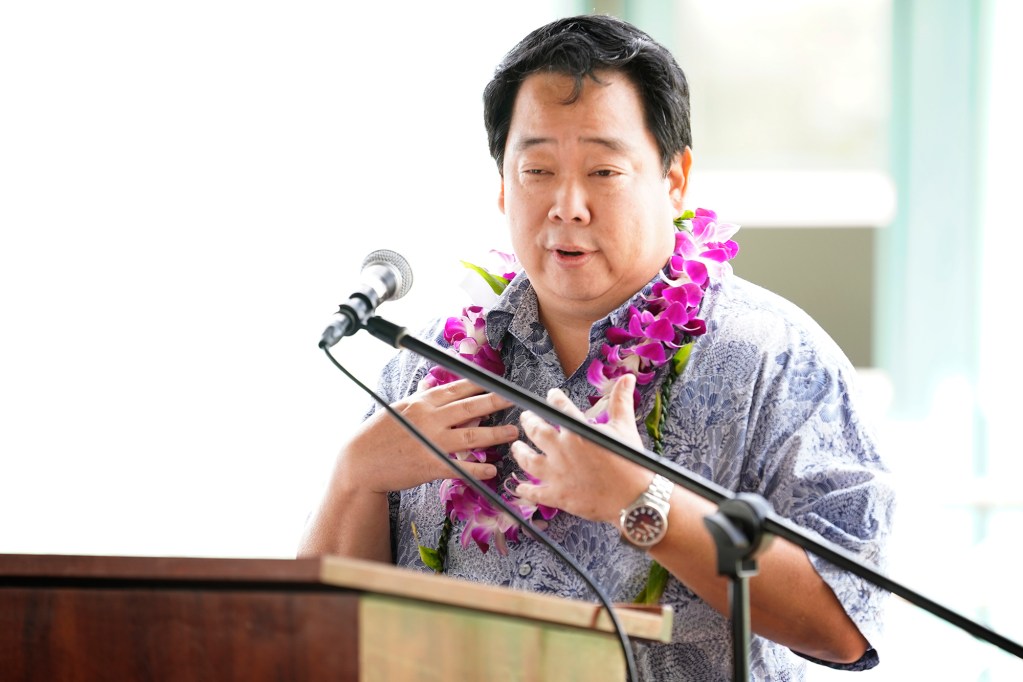
He describes the Kāko’o visits as “wellness checks” by staff volunteers, including at least one social worker. They see each foster child, speak to the foster parents, and offer additional services as needed. Workers do not visit their own clients, which allows for a fresh look at the children and foster families.
Those visits are in addition to required monthly visits by CWS social workers. Yamane said about 120 families had been visited as of early this month.
The department is also about to announce a new requirement that families who adopt children out of the CWS system must participate in pre-adoption training, Yamane said. The state already offers voluntary pre- and post-adoption training.
“These mandatory services and the Kāko’o Program are to equip and support our current foster families and our foster kids with as much resources as possible, support and love,” he said.
Seeking More Change, Soon
The people who spent a year attending community meetings and working on the Mālama ʻOhana report include biological parents, former foster children and foster parents.
And they want much more dramatic change.
In a public briefing last fall, Mālama ʻOhana Working Group Co-Chair Venus Rosete-Medeiros told lawmakers the report “rests on the premise that the system as it currently operates perpetuates harm, inequity and systemic failures that fail to adequately serve our children and families.”
Rosete-Medeiros argued for a “new model of care” grounded in prevention, community empowerment and cultural responsiveness.
The group briefed lawmakers on its findings, but never produced a package of bills. Instead, Green’s Office of Wellness and Resilience produced two measures that advanced core themes from the report.
One was House Bill 1079, which would require the resilience office and DHS to implement a system of trauma-informed assessments, training and care to help children in the system. It also aimed to help DHS caseworkers cope with their experiences.
Tia Hartsock, director of the resilience office, said in written testimony that the bill “is an essential tool for improving the child welfare system’s ability to effectively support both families impacted by trauma and the dedicated professionals who serve them.”
Another measure, Senate Bill 952, would have created a five-year pilot project to divert a group of at-risk families and children away from the CWS system by rapidly providing financial help and necessities such as food, clothing, housing, child care and transportation.
That was based on a Mālama ʻOhana finding that “most families who come to the attention of the current system need support services rather than protective intervention,” according to Hartsock.
Both bills died in the final days of the session because they didn’t receive funding, Marten said, although technically lawmakers can revive them next year.

Lawmakers did pass bills related to child welfare, but not the sort that would overhaul the CWS system itself.
Those measures included one that creates a new crime of “torture” to deal with offenders in child starvation and other abuse cases. Another would increase criminal penalties for anyone who deliberately injures a protective services worker, including child welfare workers.
“It was disappointing, but also maybe expected, because there’s so much to be done, and it’s got to be a comprehensive approach,” Tochiki said. At the Legislature, “I think everybody was hoping for more tweaking than a comprehensive approach.”
Considering Outside Oversight
San Buenavantura considered a bill this session to create an oversight commission to monitor the workings of a system that is now almost completely hidden from public view.
Senate Bill 798, introduced by Senate Judiciary Chair Karl Rhoads, envisioned a commission that among other tasks would delve into CWS training and operations, and develop recommendations “to reduce child harm and death.”
San Buenaventura remarked at the hearing on the bill on Jan. 29 that “we do believe that CWS needs help, and it needs to come from an independent source.” But she deferred action on the measure, citing technical flaws.
She said after the session ended that she wants to give Yamane time to make changes, saying his work so far “sounds promising.”
Both Marten and San Buenaventura said staffing in the CWS system is a huge concern. The department got money to offer extra pay to recruit new workers, but “until we can reduce vacancies, we can’t ask existing social workers to more work than they are doing,” San Buenaventura said.
The department said in a report last year that 37% of its caseworker positions in CWS were vacant in February 2024, which was a modest improvement from the year before.
Marten acknowledged this was a “very disappointing year” for the Mālama ʻOhana Working Group, “but to be fair, we did get a conversation started.” She pointed out that the report from the group arrived shortly before the Legislature convened, leaving little time to study its proposals.
“There’s unfinished business,” she said. “Bills don’t always pass the first time, and we’ll come back.”
Yamane said the department is continuing its efforts to update and modernize training, and is overhauling the department’s policies and procedures. He wants the department to be “always innovating, we’re always self-reflecting.”
But Tochiki believes there is a long way to go. She recalled the testimony of a former foster youth in Hilo at a Mālama ʻOhana meeting who described CWS as “a system of luck.”
“Like you might get a really good social worker, you might get a really good foster parent, you might get a really good guardian ad litem, a really good judge. And you’re lucky,” she said. “But you might also be unlucky.”
Civil Beat’s community health coverage is supported by the Atherton Family Foundation.
Civil Beat’s reporting on the Hawaiʻi State Legislature is supported in part by the Donald and Astrid Monson Education Fund.